

Rescue Dogs Aren’t Broken: The Myth That Sets New Owners Up to Fail

Here’s something that happens more often than it should. A kind-hearted soul adopts a rescue dog, full of excitement and good intentions. The dog arrives and hides under the bed. Or barks at everything. Or has accidents indoors. Or snaps when someone reaches for their collar. And the new owner, bewildered and a little deflated, starts to wonder if they’ve taken on a dog with “problems.”
They haven’t. They’ve taken on a dog who is doing exactly what a dog in their situation would do.
The idea that rescue dogs come pre-loaded with behavioral baggage is one of the most persistent and damaging myths in the dog world. It puts new owners on the back foot before they’ve even started, and it sets dogs up to be misunderstood at precisely the moment when understanding them matters most.
What looks like a problem usually isn’t
When a dog arrives in a new home, they face something that would challenge even the most confident, well-socialized animal. Everything is unfamiliar. The smells, the sounds, the layout of the space, the people, the routines… All of it is new and unreadable. And crucially, the dog has no control over any of it. They didn’t choose to be here. They don’t know if they’re safe. They don’t know what the rules are, or whether the people around them can be trusted.
Not being in control of your own situation is stressful for anyone, and dogs are no exception. For a dog who may have had previous experiences that gave them good reason to be cautious around people, it’s even more so.
So they behave accordingly. They hide, because hiding is safe. They bark, because barking creates distance. They flinch or snap when someone reaches toward them, because previous experience has taught them that hands coming toward their head sometimes means something unpleasant. They have accidents indoors, because they’ve never lived in a home where outdoor toileting was the expectation.
None of this is a behavior problem. What it is, is communication.

What dogs remember
Dogs don’t replay past events the way humans do. They don’t lie under the bed thinking about what happened to them before they came to you. But they do carry emotional associations. These come in the form of powerful, embodied memories of how specific situations felt, and shape how they respond to similar situations in the present.
Our Saluki-cross Louis came to us after two years of being chained up and mistreated and then another two in a shelter. Sadly, the emotional residue of that experience was very much present in how he navigated the world, particularly around men, and particularly in situations where he felt cornered or unable to escape.
Pitbull-Labrador cross Maggie came to us as her fourth home. She was anxious about being left alone and would grab onto your bag or clothes to try to stop you leaving the house. She wasn’t being “annoying.” She’d simply learned, through repeated experience, that people leave, and that when they do, things can get bad. Her behavior made complete sense given her history. But it could have looked like a problem if you didn’t know any better.
Another of our rescue dogs, Roxy, had spent her first two years in a shelter so had essentially no experience of home life. When she arrived, she barked at everything: men, her reflection in the oven door, the newsreaders on TV, house visitors. Of course she did. She had no framework for any of it. The world was full of unfamiliar things, and the barking behavior was how she expressed her stress.
In each case, what could have looked like a behavioral problem was actually a logical response to a situation based on a specific history. The behavior wasn’t the issue at all. But the experience that produced it was.

Canine behaviors most commonly mistaken for problems
Hiding and shutdown
A dog who won’t come out from behind the sofa, won’t eat, and barely moves is not being difficult. They’re overwhelmed, and withdrawal is their way of managing that. Our seventh rescue dog, Florence, spent her first four weeks with us living in a bathroom, too scared to venture any further. She wasn’t “broken.” She was simply decompressing and trying to figure out whether this strange new place was safe.
Fear-based reactivity
Barking, lunging, or growling at people, dogs, or situations isn’t aggression for its own sake. It’s a fear response. It’s the dog’s way of creating distance from something that feels threatening. The bigger the reaction, the bigger the underlying fear.
Resource guarding
Resource guarding is a common and completely natural dog behavior. A dog who growls over their food bowl, bed, person, or toy has often learned, somewhere along the way, that resources can disappear. Protecting them is the rational response to that experience. One of our current rescues, Roman still watches his bowl if another dog comes close, so we feed him separately. He’s not “an aggressive dog.” He’s a dog who learned that precious food isn’t always guaranteed.
Incomplete house training
Many rescue dogs have lived outside, in kennels, or in environments where toileting indoors was the norm. They’re not trying to be difficult when they have accidents. They simply don’t know yet what’s expected. This is a training gap, not a character flaw.
Clinginess or separation anxiety
A dog who can’t settle when left alone, who follows you from room to room, who cries or destroys things when you leave is a dog who doesn’t yet know that you’ll come back. With time, patience, and the right approach, many dogs get there. Maggie certainly did.
Flinching or snapping when touched
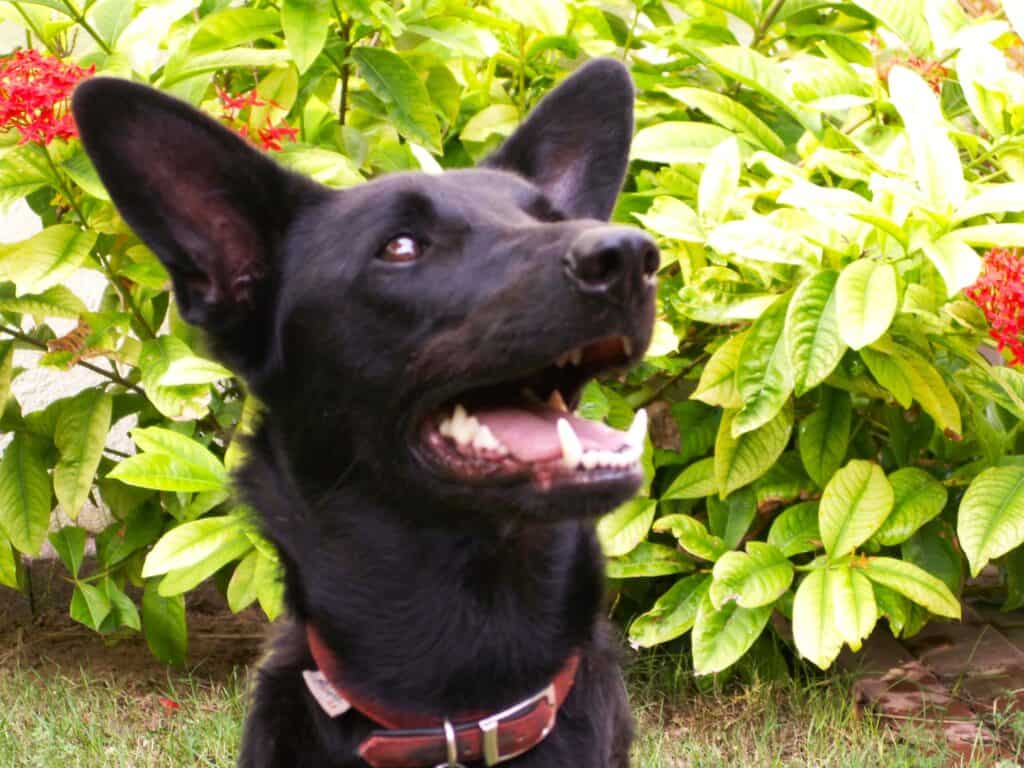
A dog who reacts badly to being handled has usually had experiences that gave them good reason to. This doesn’t make them unpredictable or unsafe. It makes them a dog who needs to learn, gradually, that touch from this person in this context is safe. Louis snapped at my hand more than once when he first arrived, before I learned to read him and he learned that he could trust me.
Why the 3-3-3 Rule is only part of the picture
You’ve probably come across the 3-3-3 rule: three days to decompress, three weeks to start settling, three months to feel at home. Maybe it’s a useful framework for managing expectations, but I’ve never found it to be accurate.
Unfortunately, it’s easy to read it as a promise, and that by the three-month mark, the dog you’ve adopted will be fully settled and any challenging behaviors will have resolved. But that isn’t how it works.
Florence took six months before she was totally at ease. Louis never fully shed some of his wariness, though he made enormous improvements and we learned to manage it and work with it. Daisy, who we rescued off the street in Dubai, settled quickly but retained specific “issues,” specifically with having her paws handled. We work on that for quite a few years before she was totally trusting.
The 3-3-3 timeline is nothing more than an extremely general guide, not a guarantee. And if a dog is still showing certain unwanted behaviors at three months, or six months, or longer, doesn’t mean they’re broken. It means they’re still adjusting, and they need more time, more training, and more consistency.
What actually makes the difference
The dogs who settle best in new homes are not necessarily the ones who were handled most actively in their early weeks. They’re often the ones whose new owners gave them space to decompress, kept the environment calm and consistent, and let the dog set the pace for everything.
A safe space. Reliable routines. Low-pressure positive experiences. Respect for what the dog’s body language is communicating. The willingness to go slowly even when you want to speed up.
These things aren’t complicated. They’re just not always what people expect to be doing when they’ve just adopted a dog and they’re excited to bond and explore and introduce their new family member to the world.
All of it happens; just later, after the dog has had enough time and enough consistent, positive experience to understand that this place is safe and these people can be trusted.
A word on labeling
One of the most unhelpful things that can happen to a rescue dog is being labeled early. “He’s aggressive.” “She’s got separation anxiety.” “He’s dog-reactive.” These labels, once applied, tend to stick, and they change how people interact with the dog in ways that can actually reinforce the behavior they’re trying to address.
A dog who is reactive on leash is not an aggressive dog. They’re a dog who is overwhelmed in that context, and who has learned that reacting works to create the distance they need. That’s a very solvable problem with the right approach. But “aggressive dog” closes doors that “overwhelmed dog who needs support” keeps open.
The behavior you see in the first weeks of rehoming is the least representative version of who that dog actually is. It’s a snapshot of a dog under stress, in an unfamiliar situation, doing their best with the tools they have.
The dog on the other side of the adjustment
Every dog I’ve adopted has had a version of this adjustment period. Some lasted weeks and some lasted months, but all of them came out the other side.
Florence, who arrived so shut down she had to be carried into the house, eventually ran freely through the forest on our walks and never strayed far from my side. Roxy, who barked at her reflection and the TV and anything else that moved, became one of the most mellow dogs in the house. Maggie, who grabbed at me every time I tried to leave, learned that I always came back and would take her on the best adventures ever.
None of them were broken. They were just dogs who needed time, and consistency, and someone willing to meet them where they were rather than where they were expected to be. If you can take a step back and work with the dog that’s in front of you, rather than the dog you want or expect them to be, you’ll find that the dog you hoped for was there all along. They just needed time to show you.
I have lived and worked with fearful rescue dogs for 20 years. This article draws on the experiences and research documented in the following articles on my site:
