

7 Signs Of Resource Guarding In Dogs (Real-Life Examples)

Quick Answer
If you’re a dog owner, you may have noticed that your furry friend can get possessive over certain resources, such as food, toys, or even you.
This is known as resource guarding, and it occurs when a dog thinks there is a threat to something she values highly and very badly wants to keep.
While resource guarding is a completely normal canine behavior, it can become a problem if left unaddressed, especially if it escalates to aggression towards humans or other pets.
In this article, we’ll explore how to recognize signs of resource guarding in your dog and what you can do to manage it.
Key Takeaways
- Resource guarding is a normal behavior for dogs, but it can become a problem if left unaddressed.
- Triggers and causes of resource guarding can vary, but prevention and management strategies can help mitigate the behavior.
- Common resources that dogs guard include food, toys, and sleeping areas, but dogs may guard any resource or item they consider to be high-value – even from a significant distance.
What Are The Signs Of Resource Guarding In Dogs?
Knowing the signs of resource guarding can help you keep everyone safe.
Here are 7 of the most common signs you may see in your dog’s body language:
#1. Stiff Body Language
Dogs that are resource guarding often display stiff body language.
This means that their body becomes tense, and their muscles become rigid.
They may also hold their head and tail high, making themselves appear larger and more intimidating.
Sometimes dogs will have raised hackles (when the fur along the back stiffens) too.

#2. Freezing
Another sign of resource guarding is freezing.
This happens when a dog stops moving and becomes completely still, like a statue.
It may be accompanied by a head turn, when the dog turns her head to the side and, very stiffly, shows her neck.

#3. Pinned Back Ears
Sometimes, a dog may pin back her ears as a precursor to aggressive behavior.
When the ears are pinned back it can be a sign of heightened alertness and readiness to react, including defending territory or resources.
#4. Intense Staring
Dogs that are resource guarding may stare intently, with a fixed gaze, at the person or dog who is getting too close for their liking.
This is known as a hard stare and you may also see the whites of the dog’s eyes (known as “whale eye”).
Staring (as opposed to soft eye contact) is considered hostile in dog speak.
It’s a serious warning sign and should not be ignored.

#5. Lip Curl
When a dog pulls back her lips to expose her teeth, it is a clear warning sign that she is feeling threatened and may become aggressive if the threat doesn’t go away.
In other words, if you (or the other dog) continue your approach.
This behavior, known as lip curling, can be quite obvious, especially when accompanied by a growl or a snarl.
However, lip curls can also be very subtle, with the lip being raised just the tiniest fraction of an inch.
This means it can be difficult for the human eye to spot.
Nevertheless, it’s essential for pet parents to be vigilant and observant, as dogs can escalate their behavior rapidly.
Within a matter of seconds, for example, a dog can transition from an apparently calm but stiffened posture, to a subtle lip curl accompanied by a low growl, to all out snapping, lunging – or even biting.
Which should be avoided at all costs, for everyone’s sake.
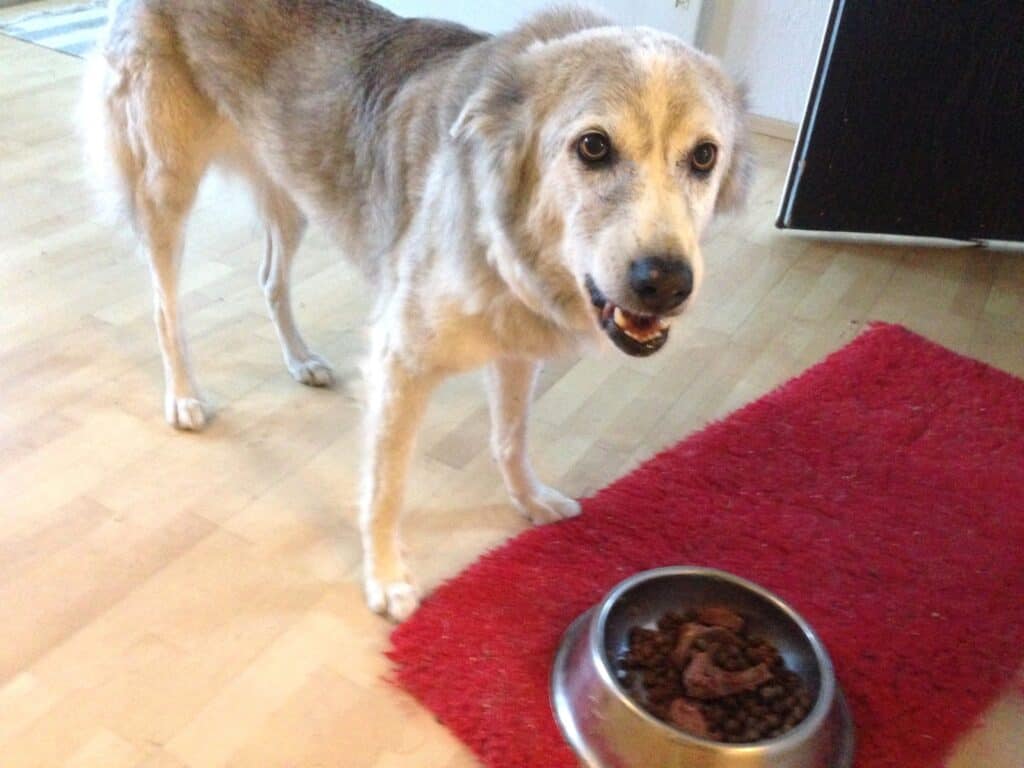
#6. Rapid Ingestion Or Blocking
Some dogs will quickly ingest their food or a food treat to avoid the risk of having it taken away.
Others will try to block access to the resource by positioning themselves in front of it, standing over it, or moving it to another “safer” location (Jacobs et al., 2018).

#7. Vocalizing
Dogs that are resource guarding may also vocalize their aggression.
Vocalizations usually start with growling (tends to be of a low pitch), then escalate to snarling, and possibly barking too.
Case Study: Video Of Daisy Guarding A Toy
In the video above, our Saluki-cross Daisy, who we had rescued from the street exhausted and starving, is telling me quite clearly that the giant furry bumblebee is hers.
She freezes, then curls her lip, then growls, and finally whips her head up to grab the toy before I can get too close.
Here’s the breakdown (you might want to play it on slo-mo):
- 00.01: Daisy is already guarding the toy. It’s hard to tell but she is doing a classic “mini-freeze” right here. That’s the first warning.
- 00.02: Still freezing, the top lip starts to curl. That’s the second warning.
- 00.03: Top lip is more obviously curled now.
- 00.03: She’s growling (third warning) and the teeth are fully on display, in case you missed the first two warnings.
- 00.04: Her head whips around quickly to defend her resource. She also gives a single warning bark. If someone walked past at that moment or put their hand down to take the toy – or even if she THOUGHT they were going to take the toy – they may well get nipped. Or worse.
- 00.05: She has retained her precious resource. Panic over.
This all happens in UNDER FIVE SECONDS.
It’s no wonder people get bitten.
You can’t expect a child to be aware of any of that.
Even for adults, it can be so easy to miss these signs, especially if a) they are unaware of what to look for and b) because they happen so quickly.
And the dog gets the blame.
Yet Daisy here is so clearly communicating with us, which is a GOOD THING.
The last thing you want is a dog who gives no warning.
The challenge is for dog owners everywhere to be able to read the signs, to register them quickly, to understand what their dog is telling them and to respect that in order to avoid any escalation of an emotionally charged situation.
6 Resources Commonly Guarded By Dogs
While resource guarding (aka possessive aggression) is considered to be a normal part of the canine behavioral repertoire, many dog owners still see it as a problem.
But first, to understand if your dog is resource guarding, you need to know what resources she considers valuable.
Here are the most common examples:
#1. Food
Some dogs guard their food bowl or the area around their food bowl.
If a person or another pet approaches their food source while they’re eating, they may growl as a warning to stay away.
Food guarding behavior can become dangerous if the dog’s owner does not understand or acknowledge the dog’s warning signals.

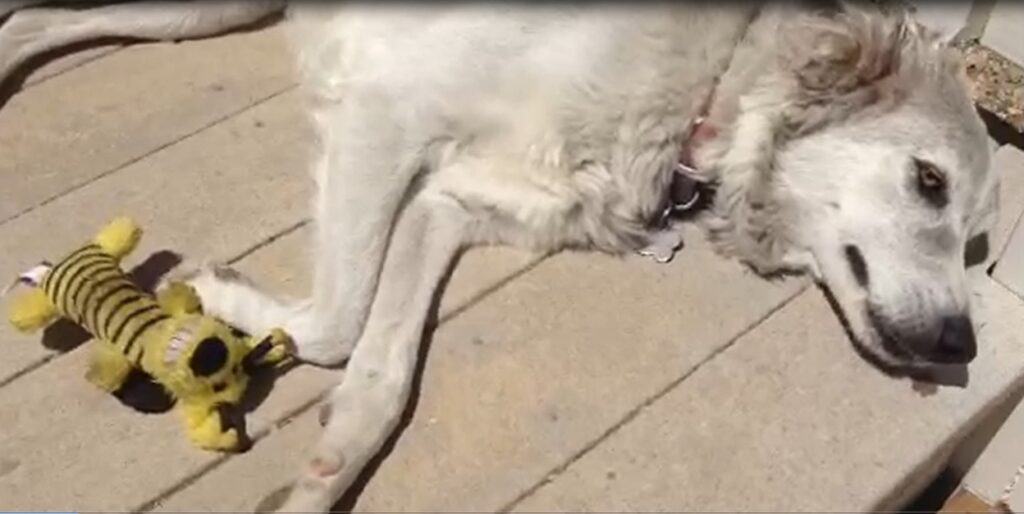
#2. Toys And Chew Toys
If your dog has a favorite toy or chew toy, she may become possessive of it and not allow anyone (human, dog, or both) to approach or touch it.
Even if she’s not interacting with it at the time.
Even if she’s far away on the other side of the room.
#3. Bones
Bones are another item dogs commonly guard.
In fact, that’s how I learned that Daisy was a resource guarder.
I happened to walk past her one day while she was chewing on a bone in a doorway.
Of course, I should have thought of it, but didn’t.
I walked too close for her liking so she nipped at my leg.
It wasn’t deep at all but she did draw blood.
In her eyes, I was coming too close to her precious resource and, because I hadn’t been paying attention, I had missed all of her warning signals.
So she did what she felt she had to do to protect her resource.
Did I take it personally?
No.
Did I understand why she did what she did?
Absolutely.
Did I pay more attention in future?
You bet!
Does this mean Daisy was an “aggressive dog”?
Absolutely not, she was a sweetheart who we were honored to share our lives with for almost 15 years.

#4. Territory
Dogs often guard their territory, like their home or yard.
Some dogs also guard their owners, other family members, or pets.
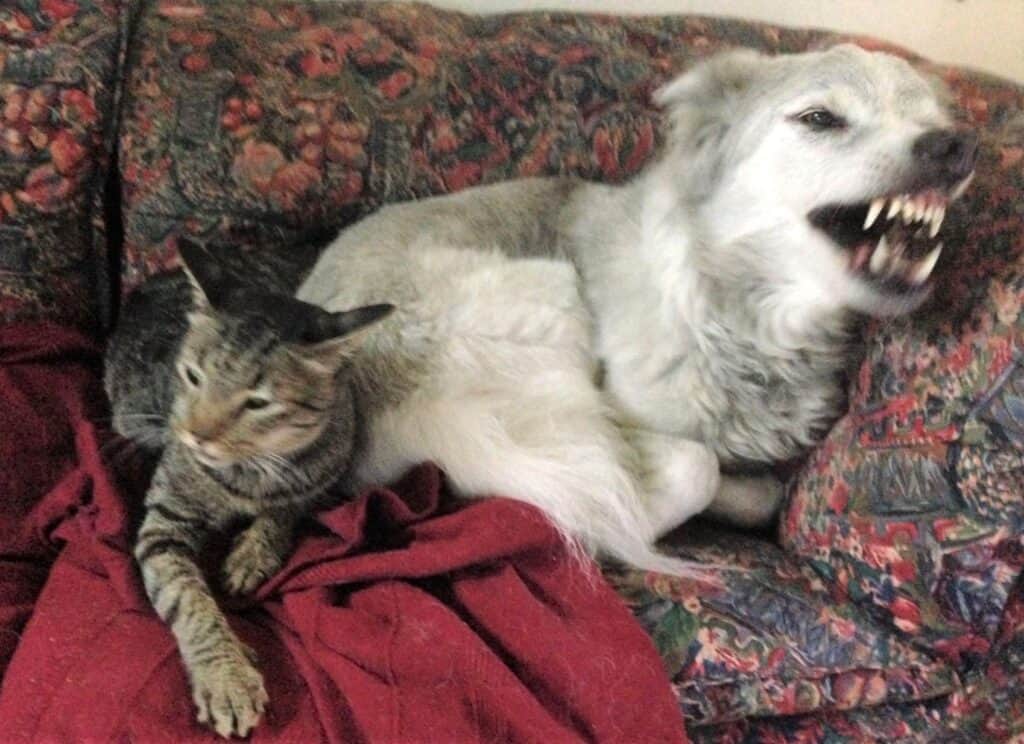
#5. Bed Or Sleeping Area
It’s quite common for dogs to have a tendency to guard their bed or their sleeping/resting area.
Let’s face it, no one wants to be disturbed or feel threatened when they’re sleeping, and dogs are no different.
So if someone approaches or tries to move them from their resting spot, they may well stiffen and growl as a warning to stay away and leave them alone.
#6. Stolen Items
Sometimes dogs guard items they have “stolen.”
These items could be just about anything.
The aforementioned Daisy (in addition to guarding bones, chew toys, toys, and her food bowl) liked to gather and guard random objects.
These were usually shoes and dog leashes, but could be anything else she deemed valuable at the time – an empty paper bag, a newspaper, an envelope, a toy, a sock…
If you went anywhere near her while she was interacting with her precious item, she would growl at you as a warning to back off.

How To Manage Resource Guarding
Managing your dog’s resource guarding behavior is crucial to ensure the safety of your family, other pets, and visitors.
Here are some effective management strategies that you can implement:
Safety First
Above all, the most important thing is to make sure everyone is safe.
This goes for resource guarders themselves, as well as the humans and any other pets in the home.
So try to be aware of potential triggers and try to avoid guarding situations arising in the first place.
Children should be taught to never approach the dog when she is eating or sleeping.
Nor should they ever try to remove food items, toys, or “stolen” items from the family dog.
Children should absolutely not try to climb on the dog when she’s resting (or any other time for that matter) or interact with her in any way.
Controlled Feeding
Feeding your dog in a controlled environment is an important part of managing resource guarding.
You can do this by placing your dog’s food bowl in a quiet area where she won’t be disturbed, then leave her to eat in peace.
Wait till she’s finished eating and left the area before you approach to remove the bowl again.
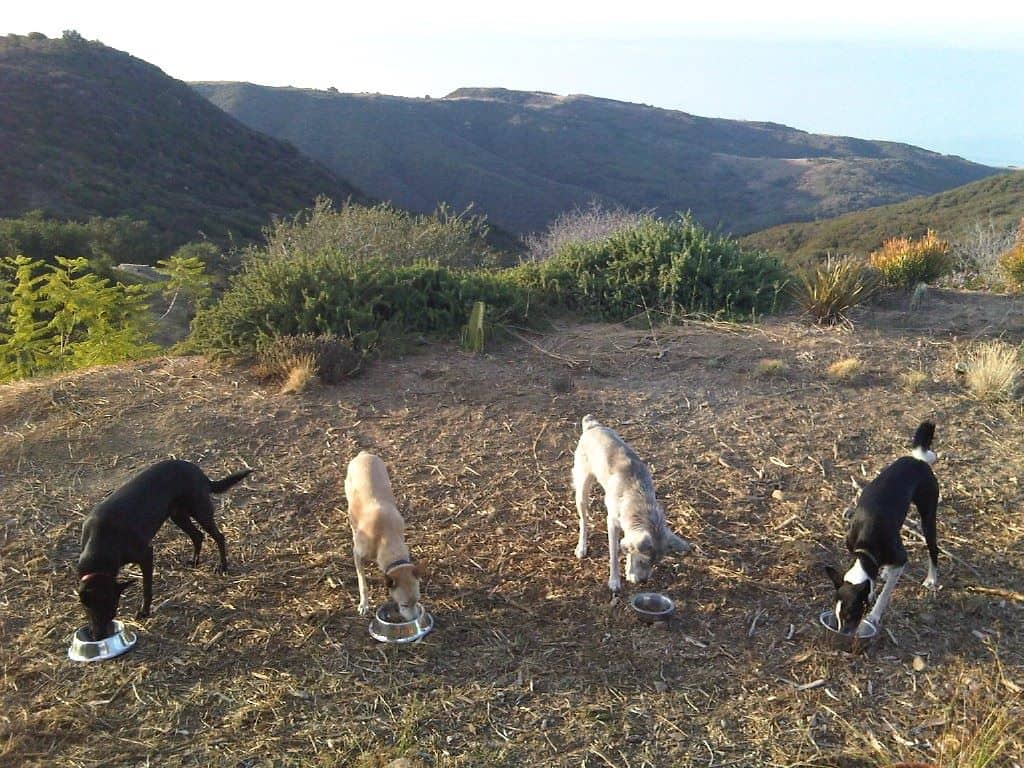
If you have multiple dogs, feed them in a separate room to avoid competition and potential guarding behaviors.
The same goes for chew toys, rawhides, and bones.
You can always use dog gates or baby gates to create separate zones if you don’t have enough spare rooms or space.
Toy Play
“If you have a toy guarder, do toy-play with the dogs separately, and put coveted toys away when the dogs are together,” says respected dog trainer Pat Miller of Peaceable Paws.
Again, you can divide up the space you have using dog gates or baby gates to make sure everyone stays calm and safe.
Teach “Drop It” And “Leave It”
Using positive reinforcement training methods to teach your dog the “drop it” and “leave it” cues can be helpful in preventing resource guarding.
Here’s renowned positive reinforcement dog trainer Zak George demonstrating how to train “drop it:”
And here’s the amazing Battersea Dogs and Cats Home giving a great demo on how to use positive reinforcement to train “leave it:”
Professional Help
In many cases, seeking professional help from a certified applied animal behaviorist or a certified professional dog trainer (make sure they use positive reinforcement training methods) is the best and safest way to manage resource guarding.
They can provide you with a personalized training plan based on desensitization and counter-conditioning, as well as strategies to manage your dog’s behavior safely and effectively.
Remember that it’s natural for dogs to guard their (to them) valuable resources, but it’s crucial to manage their behavior to ensure everyone’s safety.
Mistakes To Avoid
As a responsible dog owner, it’s important to recognize the signs of resource guarding in your dog.
However, it’s equally important to avoid making certain mistakes when dealing with resource guarding. Here are some mistakes to avoid:
Avoid Punishment
Punishing your dog for growling or displaying possessive aggression can make things much worse and must be avoided at all costs.
Punishing a dog who is already emotionally aroused (and not in a good way) can induce her to escalate into full-on aggression.
Dogs are master communicators through their body language, facial expressions, and vocalizations.
Unfortunately, while dogs understand each other very well, we humans tend to fall short!
So it’s important for us to understand when a dog growls, it is a valuable way for them to communicate with us.
It’s their way of letting us know that they’re feeling uncomfortable or distressed.
If you try to discourage or stop your dog from growling by adding something unpleasant (e.g. shouting at her, spraying her with water, causing pain and fear with a horrible electric shock) to the situation, you run the risk that next time, she’ll suppress her warning signals.
Why?
Because she has learned that growling has unpleasant – and potentially painful – consequences.
So why would she take the risk of that happening again?
Much safer (in her eyes) to skip the polite warning and go straight for the snap – or even bite – instead.
And now, sadly, you have a potentially dangerous dog on your hands.
No one wants that.
Don’t Attribute Your Dog’s Behavior To “Dominance”
Resource guarding has nothing to do with your dog trying to “dominate” you or take over the house.
The concept of dominance theory, a common but outdated approach to dog training, lacks scientific validity.
It rests on the erroneous notion that dogs are in constant power struggles to establish an ‘alpha’ leader within their pack.
This theory originated in the 1930s and 1940s, stemming from observations of captive wolves by Swiss animal behaviorist Rudolph Schenkel.
Unfortunately, these observations were inaccurately extended to wild wolf behavior and eventually to domestic dogs.
Consequently, the misconception that dogs must be dominated for proper behavior has persisted for many years.
Avoid Forced Removal
Forced removal of items from your dog’s possession can be dangerous and may even exacerbate her resource-guarding behavior.
It’s essential to avoid approaching her and trying to physically take items from her mouth or paws as this has the real risk of you getting bitten.
Instead, you can try to trade the item with a high-value treat (e.g. hot dogs, chunks of chicken or cheese) or high-value items (e.g. one of her favorite toys) so your dog learns that good things happen when you approach.
It also rewards her for good behavior.
Bottom line: Dealing with resource guarding requires patience, caution, and a lot of work.
Avoiding these mistakes can help you keep your dog calm, make sure everyone stays safe, and prevent the behavior from escalating.
My Dog Is A Resource Guarder – Does That Mean She Is “An Aggressive Dog”?
It’s important to understand that a dog who resource guards is generally not “an aggressive dog.”
As I’ve said, it’s a completely normal dog behavior.
It’s a snapshot in time based on the context in that moment.
We were easily able to switch Daisy out of her “aggressive state” by switching her highly valued shoe or paper bag with a high value treat.
But this is something you need to work on, very carefully and cautiously, ideally with the help of a professional trainer who is licensed and certified.
What Triggers Resource Guarding In Dogs?
Not all dogs exhibit resource guarding behavior to the same degree, and some dogs don’t do it at all.
The reasons for this are currently unknown, according to researchers (Jacobs et al., 2018).
However, the following factors may be significant:
Evolutionary Background
Dogs are descended from wolves, who are natural scavengers and hunters.
In the wild, resources such as food, water, and shelter are scarce, and wolves must compete with other animals to survive.
As a result, resource guarding is a natural behavior that has evolved to help wolves protect their resources from other animals.
Past Experiences
Past experiences can also contribute to resource guarding behavior in dogs.
If a dog has experienced food or resource scarcity in the past, they may be more likely to guard their resources in the future.
Additionally, if a dog has been punished or had their resources taken away in the past, they may learn to guard their resources as a way to prevent this from happening again.
Lack Of Socialization
Early socialization is crucial in preventing resource guarding issues in dogs.
Dogs who are not introduced to different people, animals, and places during their critical socialization phase (usually between 3 and 14 weeks old), or who have not had positive experiences with all these different people, animals, and places, may become more fearful or anxious as they grow up.
This generalized fear or anxiety can fuel resource guarding behavior in the adult dog as she is more likely to feel insecure and, thus, perceive her resources to be threatened.
READ NEXT
Resources
- Factors associated with canine resource guarding behaviour in the presence of people: A cross-sectional survey of dog owners – Jacquelyn A. Jacobs, Jason B. Coe, David L. Pearl, Tina M. Widowski, & Lee Niel
- How to Manage Your Resource-Guarding Dog – Pat Miller
- How to Stop Resource Guarding: The Ultimate Guide – Video] – Zak George’s Dog Training Revolution
- How to Teach ANY DOG “Drop it” / “Let Go” in Minutes! [Video] – Zak George’s Dog Training Revolution
- Preventing Food Guarding – Megan Maxwell
- Prevention and Management of Resource Guarding – Companion Veterinary Clinic
- Resource Guarding: Treatment and Prevention – Dr. Patricia McConnell
- Resource Guarding in Dogs – John Ciribassi DVM
- Teach Your Dog to Leave It | The Battersea Way [Video] – Battersea Dogs and Cats Home
NEED A DOG TRAINER OR BEHAVIOR EXPERT?

If you need more help dealing with a training or behavior issue, please find professional help from a force-free dog trainer who can consult with you either in person or remotely.

GOOD PLACES TO START ARE:
- COAPE Association of Pet Behaviourists and Trainers
- Pet Dog Trainers of Europe
- International Companion Animal Network
- Institute of Modern Dog Trainers
- Pet Professional Guild

All dog owners deserve to have successful relationships with their canine companions!
