

Dogs Squabbling? What Really Happens When You Let Them “Sort It Out”

If you share your home with more than one dog, there’s a reasonable chance someone has said it to you at some point. Maybe when you first brought a new dog home, or when tensions flared between your two resident dogs. Maybe from a friend, a neighbor, a well-meaning relative.
“Just let them sort it out.”
It sounds reasonable. Dogs sorted things out long before humans started interfering. Maybe stepping back is the right call.
It isn’t. And here’s why.
What “sorting it out” actually looks like
When people say let them sort it out, they usually imagine one of two outcomes: either the dogs have a brief scuffle, establish who’s who, and settle into a comfortable hierarchy, or they circle each other warily for a while and eventually reach a mutual understanding.
What they don’t picture is what more commonly happens.
One dog learns that the other is a source of threat. Each subsequent encounter reinforces that association. The lower-confidence dog starts restricting their movements around the house to avoid flashpoints. They stop going near the food bowl when the other dog is present, stop settling in their preferred spot, start checking constantly over their shoulder. Meanwhile, the more assertive dog learns that intimidation works, which means they’re likely to use it again.
Nobody sorted anything out. The dynamic simply embedded itself.
And that’s in the relatively benign version. In a worse version, an actual fight happens, one or both dogs get injured, and the negative association each dog now has with the other is significantly harder to unpick.

Why dogs don’t actually want to fight
This is worth understanding, because it changes the framing entirely.
Dogs don’t fight for the sake of it. Fighting is biologically expensive. It carries a real risk of injury, and an injured dog in the wild is a vulnerable one. Research into free-ranging dogs, who live in groups without human interference, shows that they prefer appeasement and deference over conflict. They use subtle body language, calming signals, and spatial management to navigate their social relationships with minimal confrontation.
In other words, given genuine choice and enough space, most dogs will choose peaceful resolution. The problem in a domestic multi-dog household is that the choice and the space aren’t always available.
When two dogs who are uncertain about each other are required to share the same environment, navigate the same doorways, eat in proximity, and compete for the same resting spots and attention, the conditions for conflict exist regardless of what the dogs would naturally choose. “Let them sort it out” assumes that the natural resolution mechanism can operate freely. Often, in a home environment, it can’t.
The signals you need to know before things escalate
Most dog fights don’t come from nowhere. They come from a sequence of earlier signals that were missed, ignored, or misread.
A dog who is uncomfortable communicates that long before they escalate to aggression. The communication can be extremely subtle, like a slight stiffening of the body, a lip lick, a yawn when they aren’t tired, a barely visible curl of the top lip. If those signals are ignored, the dog has no option but to turn up the volume. A growl. Then a snap. Then, if that also fails to create the distance they need, potentially a fight.
Our fearful rescue dog Louis’s tell was a top lip curl so small I almost missed it when we first adopted him. Just a millimeter of movement, a second or two before a snap. Once I learned to see it, I could intervene before anything happened. He never needed to snap at anyone again because the early signal was enough.
When well-intentioned dog owners try to suppress those early signals (punishing growling, for instance, on the grounds that it’s “aggressive” behavior – it’s not, by the way), they are removing the dog’s warning system without removing the underlying discomfort. The result is a dog who still has all the same triggers but who has learned that their very important communication signal (their warning that they feel threatened), is not only ignored, but that it produces punishment. So they skip it, and the bite comes with a lot less notice than it used to.
Understanding what “sorting it out” looks like in body language terms is the essential starting point. If you can see the early signals, you can intervene before anyone needs to escalate.
The difference between playing and fighting
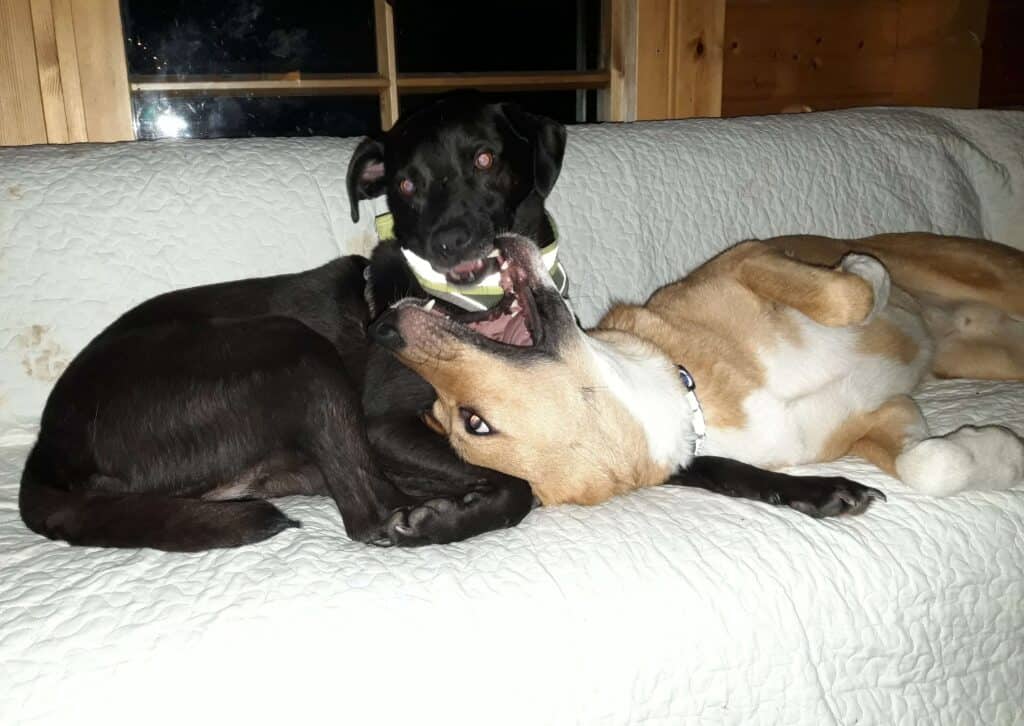
One of the most common sources of confusion in multi-dog households is distinguishing rough play from the beginning of a conflict. They can look and sound alarming in ways that make owners want to intervene when nothing is actually wrong, or they can blur gradually into something more serious in ways that are easy to miss.
Healthy dog play has a particular quality to it. The body language is loose and bouncy. Mouths are soft. There’s role reversal when the dogs take turns being the chaser and the chased, the wrestler and the wrestlee. There are natural pauses, moments where both dogs shake off and reset before re-engaging. The play bow appears: a dog dropping their front end down, inviting more play.
Two of our rescue dogs, Roman and Florence, used to play in ways that horrified people who saw photos of them. Their mouths would be wide open, teeth visible, and Roman’s jaws around Florence’s muzzle. But their lips and facial muscles were relaxed, their bodies were bouncy, and they could both leave whenever they chose to. That’s healthy play, even though it may not always look that way to human eyes.
What signals a shift toward something more serious: one dog repeatedly trying to disengage while the other won’t let them. The bouncy movement going stiff. A dog going still and fixed rather than loose and fluid. One dog repeatedly standing over another and staying there. The pauses disappearing.
If you see those signals, it’s time to interrupt. Not with shouting or physical intervention if you can avoid it, but with a calm redirect. Call one dog over, create some physical space, give both dogs a chance to reset. Intervene before it tips over, not after.
What to do if a fight does happen
Even in well-managed multi-dog households, fights can happen. The priority in that moment is to separate the dogs safely. And safety includes your own.
The instinct is to grab a collar. Do not grab a collar. A dog in a fight is in full emotional overload, and even the most trusted dog may redirect aggression onto whoever is nearest. That includes you. Their rational brain is largely offline in that moment. It’s not personal. But it’s a real risk.
When two of our other dogs, Maggie and Daisy, got into a serious fight one day in our front yard, there was no one else home, no hosepipe nearby, and nothing I could use as a barrier. Maggie’s jaws were clamped over half of Daisy’s face and Daisy couldn’t break free.
I was terrified, but forced myself to stay calm. No yelling. No panicking. I approached Maggie from behind, took hold of her back legs just above the knees, and walked backward diagonally (known as the wheelbarrow method). Once they were about five yards apart, I set her back legs down gently, kept a light hold of her collar, and spoke to her quietly until she started to settle.
Then I addressed Daisy, who was thinking about coming in for another round. I made soft eye contact, raised my hand in a “wait” signal she already knew, and held my breath. She hesitated, looked at me, (luckily) respected this signal from her most trusted person, and backed off.
Daisy had a small bite mark on her face below her right eye. That was it. My first thought when the fight started was that I would need to get her straight to the vet once it was over, because she could lose the eye. Thankfully she was fine, as was Maggie. But both dogs were exhausted and extremely subdued. I kept them separated for several weeks before beginning a careful, structured reintroduction.
They never became close companions. But they did learn to coexist. Sometimes that’s the best outcome available, and it’s still a genuinely good one.

After a fight: what not to do
The instinct after a dog fight is often to tell the dogs off and convey that what just happened was “unacceptable.” This is understandable but completely counterproductive.
Punishment (at all times, but especially after a fight) adds fear and confusion to an already highly charged situation. It doesn’t teach the dog what to do differently. It teaches them that the presence of the other dog correlates with unpleasant things happening, which is exactly the opposite of the association you need to build.
Keep both dogs calm and separate. Offer each of them something calming once they’ve had a chance to decompress, like a stuffed KONG, a lick mat, or a safe chew. Licking and chewing have a genuinely calming effect on the nervous system. Then check both dogs for injuries, even small ones. Bite wounds can be deeper than they appear, and what looks like a surface puncture can harbor bacteria deep in the tissue. If in any doubt, call your vet.
What actually works instead
The alternative to “letting them sort it out” isn’t constant intervention or managing every interaction with military precision. It’s understanding what your dogs need and setting up the conditions for coexistence to work.
- Enough resources. Separate feeding stations, separate sleeping spots, more than enough of everything so there’s nothing worth competing over. Dog gates that allow any dog to leave a situation that feels uncomfortable. Enough space that no dog ever feels cornered or unable to create distance.
- A structured approach to any new introduction. Scent before visual contact. Visual contact before physical access. Shared space only when both dogs are consistently calm in each other’s vicinity. Moving at the slowest dog’s pace, not yours.
- Paying attention to the early signals. Knowing what your specific dogs look like when they’re comfortable and when they’re not, and trusting what their body language is telling you.
- If things escalate beyond what you can manage alone, getting professional support early. Studies show that behavioral interventions significantly reduce conflict in multi-dog households, with success rates of over 70% in male-male pairs. The earlier you address tension, the less entrenched it becomes and the better the outcomes.
“Let them sort it out” is well-meaning advice. But in a multi-dog household, it hands the problem back to the dogs without giving them the tools to solve it. The environment, the management, the conditions for peaceful coexistence are ours to provide. After all, dogs aren’t looking for conflict. In the wild, they’d naturally avoid it. In our homes, it’s simply harder for some dogs. And bridging that gap is our job, not theirs.
Quick reference: when to intervene and when to step back
Step back (play is healthy): Loose, bouncy movement. Soft mouths. Role reversal. Natural pauses. Both dogs can disengage when they want to.
Intervene calmly (tension building): One dog repeatedly trying to leave. Movement going stiff. Fixed stare. Pauses disappearing. One dog consistently standing over the other.
Separate immediately (fight in progress): Never grab a collar. Barrier, towel/blanket, or wheelbarrow method from behind. Loud noise or water as a last resort. Your safety first.
After a fight: Separate, calm, check for injuries. No punishment. Structured reintroduction when both dogs are consistently relaxed separately.
What prevents it: Adequate resources. Space to disengage. Attention to early signals. Structured introductions. Professional help early if needed.
This article draws on the experiences and research documented in the following articles on my site:
- Too Rough? How to Tell If Dogs Are Playing or Fighting
- Can Two Male Dogs Ever Get Along Without Fighting?
- What to Do After a Dog Fight (Without Making Things Worse)
For the cat version of this topic, see Cats Fighting? Why “Just Let Them Work It Out” Is Terrible Advice
