

Are Shock Collars Safe For Dogs? Nope, Not Worth The Risk

As a responsible pet owner, it’s natural to seek the best training methods for your furry friend. But although a shock collar may sound like a safe solution for training your dog or an easy fix for a behavior problem, nothing could be further from the truth.
The reality is that using electric shock as a “training” method can cause serious physical and psychological harm. And it’s not just me who says so.
Animal welfare associations, veterinarians, and professional trainers all over the world agree – shock collars are simply not the answer when it comes to training your pup.
Instead, there are more humane and effective alternatives readily available that make training fun for both you and your dog – without resorting to painful tactics.
In this article, I’ll explain exactly why shock collars are a potentially harmful choice for your beloved canine, while showcasing the power of positive reinforcement methods that will ensure a happy, well-trained, and well-behaved dog.
How Do Shock Collars Work?
A dog shock collar operates through a remote control transmitter (for the human) and a collar that holds two metal contact points (like prongs) and a small unit with a radio receiver and batteries (for the dog).
- The collar is placed tightly around the dog’s neck so the metal points are touching the dog’s neck or throat.
- The dog owner or trainer controls the unit on the dog’s collar remotely by using the transmitter, delivering an electrical shock to the dog whenever they decide to do so.
- The shock can range from a mild vibration to a painful electric shock, depending on the level set by the human handler (Whole Dog Journal, 2006).
The theory is that the dog will be startled enough – or, more likely, hurt and scared enough – to stop whatever unwanted behavior he is engaging in at the time, such as excessive barking at the neighbors or jumping up on house guests.
Experiencing An Electric Shock Collar: How It Would Feel On A Human?
Respected veterinarian Dr. Peter Dobias explains it like this:
“Open your hands with your thumbs touching each other. Place your thumbs at the base of your throat and with your fingers pointing back and surrounding the neck.
“Now, take a deep breath, squeeze and pull back with all your force keeping your thumbs connected.
“This is how many dogs feel when they are pulling on their leash that is attached to a collar.
“If you are still keen to continue with this experiment, put a choke chain around your neck, attach it to a leash and ask a friend to pull and jerk on it periodically. Welcome to the dog world!”
Renowned dog trainer Victoria Stilwell went a step further and, in a live demonstration, tried a shock collar on herself.
Her goal was to demonstrate first-hand what a dog goes through when he receives an electric shock.
Even though it was set to the lowest level to start with and she held it against her wrist and not her neck or throat, she still found the experience to be painful and unpleasant:
The Fallout Of Using A Shock Collar
Ask any positive reinforcement trainer and they’ll probably have a story about a dog they had to try to rehabilitate after the damage caused by the use of shock collars.
Or worse still, a dog that had to be euthanized because he was too far gone. And all completely avoidable.
If you want some examples, I’m going to drop a link here with a serious content warning.
These stories feature pain and injury caused to dogs due to the use of shock collar training and are extremely distressing.
If you don’t want to read them I don’t blame you. I wouldn’t either. The headlines alone are enough to break your heart.
- READ ONLY ON ADVISEMENT: Dog Training Shock Collar Abuse Cases
The Problem With Punishment
Here’s the thing about punishment. You need to get your timing, intensity, and duration spot on. Every time.
Which is virtually impossible even for experienced, skilled dog trainers. And any modern dog trainer who has kept up-to-date with their education won’t be using punishment in the first place.
But let’s delve deeper anyway because this is important.
Timing
If the timing of your electric shock is off, it may be delivered for an unrelated behavior.
For instance, a dog could be shocked while standing quietly and looking out the window or sniffing the ground, a couple of seconds after he has already finished engaging in whatever unwanted behavior the handler intended to punish.
As a result, he may struggle to make the association between the specific behavior and the punishment, leading to increased confusion.
Moreover, the unpredictability of the shocks can be incredibly stressful for the dog, causing anxiety about when the next shock will come and why.
Intensity
Overdoing a punishment can lead to your pup becoming fearful, not just of the electric shock or the collar itself but also of you (or anything else) present at the time.
But if the punishment isn’t “intense” enough (in other words, it’s not sufficiently scary or painful), your dog may not pay it much attention and simply carry on with what he’s doing.
Alternatively, the behavior may be so reinforcing that the dog will carry on doing it anyway.
Not only that but there also appears to be a significant individual difference among dogs in terms of sensitivity to the pain caused by an electric shock (Masson et al., 2018).
In other words, what may be frightening or painful for one dog might be less significant for another.
This renders it almost impossible to strike a balance and determine the “appropriate” intensity of shock for any particular dog in any particular context on any given day.
Duration
Similarly, when it comes to the duration of punishment, it’s just as difficult to get it right.
If you shock your dog for too long, he may become frightened or anxious.
On the other hand, if you don’t shock him for “long enough,” he may not even register the punishment.
The Effects Of Using A Shock Collar
The fear of experiencing pain can be just as damaging to a dog’s emotional health as actually experiencing the pain.
Imagine going through life never quite sure if, when, or why you were going to get your next electric shock.
It would be enough to mess with anyone’s head.
Bearing that in mind, let’s now look at some of the risks associated with using a shock collar on your dog.
The Psychological Effects
Fear/Anxiety/Stress
Mentally, electric shock can induce fear, anxiety, stress, and an overall negative or depressed mood state.
Shutting Down
Some dogs may give up and shut down completely, offering no behavior at all, to minimize the risk of being shocked (known as “learned helplessness”).
Stunts Learning Ability
Electric shock controls a dog without allowing the dog to engage his brain to make his own choices and solve problems.
When in an emotionally aroused state (fear/stress/anxiety) a dog’s rational brain is inhibited, making it impossible for him to learn anything new.
This is the exact opposite of what training is intended to do.
Doesn’t Train An Alternative Behavior
Electric shock forces a dog to “behave” without understanding the root cause or underlying emotion driving an unwanted behavior.
While the dog may stop what he’s doing, he does not learn an alternative, more appropriate behavior, or what his owner would like him to do instead.
Risk Of Escalation
The person operating the remote transmitter may increase the duration, intensity, and/or frequency of the punishment if the dog does not respond immediately – making it even more aversive than it was before.
Damages The Human-Canine Bond
The dog may start to associate the fear and pain of the electric shock with his owner’s presence, damaging their mutual bond and causing distrust.
Aggressive Behavior
Fear, stress, and anxiety caused by painful, unpredictable electric shocks can create entirely new behavioral problems.
Often, dogs will do anything they can to escape or avoid the fear and pain of being shocked.
For example, a dog may engage in aggressive behavior in the future as he desperately tries to avoid the frightening, painful experience of being shocked.
The result is an increased risk of fear-related aggression toward people, which can pose a public health risk for dog bites.
And if it happens, it’s always the dog who gets the blame and – often – pays the ultimate price.
Suppressed Behavior
If a dog suppresses a behavior (e.g. fence fighting with other dogs) due to being shocked, the behavior does not simply disappear.
First, he may start to associate the pain of the shock with the presence of the other dogs, which is not a good place to be.
Second, it’s highly likely the behavior will reappear at an elevated level at some other time – because it hasn’t just gone away on its own.
Unpredictability
Using shock to punish dogs when they give out warning signals of potential aggression (e.g. growling) can lead to a suppression of these signals, again resulting in increased unpredictability and injury risk.
Sources: RSPCA; Victoria Stilwell Positively; Pet Professional Guild
Can Cause Life-Long Emotional Damage
No one wants to unintentionally hurt their dog.
No one wants to make their dog so terrified that it poses a serious threat to his overall welfare.
Yet that is exactly the risk dog owners take if they use a shock collar.
“The emotional damage caused by shock collars is often beyond repair and requires a lifetime of treatment,” says veterinarian and American College of Veterinary Behavior resident Dr. Lynn Honeckman.
“The wounds I see are beyond skin-deep – they are soul deep.”
Victoria Stilwell echoes the sentiment in this video, where she explains to one of her clients how the use of a shock collar has caused her dog Roxy’s extreme anxiety and reactivity to other dogs*:
*Don’t worry, the video has a happy ending. With Victoria’s help and the magic of positive reinforcement training, Roxy learns to be calm around other dogs and not react aggressively toward them.
I’ll talk more about positive reinforcement training a bit later.
The Physical Effects
It should go without saying that using an electronic training device on your dog can also cause discomfort, physical pain, injury, or even long-term health issues, including:
Elevated Cortisol Levels
Because shock collars work by causing fear and pain, a dog may simply “get used to” (a process known as “habituation”) feeling scared or anxious.
This can lead to increased cortisol levels (stress hormone), blood pressure, and heart rate, which can have a detrimental effect on the dog’s immune system and overall health, not to mention his physical and mental well-being.
Dogs’ Skin Is Thinner Than Humans’
According to the Vet West Animal Hospitals, the canine epidermis is 3-5 cells thick, compared to humans, where it is at least 10-15 cells thick.
This implies that a dog’s skin is more sensitive to shock than human skin because it is not as thick.
Damage To Dog’s Delicate Throat Area
The neck is a particularly sensitive area for dogs, housing important structures such as the larynx, trachea, and thyroid gland.
There is a risk of injury if these vital organs are subjected to any kind of trauma, force, or pressure, including electric shock.
Risk Of Skin Irritation
Research shows that shock collars carry a risk of physical damage to the skin on the dog’s neck (Polsky, 1994).
Researcher Sylvia Masson and colleagues (2018) explain that “to ensure that the metal pins are in close contact with the skin of the neck, an e-collar must be fitted tightly.
“Aside from being uncomfortable, the points where the metal pins make contact with the skin can become irritated, and this can result in the development of pressure necrosis or wounds.
“Anti-bark collars and electronic fence collars must be worn for long periods, so these risks are especially high in these contexts,” they add (Masson, et al., 2018).
Risk Of Burns
Masson and colleagues (2018) also point out that if a shock collar device malfunctions, it can lead to “damage caused by electricity.”
Anecdotally, some trainers have reported seeing burns on a dog’s neck as the result of receiving an electric shock from a shock collar.
The Alternatives To A Shock Collar
Despite all this, there are still dog trainers who advocate for the use of electronic shock collars as a means of training pet dogs.
- Even though there is a growing body of evidence supporting the detrimental effects of shock collars on dogs.
- Even though scientific research suggests that shock collars are not recommended for the treatment of behavior problems in dogs, as they do not address the root cause of the problems and can worsen negative associations and behaviors.
- Even though multiple professional animal welfare and veterinary organizations worldwide recommend against its use and advocate for humane training techniques based on evidence-based learning theories that avoid using coercion and force.
Depressing, isn’t it?
But if you’re still here after reading all that, you’ll be happy to know there is a better way.
What Is Positive Reinforcement Training?
Positive reinforcement training (also known as reward-based training) is a highly effective and humane approach to dog training.
It focuses on rewarding desirable behaviors (i.e. good behavior), rather than using aversive methods* and punishing undesirable behaviors (i.e. so-called bad behavior).
This means dogs are not subjected to physical or emotional harm during the training process and there is no risk of any negative consequences, such as those outlined above.
*Aversive training methods refer to anything that works by causing pain or fear, including electronic training collars, automatic bark collars, citronella collars, electric fences (aka an invisible fence), as well as a prong collar, pinch collar, or choke chain.
How Does Positive Reinforcement Training Work?
Positive reinforcement training is based on the principle that dogs learn through association, and by creating positive associations with certain behaviors, we can encourage them to behave in ways that we find desirable.
So by using positive stimuli, such as treats or praise, you can encourage your dog to repeat a behavior you want to see more of.
For example, if you want him to sit on cue, give him a treat every time he sits.
Then gradually add in your cue word, “sit.”
Over time, the dog learns that sitting on cue leads to a reward, and he is more likely to sit when you ask him to because behaviors that get rewarded get repeated.
The “sit” soon becomes a learned behavior and you can begin to phase out the reward.
It is a highly effective and gentle method of training that can be used to teach dogs a wide range of behaviors, from basic obedience to more complex tasks.
What Are The Benefits Of Positive Reinforcement Training Methods?
Positive reinforcement training offers numerous benefits for dogs, as well as pet parents.
Benefit 1: Stronger Mutual Bond
It creates a stronger bond between the dog and dog owner, as the two work together as a team and have fun during the training process.
As the dog learns to associate positive behaviors with good outcomes, he is more likely to behave well in the future.
Benefit 2: Positive Training Environment
Because positive reinforcement focuses on rewarding dogs for appropriate behaviors – rather than punishing them for inappropriate behaviors – the whole training environment is different.
How?
Because nothing bad is going to happen. Nothing scary. Nothing painful.
The worst that is going to happen is that the dog does not get a reward if he doesn’t do the required behavior.
Benefit 3: Encourages Good Decision-Making
This encourages dogs to use their brains, try harder, and make their own decisions.
This is far better than shocking a dog into submission.
When a dog makes the right choice he gets rewarded for it, which builds his confidence and sets him up for success rather than failure.
Benefit 4: Mental Stimulation
Not only that but allowing dogs to use their brain and think for themselves, means their emotional brain is inhibited, leading to a calmer, more relaxed dog all around.
Because of this, positive reinforcement training can be used to teach a wide range of behaviors, from basic manners to far more complex tasks.
Benefit 5: Optimal Learning Environment
Compare that to the shock collar, which only teaches a dog that random electric shock is scary, painful, anxiety-inducing, and extremely stressful.
As shock collars are designed to work using fear and pain, it means a dog is placed in a far from optimal learning environment.
How can he learn anything new when he’s too worried about when the next shock is coming? His emotional brain will be in overdrive while his rational brain is forced to take a back seat.
Which dog would you rather have?
One who is happy and confident and wants to learn new things?
Or one who is too scared to do anything or, conversely, is too scared not to do something in case he gets another electric shock?
Positive Reinforcement vs. Positive Punishment
As we’ve seen, positive reinforcement involves rewarding a behavior to increase the likelihood that the behavior will be repeated in the future.
So if you give your dog a high-value treat every time he comes back when you call him, he will learn to associate coming back when called with a positive outcome and will be more likely to do so in the future.
Positive reinforcement focuses on increasing desirable behaviors by providing a positive consequence.
On the other hand, positive punishment involves adding an aversive stimulus to decrease the likelihood of a behavior being repeated.
For example, if you shock your dog every time he jumps on the couch, he will learn to associate jumping on the couch with a negative outcome and will be less likely to do it in the future.
Positive punishment focuses on decreasing undesirable behavior by providing a negative consequence.
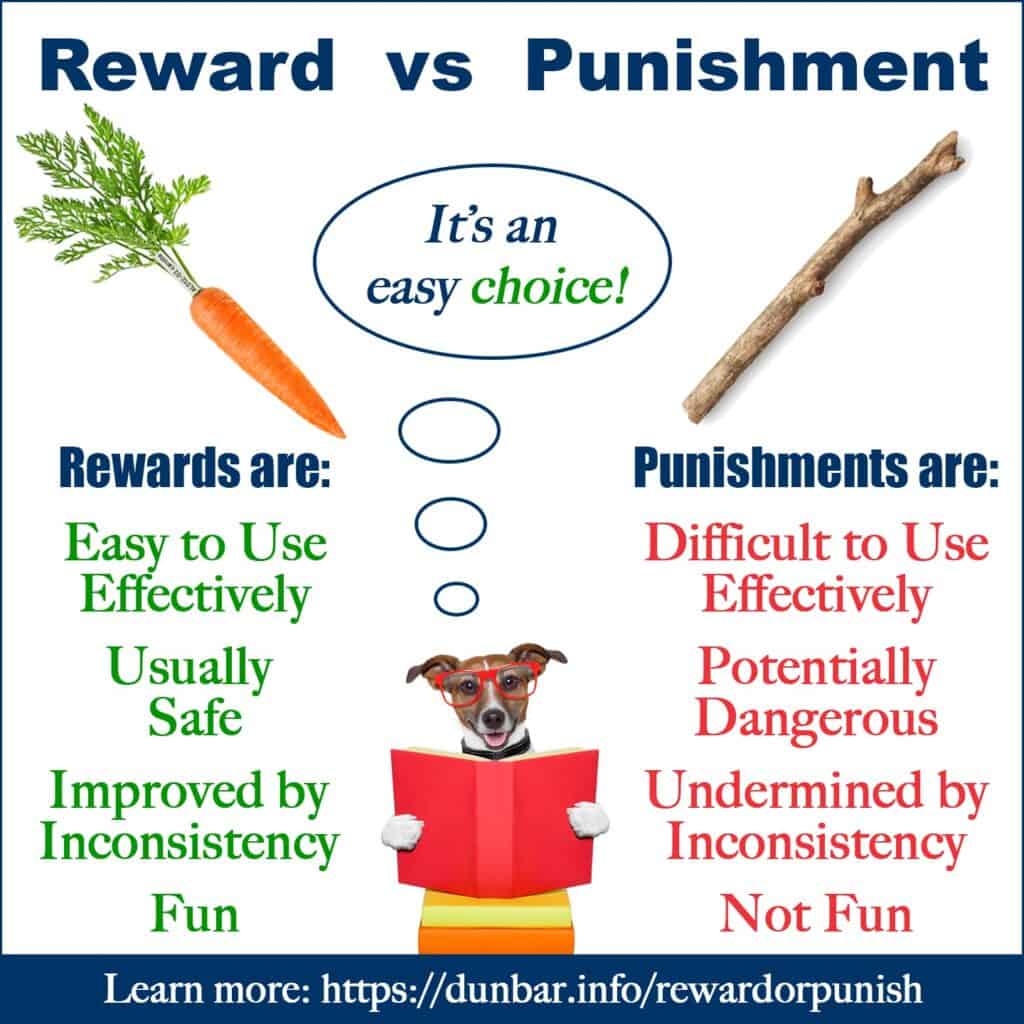
The key difference between positive reinforcement and positive punishment is the type of consequence provided.
This handy graphic from the Dunbar Academy, founded by veteran dog trainer and behavior expert, Ian Dunbar, makes this nice and clear:
Common Myths Surrounding The Use Of Electric Shock In Dog Training
Let’s now look at some of the common myths surrounding the use of electric shock in dog training.
Myth 1: Shock Collars Are Just As Effective As Positive Reinforcement
False. As we’ve seen, dog shock collars focus on punishing bad behaviors rather than rewarding good ones, making them far less effective at teaching long-term behavior changes.
Plus, they can cause a lot of psychological and physical distress for the dog.
Myth 2: Shock Collars Are Humane
False. Shock collars use electric shocks to correct behavior which can be incredibly painful and even dangerous for dogs, causing both physical and psychological damage.
For this reason, it is not considered humane or ethical to use a shock collar.
Myth 3: But It’s Only A Vibration
False. Some trainers will tell you, “It’s just a vibration.” But it’s not that simple.
“Often, a dog trainer will hear that a dog doesn’t even need to be shocked anymore, as the vibration (or just ‘holding the collar up’) is enough to alter behavior,” says professional dog trainer Kristi Benson.
“Although using just the vibration warning feels like a more gentle solution here, the vibration only works because the dog has learned that a shock is next.”
Myth 4: But It’s Fine When It’s Used “Correctly”
False. Shock collars work because being at the receiving end of random electric shocks is frightening and painful.
The risk of behavioral fallout is immense. There’s not really any “correct” or “incorrect” about it.
Myth 5: But The Dog Gets A Warning Beep
False. Some trainers claim that shock collars are humane because they emit a warning sound alerting the dog a shock is imminent.
The dog is then expected to respond accordingly before he is shocked.
But it is a long reach to claim this is humane.
“The threat of pain is just as capable of inducing stress, fear, and emotional damage as the pain itself,” says Ban Shock Collars.
“Many dogs don’t know why they are being shocked and consequently don’t know how to respond.
“Therefore, when the warning beep is not responded to and the punishing shock is delivered it causes even further confusion.”
Oh and by the way, that “beep” can be generalized to other beeps, such as when you use a remote control to turn on the air conditioning, a truck reversing, or when the smoke alarm battery is running down.
So instead of a trained dog you have a dog who is more scared than ever.
Myth 6: But I Tried It On Myself And It Didn’t Hurt
False. It’s not really for anyone to say what someone else finds painful or not.
I’ve already talked about how a dog’s skin is thinner than a human’s and we’ve also seen professional trainer Victoria Stilwell placing the metal prongs of a shock collar against her wrist.
She found it painful and that should be enough for anyone.
What Are The Safest Ways To Train A Dog Using A Shock Collar?
The safest way to train a dog using a shock collar is not to use one at all.
Instead, find a certified positive reinforcement trainer who can train your dog with humane, science-based methods without having to resort to applying pain and fear.
Why train a dog using a device that causes pain when all the current scientific data shows us that positive reinforcement is the most effective way in the long term?
Both in terms of learning and our dogs’ physical and emotional well-being and welfare?
Before You Go
It doesn’t matter what you call it – a shock collar, an e-collar, an electric collar, a remote training collar, or a remote training system – electric shock is old school and has no place in modern dog training or changing a dog’s behavior.
So for the love of your dog, ditch the idea of using a shock collar and opt instead to have fun teaching him with humane, science-based training methods.
Not only will you have a well-behaved, happy, confident dog who makes good choices, but you are also guaranteed a strong bond with your dog built on mutual trust.
And this will be far more rewarding than any “quick fix” collar could ever provide.
READ NEXT
Resources
- 5 Reasons Not To Use A Shock Collar – BC SPCA
- A List Of Things That Shock Collars Are Not – Kristi Benson
- Choke, Prong And Shock Collars Can Irreversibly Damage Your Dog – Dr. Peter Dobias
- Dog Training Shock Collar Abuse Cases – Ban Shock Collars
- Electronic Shock Collars: Are They Worth The Risks? – R.H. Polsky
- Electronic training devices: Discussion on the pros and cons of their use in dogs as a basis for the position statement of the European Society of Veterinary Clinical Ethology – Sylvia Masson, Silvia de la Vega, Angelo Gazzano, Chiara Mariti, Gonçalo Da Graça Pereira, Christine Halsberghe, Anneli Muser Leyvraz, Kevin McPeake, & Barbara Schoening
- Open Letter Regarding the Use of Shock in Animal Training – Pet Professional Guild
- Pet Training and Behavior Consulting: A Model for Raising the Bar to Protect Professionals, Pets and Their People – Niki J. Tudge, Susan J. Nilson, Debra A. Millikan, & Louise A. Stapleton-Frappell
- Shock Collar on Puppy Leaves Lasting Damage [Video] – It’s Me or The Dog
- The Canine Shock Collar Debate – Pat Miller
- The Difference Between Canine and Human Skin – Vet West Animal Hospitals
- Victoria Shatters Huge Shock Collar that was Strapped to Tiny Dog [Video] – It’s Me or the Dog
- Victoria Uses A Shock Collar On Herself [Video] – VS Positively
- What Are The Animal Welfare Issues With Electric Shock Collars On Dogs? – RSPCA
- Which Type Of Dog Collar Is Best For Your Dog? – Humane Society of the United States
NEED A DOG TRAINER OR BEHAVIOR EXPERT?

If you need more help dealing with a training or behavior issue, please find professional help from a force-free dog trainer who can consult with you either in person or remotely.

GOOD PLACES TO START ARE:
- COAPE Association of Pet Behaviourists and Trainers
- Pet Dog Trainers of Europe
- International Companion Animal Network
- Institute of Modern Dog Trainers
- Pet Professional Guild

All dog owners deserve to have successful relationships with their canine companions!
