

Too Rough? How To Tell If Dogs Are Playing Or Fighting

This post may contain affiliate links, which means we may receive a commission, at zero cost to you, if you make a purchase through a link. Please see our full disclosure for further information.
It can be tough to tell whether dogs are playing or fighting, especially if you’re not familiar with canine body language.
Dogs can look – and sound – like they’re fighting when in fact they’re just having good fun playing together. But it’s important to know what’s going on because it can be really scary when two dogs start fighting.
By learning to read dog body language and facial expressions better, you’ll be able to tell the difference between play and aggressive behaviors, and know when to step in before things escalate.
Playing or fighting?
When a friend of mine saw the photo of Roman and Florence playing at the top of this article, she was horrified because she thought Roman was behaving aggressively and biting Florence across the muzzle.
I was astonished. “But you can see how soft their mouths are and how relaxed their facial muscles are,” I protested. “It’s obvious that they’re playing and not fighting…Isn’t it?”
Well, no! Apparently, it isn’t obvious at all – unless you know what signs to look for. So in this article, I’ll explore how you can tell the difference between the two behaviors so that you can keep yourself and your furry friends safe.

What is the function of play?
Play helps animals build up their confidence and develop their social skills. Through play, they learn to read the intentions of others, how to collaborate and compete appropriately, and practice social interactions – all in a safe environment. It’s a pleasant emotional state for them to be in. It’s fun and exhilarating.
In terms of social development, play is important as animals who’ve played more growing up tend to be less fearful, less prone to aggressive behavior, and more socially creative.
Play can also inhibit fear and act as a buffer against stress because even fearful animals feel more in control of their environment. It’s also good exercise.
What is the body language associated with play?
As I mentioned above in the Roman and Florence example, dogs at play have soft mouths (teeth not on display) and facial expressions, as well as loose body movements. Other features of a dog play session include:
- Play growls
- Excited barking
- Playful nips that involve bite inhibition (i.e. the dog controls the pressure of any biting behavior because he has no intention of inflicting damage)
- Light and bouncy movements
- Open mouth (like a “big grin”)
- An upright, wagging tail

What is the function of fighting?
Fighting involves rage, which, as opposed to play, is an unpleasant emotional state to be in.
When dogs fight they may be defending their territory or some precious resource, or they may be frustrated for some reason. Or they may feel cornered and just want the other dog to go away. They may not want to fight at all, but feel they have no other choice.
When dogs fight, they typically try to inflict damage and may kick, bite hard, wrestle, lunge, lash out, or pin the other dog down. Although fighting is a risky strategy because it brings with it the risk of injury or even death, it can also bring about what the dog wants.
For example, a dog may learn to use aggression as a way of solving his problems. If another dog walks past him while he’s out on his walk and he wants that dog to go away, he may learn that lunging, barking, and growling at that dog gets him the outcome he desires. The dog and her owner walk past and continue with their walk (which they would have done anyway) and the dog has got what he wanted (they went away).
To put it another way, the dog was rewarded for his behavior which means he’ll do the same thing again. Because it worked. So although rage is generally an aversive emotion, a dog may end up with mixed feelings if he ends up getting what he wanted, which can bring relief.
What is the body language associated with fighting?
Dogs will typically give plenty of tell-tale signs if they are uncomfortable with something in the environment or a specific situation so it’s important to know what to look for and potential signs of aggression.
Warning signs may include a hard or direct stare, rigid facial muscles, and stiff body muscles. The dog’s ears may be pinned back flat against his head and he may have a closed, tense mouth.
Other signs of potentially aggressive behavior include:
- Tucked tail (or tail directly upright)
- Growling
- Freezing
- Back and front legs braced (ready for action)
- Snarling (a curled lip this can be minimal and hard to spot)
- “Whale eye” (i.e. flashing the whites of the eyes)
- Raised hackles (fur raised on the back of the dog’s neck and along the spine)
Not all dogs will display all signals, and many dogs will display several signals at once. Dogs can make signals extremely quickly, within nanoseconds. Because of this, it is not always easy to spot them at first glance.
Nevertheless, when any of these signals are seen, the dog’s owner should defuse the situation as calmly and quickly as possible, ideally by safely removing the dog or managing the environment accordingly.
Knowing your dog’s triggers
Rage doesn’t usually occur out of the blue or without a reason. There are almost always signs of increased arousal, and it’s up to us, as custodians of our dogs, to recognize these so we can help defuse situations before they escalate to a full-blown rage response/fight.
Dog owners often punish the warning signals such as growling and snarling, but this runs the risk that the dog stops using these valuable communication signals and goes straight to the bite/fight instead.
It’s also important to know your dog’s triggers (e.g. other dogs, tall men, a sudden loud noise, German shepherds, the neighbor’s fluffy large dog, etc). Without triggers, there will be no increase in emotional arousal.
How do dogs know if it’s a game or serious?
When dogs are playing they need to be able to reliably communicate their intent. How do they do this? They go to MARS. Yes, you read that right!
There are four components to healthy dog play, none of which occur in real fighting:
- Meta signals
- Activity shifts
- Role reversal
- Self handicap
Meta signals
Meta signals are invitations to play. They are play signals that all parties will understand so that there are no misunderstandings.
A very common meta signal in dog play is the play bow, which can occur at the start of, during, or after play. Dogs use the play bow to tell the other dog that everything that happens from then on is intended as play, all part of the fun and not aggression.

Activity shifts
You’ll see this a lot in dog play. The dogs may change direction a lot, or go from running in circles or chasing each other to standing on their hind legs and wrestling.
Role reversal
Dogs take turns at being the aggressor and the victim in normal dog play. Some animals prefer one role over the other, which is fine as long as the meta signals are present and everyone knows where they stand.
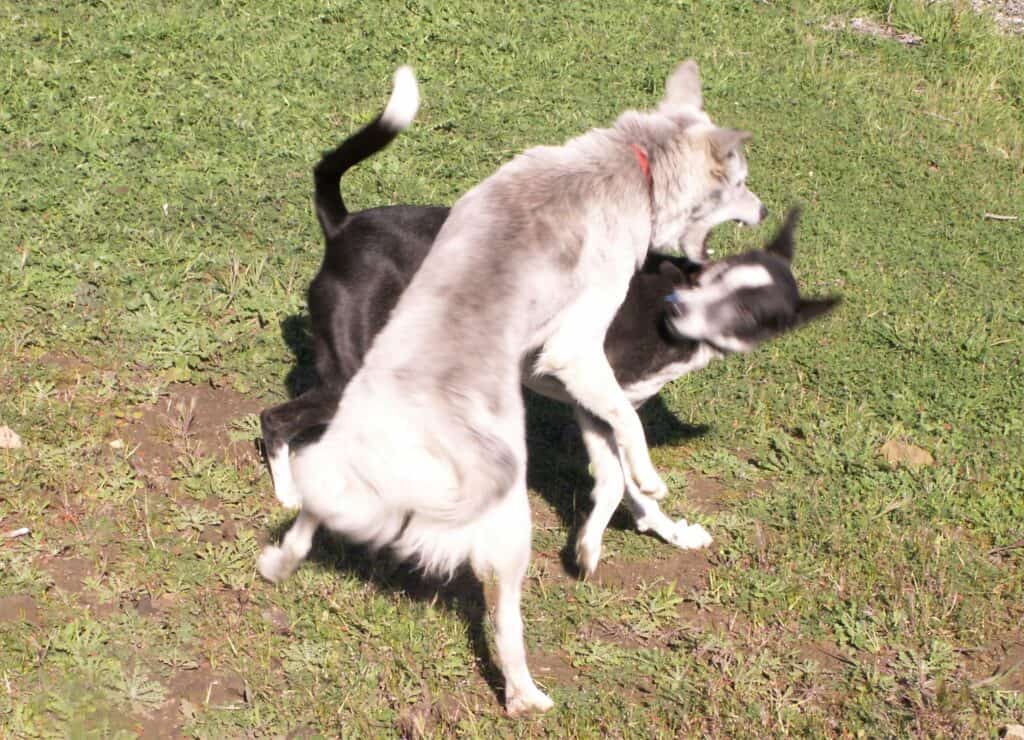
Self handicap
Bigger or stronger dogs may sometimes “handicap” themselves by not using all their strength so they can let the other dog “win” some of the time. In doing this they can ensure the other animal keeps playing by restricting their own competitive advantage.
Is it okay for dogs to bite each other when playing?
Dogs will often nip each other in play but it’s best not to let them get too emotionally aroused and risk things spilling over into something that turns aggressive. You can easily step in and call them over so they can take a quick break, shake off, and reset.
Is it okay for dogs to play rough?
This depends partly on the dogs and how well they know each other, and also on how confident or fearful they are. Certainly in familiar dogs, as long as both dogs are enjoying the encounter rough play is okay to an extent, but I would also interrupt them and make sure they take little breaks so things don’t get too crazy.

How do I know if my dogs are playing too aggressively?
Watch for the signs of aggressive behavior as outlined above. If you start to see any signs of potential conflict, it’s time to take a break.
Is it safe for my dog to play in the dog park?
There can be a risk of play sessions in dog parks escalating to aggression, especially if pet parents are not paying attention to potential warning signals.
Fearful or less confident dogs may get bullied and try to move away from the other dogs or hide behind their owner. Or they may just do their best to stay away from all the other dogs and use calming signals to try to keep them from approaching. A shy dog may find the dog park to be quite stressful, depending on the other dogs that are there at the time.
Dogs who lack social skills or who are not experienced in play may behave inappropriately and be rough or pushy, or not understand another dog’s signals.
The key is to know your dog, understand their body language, know their triggers, and remove them if they show signs of being uncomfortable or feeling unsafe.
This is exactly what we did with our fearful dog Louis. The dog park was a source of enormous stress for him, so we just didn’t go there. If we had risked it, I have no doubt he would have snapped at any dog who came near him – and you never know how that may have ended. So why put yourself and your dog in that position?
What happens when play becomes fighting?
Play often has a competitive edge and the high levels of arousal involved can sometimes spill over into competitive frustration for various reasons. When this happens a previously bouncy happy dog may get angry.
Even if the situation doesn’t escalate to full aggression, it could be very uncomfortable for dogs who don’t want to engage.
How do I prevent a dog fight?
Dogs use body language to communicate, so if you are familiar with these signals, it’ll be much easier to prevent a fight from breaking out.
You’ll be better able to tell if the dog is having a good time or if the play has gone too far. So pay close attention to the dog’s body language, avoid known triggers, and avoid scenarios where there is competition for resources (such as food or toys).
Signs that things have gone too far include stiffening up, growling, a hard stare, and baring teeth. If you see any of these signs, it’s time to take a break.
Final thoughts
Dogs communicate with each other in many ways, and one of the most important is through their body language. By being able to read the signs a dog is giving off, we can better understand what they’re trying to say.
Generally speaking, dogs will play by biting each other gently and wrestling around in a more playful way. If one dog starts growling or snapping at the other, it’s likely they’re no longer just playing around. When in doubt, it’s always best to err on the side of caution and separate the dogs until you can be sure that they’re not getting too aggressive with each other.
Knowing your dog’s triggers and avoiding known problem areas can help keep playtime safe and enjoyable for everyone involved. And as always, be aware of your surroundings and remove your dog from the situation if things start to get too rough.
**I know some of the photos are blurry but dogs move fast when they’re playing! I don’t have any pix of dogs being aggressive or fighting either, because that’s not the time to be standing there with your phone. But hopefully now you have a better idea of what to look for. Questions? Drop me a line at team@catanddoghouse.com.
Resources
- Canine Body Language: A Photographic Guide Interpreting the Native Language of the Domestic Dog – Brenda Aloff
- PLAY – Animal Emotions/Module 4 [Educational Course] – Dr. Karolina Westlund/Illis Animal Behaviour Courses
- RAGE – Animal Emotions/Module 8 [Educational Course] – Dr. Karolina Westlund/Illis Animal Behaviour Courses
NEED A DOG TRAINER OR BEHAVIOR EXPERT?

If you need more help dealing with a training or behavior issue, please find professional help from a force-free dog trainer who can consult with you either in person or remotely.

GOOD PLACES TO START ARE:
- COAPE Association of Pet Behaviourists and Trainers
- Pet Dog Trainers of Europe
- International Companion Animal Network
- Institute of Modern Dog Trainers
- Pet Professional Guild

All dog owners deserve to have successful relationships with their canine companions!
