

Steps To Success: How To Leash Train A Dog That Won’t Walk

This post may contain affiliate links, which means we may receive a commission, at zero cost to you, if you make a purchase through a link. Please see our full disclosure for further information.
Quick Answer
When you’re training a dog to walk on a leash, it’s best to start at home where it is a familiar environment and there are no distractions.
Make sure you have a treat bag loaded with plenty of your dog’s favorite treats, and a long line or leash that is at least 6 ft. long.
The treats should be something high-value, that your dog absolutely loves and doesn’t usually get any other time.
Think small pieces of chicken, cheese, or hotdog.
Once you have all your supplies ready, head out into your yard or some other quiet enclosed area with your dog.
You can even train indoors if you don’t have access to a suitable area.
Introducing the leash
- Begin by introducing the leash to your dog.
- Let him sniff it and get used to it.
- Every time he interacts with it, pair it with a treat to start building a positive association.
- Clip it to his harness and give him a treat.
- Unclip it again and take a step or two away.
- Step back in and clip on the leash, again pairing the action with a treat.
- Keep going until your dog has a positive association with having the leash clipped on.
- By now, he might even be looking forward to it because he knows he will get a delicious reward.
Once your dog is used to having the leash clipped on and attached to his harness, you can start your training.
Loose leash walking training protocol*
Step 1: Your dog learns to stand calmly next to you without pulling away
- Load one hand with treats.
- Praise and treat when your dog is calm and/or looking at you.
- If your dog pulls away from you, don’t yank the leash, and don’t reel him back in. Stand still and wait until he returns to you. If he is very distracted, call his name.
- When he comes back to you, praise and treat.
Step 2: Your dog learns to stay close to you while walking
- With your dog standing calmly next to you, say his name and, “Let’s go.”
- Praise and treat after the first step, as long as your dog doesn’t dash forward.
- Keep walking and praise/treat every other step.
- Gradually increase the number of steps in between rewards.
- If your dog starts pulling, stop and wait until there is some slack in the leash again. Then take a step with him and reward him quickly for walking near you.
- Keep him guessing. Sometimes reward after 1 step, sometimes after 5, then again after 2, then after 7.
*Loose leash walking training protocol courtesy Kelly Fahey / PupScouts of Hunterdon
Here is a visual representation from Battersea Dogs and Cats Home showing what this type of positive reinforcement training to teach good leash manners would look like:
Next step: Move to a more challenging environment
Once your dog is reliably staying close to you while walking and, most importantly, enjoying himself and having fun, you can start to venture out into more distracting environments.
Dogs don’t tend to transfer skills all that well, so while your dog might have been a model dog in your backyard, he may regress completely as soon as you step out onto the sidewalk.
This is because there are so many exciting sniffs and distractions, like other dogs, scary loud trucks, and squirrels running up trees.
To combat this, as far as is possible, start with somewhere relatively quiet and gradually build up to more challenging environments.
Just like humans, when dogs are emotionally aroused, they can find it hard to think straight.
So be patient, let him sniff around a bit, and then go back to the basics of your training.
You’ll most likely find that he will quickly regain his focus and remember everything he learned.
Remember to always bring treats with you and reward your dog whenever he does something well, such as staying close to you or ignoring distractions.
What if my dog won’t walk on the leash and just lies down?
If your dog goes a short distance, then not only puts the brakes on but also lies down, it’s a sure sign he really isn’t comfortable with the situation.
Real-life example: Rescue dog Florence
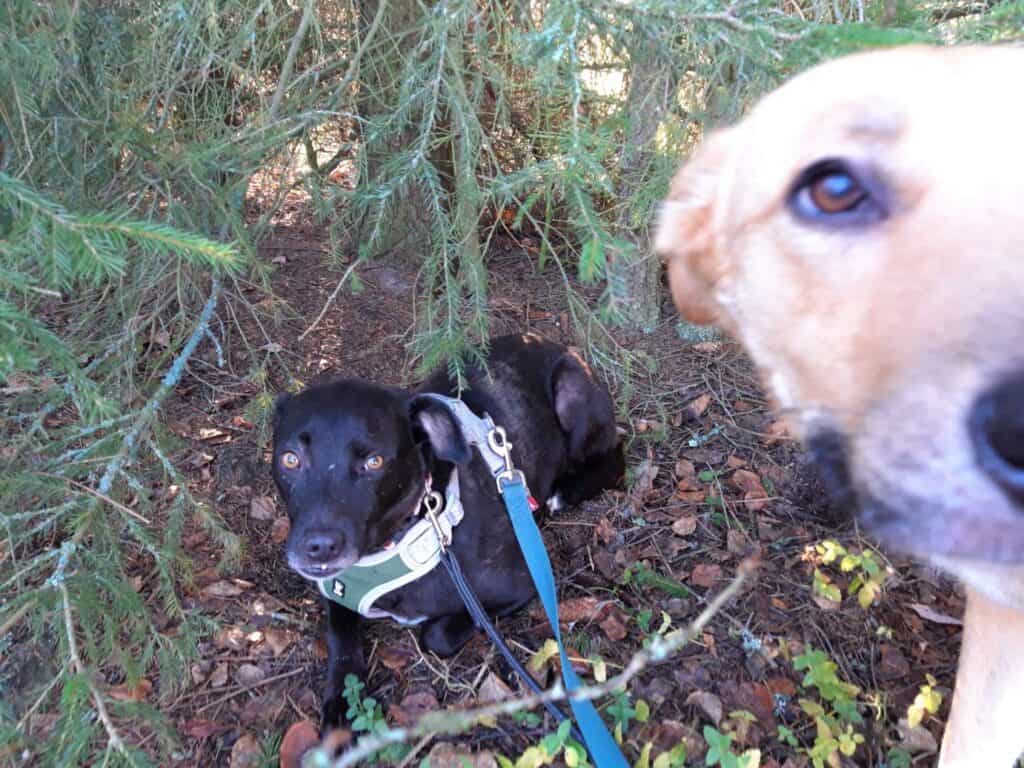
We experienced exactly this with our fearful, poorly socialized rescue dog, Florence.
It took four weeks after we adopted her before she would even venture outside, and when she did she’d just walk a few yards and then lie down.
She was scared of having me so close by and seemed to have no idea what to do. She didn’t really seem to know what the world was at all.
I got around her anxiety about my proximity and presence by using a long line so I didn’t have to stand so close to her.
I also used lots of treats to start building up a more positive association with me and with being outside and walking around this strange new world.
But it turned out that wasn’t enough in the beginning.
Enlist the help of a dog buddy
Time for Plan B then.
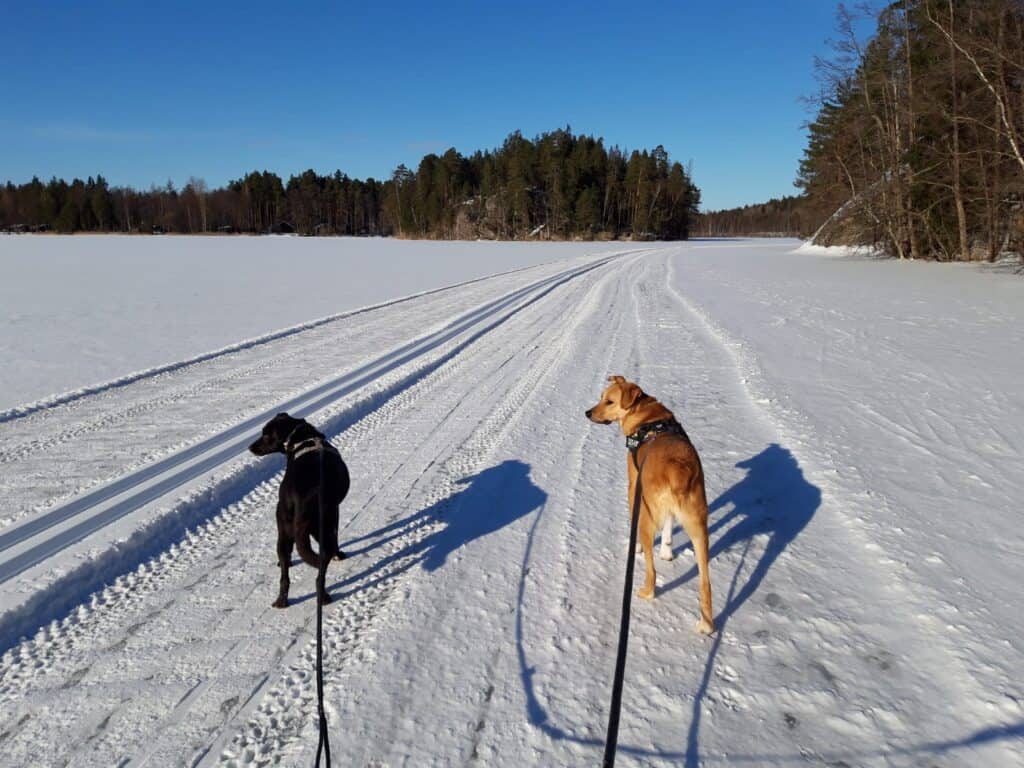
I enlisted the help of our more confident dog Roman, who we’d adopted 18 months previously.
Roman showed Florence it was safe to be out in the big wide world and safe to be with me.
She could see that he trusted us and started to learn that maybe she didn’t need to worry quite so much after all.
From there, I just waited it out.
That meant if Florence wanted to lie down till she felt safe to move again, that was her prerogative.
So I would stand there, sometimes for 30 minutes at a time in the cold, wet mud, ignoring her so she didn’t feel intimidated by me making eye contact or talking to her.
I’d just quietly wait till she made her own choice to get up and move again.
We repeated this several times for just 2-3 days, in which time her confidence soared and she stopped lying down altogether.
Because she realized that she was safe with me and it was so much fun being out in the world with Roman and exploring her new environment.
Use treats to shape behavior
I had another issue with Florence at first: she got scared if I tried to get her to change direction.
But I was able around that easily enough by laying a handful of treats in a small curved trail on the ground for her to follow.
This turned her around like a charm without me having to get too near her and risk scaring her.
The key is not to force your dog to do anything he’s not ready for and to help him learn he can trust you by letting him make his own decisions (as far as is safe to do so) and respecting them.
That way you’ll also build up his confidence.
What if my dog is too scared to walk on a leash?
First, I’d work on teaching your pup to enjoy being touched around his head, shoulders, and neck area and to have a positive association with the harness and leash.
In the meantime, you can also work on getting your dog excited about walking with you on the other end of the leash.
You can start by taking him for a walk (so to speak) around the house or your yard.
There’s no need for a leash at this stage.
Make walking fun
The goal is for your dog to think it’s fun just to be with you.
You can use treats, toys, and games as positive reinforcement (i.e. your dog is getting rewarded handsomely for being with you).
“If he puts on the brakes at home, or veers away from you in favor of something else, see if you can up the ante – make being with you far more attractive by grabbing a toy and tossing it around in an inviting way, or dashing off to hide and calling him in a super excited voice (perhaps even leaving a trail of treats behind you as you look for a place to hide that is not too hard but not too easy),” says trainer Nancy Kerns, who advises dog owners to “be unpredictable!”
Once you’ve got your dog’s attention and your pup has lots of great positive associations with being with you at home or in the yard, you can start going further afield.
“Make yourself more interesting, fun, and reinforcing than anything else out there and he will want to be with you, even through various physical discomforts like freezing sidewalks,” says Kerns.
At the same time, by allowing him to set the pace and make the decisions about when to move on, as we did with Florence, you’ll be helping him build his trust and confidence.
Should you drag a dog that won’t walk?
That would be a definite no.
Aside from the fact that your dog will probably feel even more scared, you also risk hurting him and showing him that he can’t trust you.
At the same time, you’ll be failing to teach him that going for walks is fun (which is the entire point).
There’s also the risk of building a real fear of the harness and leash and of going for walks in general.
Kerns has this to say about dragging a puppy, but it applies to adult dogs too (minus the growth plates):
“Pulling and dragging a pup can not only injure their necks and dislocate knees and elbows that are still rubbery (and with growth plates still not closed), but also give them a highly negative, unhappy association with you, the leash, and going on walks,” she says.
“Dragging and using force can only make matters worse!”
Instead, work on the steps above and make going for outdoor walks fun.
Consistency is key
Consistency is always key when it comes to training your dog.
And, of course, understanding your dog’s motivation for his behavior and being empathetic concerning his emotional state is essential.
Dogs can sense when their owners are irritated, anxious, or frustrated, and this can make the learning process much more difficult because they won’t be relaxed.
If you stay positive and patient and stick with the process, the good news is you should end up with a happy, well-behaved dog who loves going for walks!
READ NEXT
Recommended Products
- Blue-9 Balance Harness
- Euro Leash
- Freedom No-Pull Harness
- Loose Leash Walking: Online Training Course
- Perfect Fit Harness
- Tellington TTouch® Harmony Harness
Resources
- Don’t Pull Your Puppy With His Leash! – Nancy Kerns
- How to teach your dog to walk on a lead [Video] – Battersea Dogs and Cats Home
- Polite Leash Walking – Pat Miller
- Pup Won’t Go? Steps to Take for Puppy Leash Training – Kathy Callahan
- Your Puppy Blueprint – Kelly Fahey
NEED A DOG TRAINER OR BEHAVIOR EXPERT?

If you need more help dealing with a training or behavior issue, please find professional help from a force-free dog trainer who can consult with you either in person or remotely.

GOOD PLACES TO START ARE:
- COAPE Association of Pet Behaviourists and Trainers
- Pet Dog Trainers of Europe
- International Companion Animal Network
- Institute of Modern Dog Trainers
- Pet Professional Guild

All dog owners deserve to have successful relationships with their canine companions!
