
How to Design a Dog Room Your Pet Will Obsess Over

There’s a category of dog owner who has looked at their spare room, done a quick mental calculation, and arrived at a conclusion that feels completely reasonable to them: the dog should have it. Not as a storage space with a dog bed shoved in the corner. Not as a practical utility area that happens to contain their crate. As an actual room. Designed for them. With thought and care (and possibly a neon sign with their name on it).
If this sounds familiar, welcome. You are among friends here, and no one is going to tell you this is excessive. A dedicated dog room isn’t a flight of fancy — it’s an acknowledgement that your dog is a valued member of the household with genuine needs, preferences, and a personality that deserves to be catered to. Dogs who have rich, stimulating, comfortable environments are happier, calmer, and less stressed, bored or frustrated (= better behaved).
This is the guide to building that room. From practical foundations to finishing touches, here’s how to design a dog room your pup will return to again and again.
Start With Your Dog in Mind
Before any furniture is chosen or any paint color considered, spend time thinking about the specific dog (or if you’re like me, dogs) this room is for. A well-designed dog room is one that has been built around the actual animal(s), not a generic idea of what a dog might like. The differences matter more than you might expect.
Dog Type
Size and breed shape almost every spatial decision. A Great Dane needs a room where they can turn around, stretch out fully, and move between zones without navigating an obstacle course. A Chihuahua or a Cavalier operates at an entirely different scale, and a room designed for a giant breed will feel overwhelming rather than cozy to a small one. Think about your dog’s actual physical dimensions when choosing a bed, planning floor space, and positioning furniture. Ideally, the room will be made for their specific proportions.
Energy level determines how much the play zone needs to deliver. A working breed or a young high-energy dog, like a Border Collie, Vizsla, or Springer Spaniel, likely needs a room that gives their brain and body genuine work to do. Puzzle feeders, lick mats, snuffle mats, interactive toys, and physical enrichment should all feature prominently.
A calm, lower-energy breed or an older dog needs the room weighted more heavily toward comfort: cozy, easily accessible sleeping surfaces, warmth, and quiet enclosure. Neither approach is more valid; they’re just different, and getting it right makes an enormous difference to how much the room actually gets used.
Multi-Dog Homes
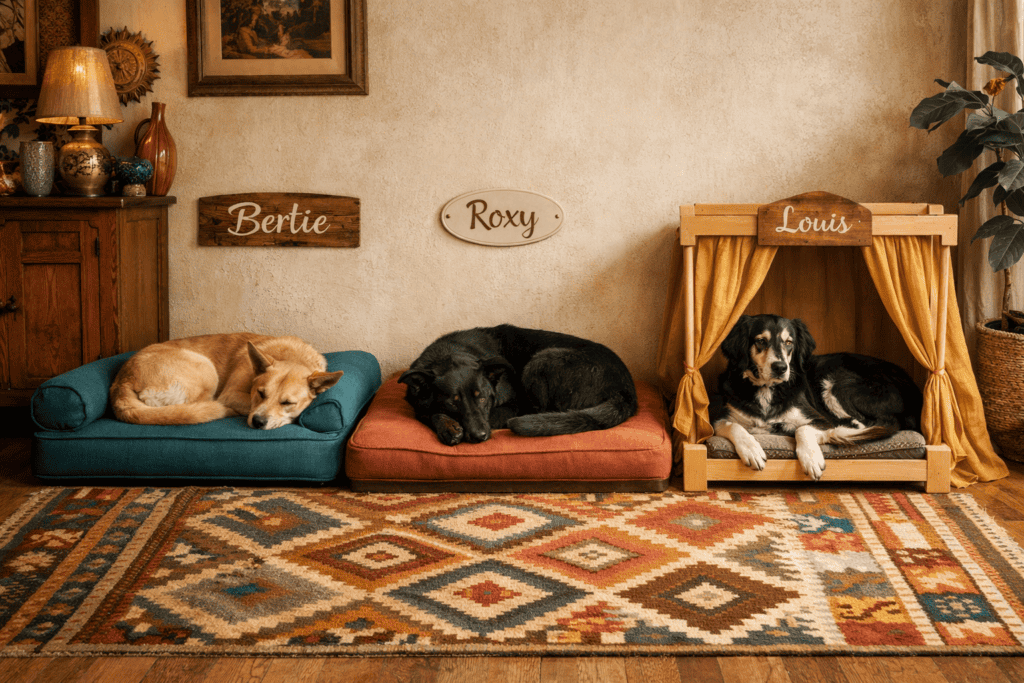
For multi-dog households, the planning stage is where you invest the most thought. Separate sleeping spots for every dog positioned far enough apart that each feels genuinely their own, are the baseline. A range of toys (to cater to individual preferences and avoid competition) and multiple water stations, so each dog can choose where they drink, are also worth building in. Make sure no single dog can position themselves as a gatekeeper and block others from entering or leaving the room.
One personal note on feeding: I wouldn’t feed my dogs in this room. With four rescue dogs at home, I feed each of them separately in different rooms entirely. Keeping mealtimes out of the shared space removes the two biggest mealtime problems in multi-dog homes: resource guarding, and dogs scarfing their food down at speed before anyone else can get to it. A dedicated dog room works beautifully as a resting, playing, and sleeping space, but mealtimes tend to be better handled elsewhere.
The Sleep Zone
Dogs sleep anywhere from twelve to fourteen hours a day, and the quality of that sleep has a direct and measurable impact on their mood, behavior, and long-term health. This is not the place to install a basic foam pad and call it done.
Orthopedic Beds
Orthopedic beds are an excellent choice for any dog over seven years old and for larger breeds at any age. The joint support they provide is significant and the difference in recovery from exercise is often noticeable. Memory foam or high-density orthopedic foam with a waterproof inner layer and a removable, washable cover is the specification to look for.
Elevated Beds
Elevated beds, like the cot-style, fabric-stretched-over-a-frame variety, are good for warmer months and for dogs who sleep hot (and can easily access them). The airflow beneath and around an elevated bed regulates temperature far more effectively than a ground-level mattress, and many dogs strongly prefer the secure feeling of being slightly raised. A well-chosen elevated bed in powder-coated steel or natural wood is also a good looking piece of dog furniture.
Canopy Beds
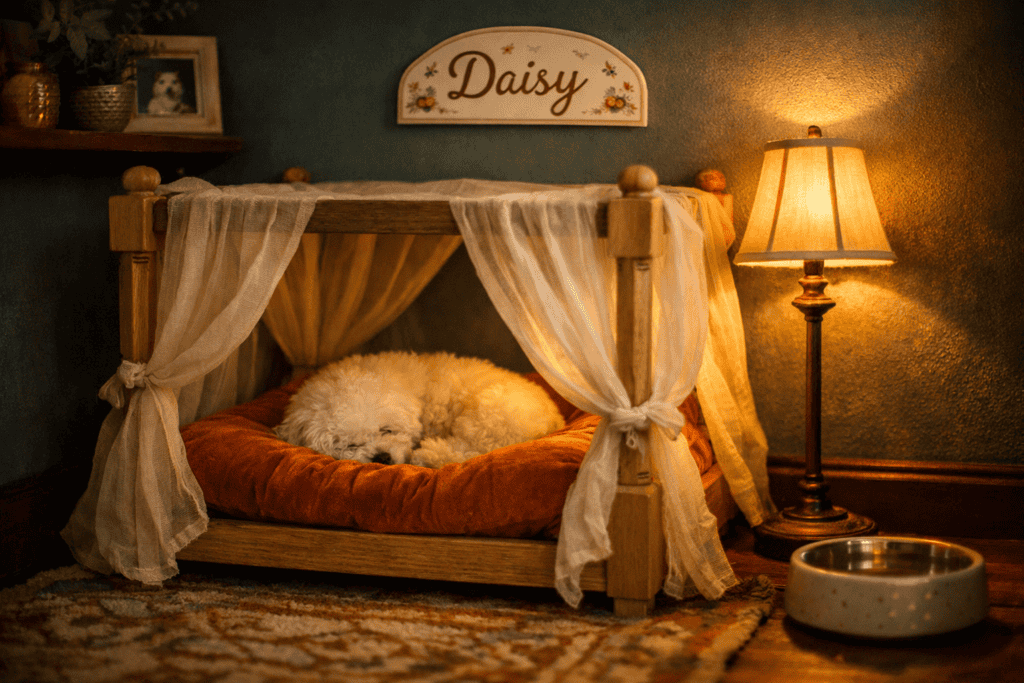
And then there is the canopy bed. This is the option for those who have committed fully to the indulgent vision of this room and have no intention of pulling back now. A small four-poster frame draped with light fabric, a curtained alcove with a padded base, or a purpose-built canopied dog bed with plush interior is the sleep zone’s statement piece. It is, objectively, a lot. It is also genuinely beautiful, and many dogs seem to take to enclosed, canopied sleeping spaces with considerable enthusiasm. The enclosure appeals to their denning instincts even when the velvet and the gold trim do not particularly register.
Whatever the style, the principle is the same: every dog in the room gets their own sleeping spot, not a shared space to negotiate over.
The Play Zone
A play zone is what makes the room genuinely enriching rather than simply comfortable. It can be the difference between a nice space and a space your dog actively seeks out, explores, and returns to throughout the day with obvious enthusiasm.
Tug Toys
A tug toy mounted on a wall hook or a bungee cord attached to a ceiling anchor gives a play-motivated dog something to engage with independently. The bungee version (a cord with a toy attached, anchored overhead and bouncing with satisfying resistance) is particularly effective for dogs who love to pull and pounce, and it requires no human participation beyond the initial setup. Position it away from the sleeping zone so active play doesn’t disturb resting dogs.
Ball Pit
A ball pit is one of those ideas that sounds impractical until you see a dog encounter one, at which point it becomes immediately obvious that this was always correct. A low-sided paddling pool or a fabric-sided play yard filled with soft balls creates a sensory experience that most dogs find irresistible — the sound, the movement, the slight unpredictability of the balls shifting underfoot. It takes up floor space, but in a dedicated room, floor space is exactly what you have. The reaction the first time your dog discovers it will be worth every square foot.
Food Puzzle Toys
Snuffle mats, lick mats, and puzzle feeders address the mental dimension of enrichment that physical play alone doesn’t satisfy.
A snuffle mat is a rubber base threaded with fabric strips that hides kibble or treats within its folds. It engages your dog’s nose and problem-solving instincts simultaneously, slowing down eating and providing genuine cognitive work.
A lick mat is a textured rubber or silicone mat spread with something soft and appealing like dog-safe peanut butter (i.e. xylitol-free), yogurt, or wet food that gives your dog a simple, repetitive task that can occupy them for a surprisingly long time. Licking is a natural behavior for dogs and an inherently calming one. For anxious dogs in particular, a lick mat is one of the most effective low-effort tools available. Freeze overnight to elevate the level of difficulty.
Puzzle feeders of varying difficulty levels, rotated regularly to maintain the challenge, extend the engagement time considerably. These are particularly valuable for dogs who spend stretches of time in the room independently. Again, freezing a food puzzle toy (like a KONG) overnight, makes your dog work even harder (and longer) to get to the food.
Indoor Agility
For larger rooms and high-energy breeds, a mini agility course is the play zone’s most ambitious addition. A low tunnel, a small jump, a weave pole set, and a pause platform can be arranged in a circuit that takes up surprisingly manageable space when scaled appropriately. Collapsible agility equipment stores flat when not in use; rearranging the course periodically keeps it novel. A dog who can run a course in their own room is a dog who gets meaningful exercise regardless of the weather outside.

The Grooming Corner
A grooming corner in a dog room transforms a task that usually happens on the kitchen floor or the bathroom tiles.
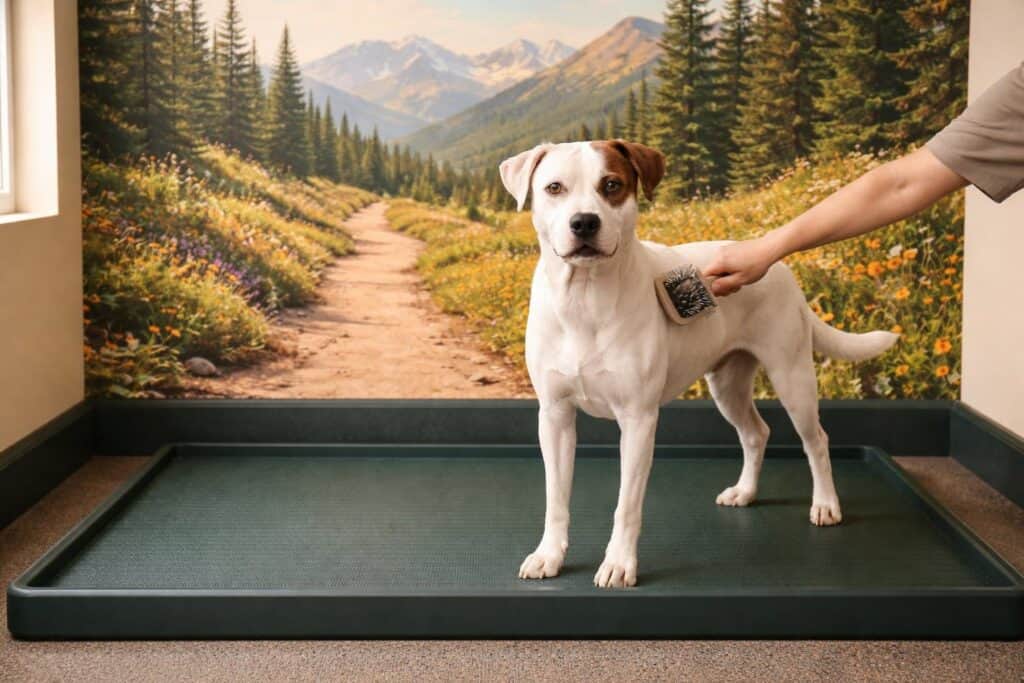
The starting point is a defined floor space with a large rubber mat. A good grooming mat has a non-slip surface that keeps your dog steady, contains the inevitable spread of hair and water, and shakes or wipes clean in minutes. A rubber mat with a raised lip is particularly effective at keeping hair from migrating across the rest of the room. With everything organized and within reach, and your dog on a familiar surface they associate with grooming, the whole process becomes noticeably calmer and quicker for everyone involved.
If you want to go further, a small, elevated grooming table is an upgrade that, depending on the size of your dog, makes everything easier. Folding, height-adjustable designs store flat when not in use. Again, a non-slip surface is essential for your dog’s safety and sense of security.
Storage for grooming supplies should be organized and close at hand, for example in a wall-mounted rack, a small cabinet, or a tiered trolley.
The Aesthetic Layer
This is where you make your dog room yours as much as theirs.
Backdrop
A wall mural or statement wallpaper is the most dramatic single thing you can do to your dog room. A nature scene, a botanical pattern, a breed-specific illustration, or a pattern featuring your dog’s breed in various poses is the more personal option, and one that makes the room feel genuinely bespoke.
Name Signs
Personalized name signs, for example, your dog’s name painted directly on the wall in a complementary color, a custom neon, a wooden letter set, or a ceramic sign above their sleeping spot, give the room an identity and make it unmistakably theirs.
In a multi-dog household, each dog’s name painted (or a handmade sign) over their preferred resting spot adds a layer of personality that makes the room feel genuinely theirs. But don’t be surprised if they still choose to swap spots from time to time.
Photo Gallery
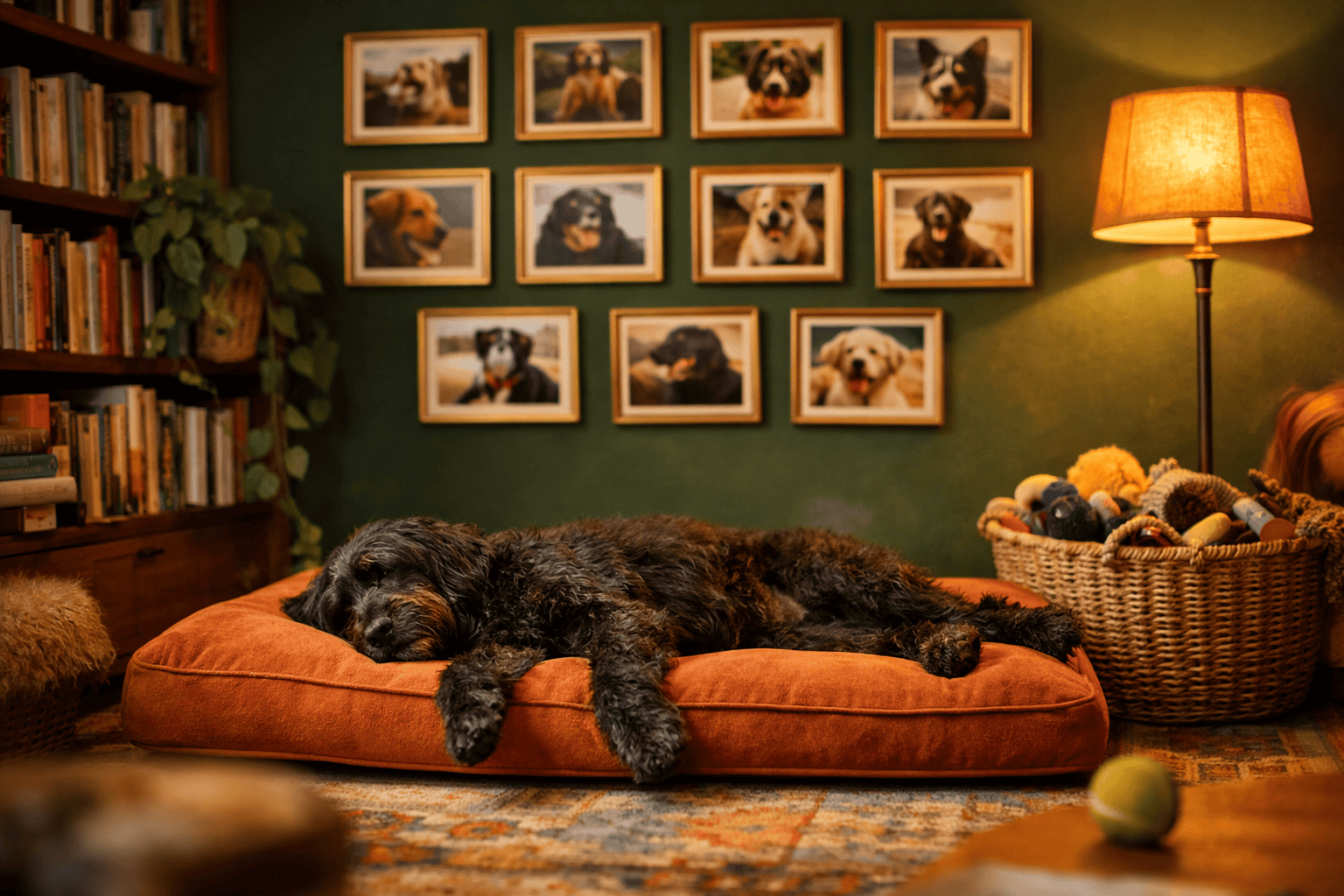
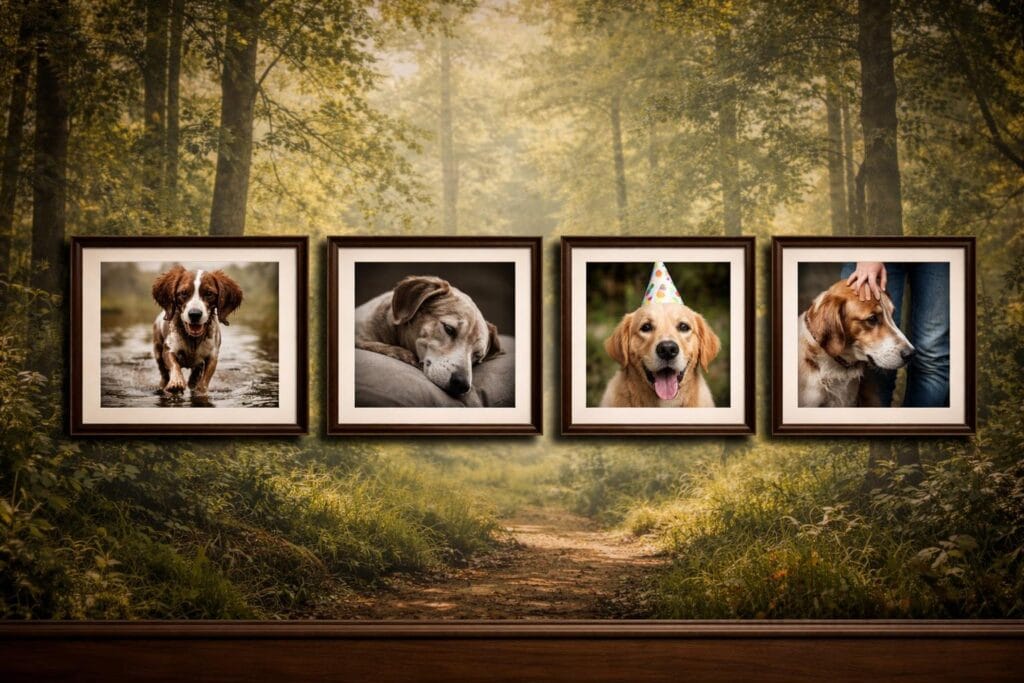
A gallery wall of dog photographs in matching frames is the finishing touch that makes the room feel genuinely loved. Action shots, portraits, sleeping moments, the ridiculous and the sublime — a curated collection in consistent frames at a consistent height along one wall (out of dog reach) turns everyday memories into a cohesive design feature, adding personality and warmth.
Surfaces
For the practical surfaces, easy-clean materials and beautiful finishes do not have to be in conflict. Washable matt emulsion in a rich, considered color paints beautifully and wipes down without losing its quality. Large-format tile or sealed wood flooring cleans quickly and a flat-weave washable rug adds warmth and pattern without the maintenance burden of a pile carpet. Your dog room can look extraordinary and still be easy to live in.
A Sense of Calm
An Adaptil pheromone diffuser plugged in near your dog’s resting area releases a synthetic version of the calming pheromone mother dogs produce for their puppies, and many dogs respond to it with a noticeable settling effect, particularly in the early days of getting used to a new space.
If you want to layer in another calming element, dog-specific music — typically slower tempos, simpler arrangements, and frequencies chosen for canine hearing rather than human enjoyment — has genuine research behind it as a stress reducer. Both work quietly in the background and require almost no effort to maintain.
The Human Touch
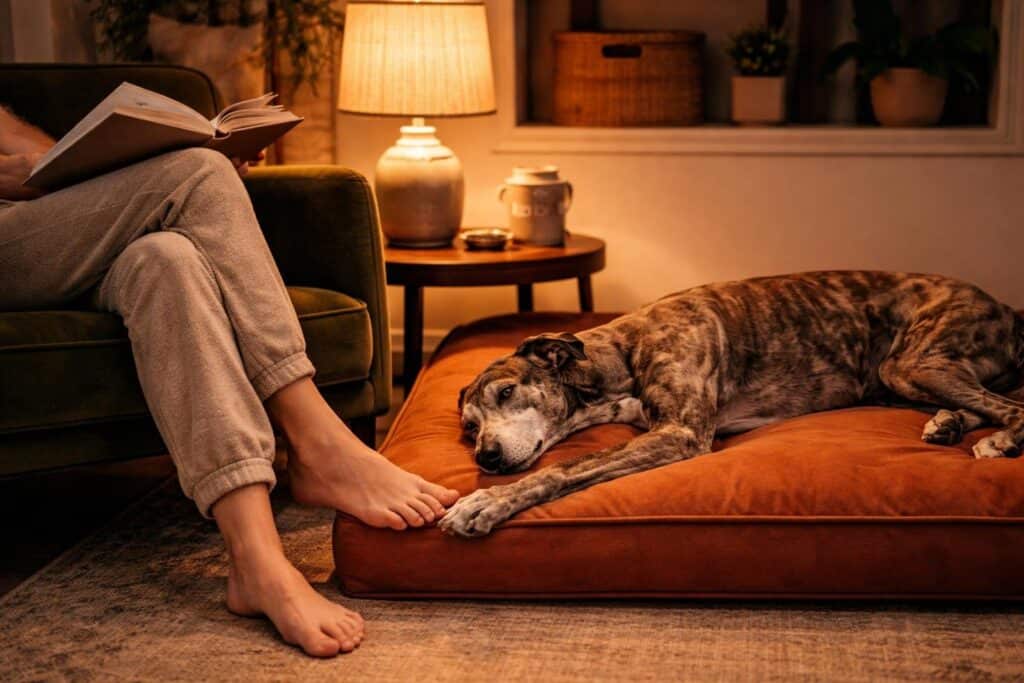
A good chair or a floor cushion large enough to actually sit on comfortably is the human element your dog room needs. A reading chair in a corner, a low-slung armchair near the play zone, a pile of oversized floor cushions beside the sleeping area — any of these gives you a reason to spend time in the room beyond feeding and grooming. Dogs, almost universally, are happiest when their person is with them.
Lighting makes an enormous difference to the feeling of a room, and it’s frequently under considered in pet spaces. Warm-toned bulbs, around 2700 to 3000 Kelvin, create the cozy, inviting quality that makes a room feel genuinely restful rather than functional. A dimmer switch means the room can shift from bright and active during play sessions to warm and low during rest times.
A ceramic treat jar on a handy shelf (too high for your dog to reach, of course) with a good seal keeps treats fresh and accessible, and a basket for the toys that live in the room, finishes the look. Dogs are not known for their tidiness, but good storage helps considerably.
Build It for Them. Enjoy It With Them.
The dog room at its best is not just a space your dog uses. It’s a space that reflects how you feel about them. Dogs can’t read the name sign above their bed or appreciate the coordinated color palette, but they can absolutely feel the calm, the comfort, and the mental stimulation the space provides.
Images in this article are AI-generated for illustrative purposes and inspiration
