

How To Stop Your Dog Chewing His Bed In His Crate (8 Expert Tips)

This post may contain affiliate links, which means we may receive a commission, at zero cost to you, if you make a purchase through a link. Please see our full disclosure for further information.
Does your dog love to chew on his bedding while he’s in his crate?
If so, you’re far from alone.
Many a dog parent struggles with this issue.
Chewing is a natural and necessary behavior for dogs, but when they chew the ‘wrong’ things we tend to think of it as a destructive behavior they need to be trained out of.
In reality, however, all we need to do is provide our pups with a more appropriate outlet for what is an instinctive behavior.
When we do this, we can simply redirect our dogs’ chewing habits to something more suitable, while saving their bedding and helping them feel more relaxed and comfortable in their crate.
It’s a win-win.
How to stop a dog from chewing his bed in his crate
Dogs chew for many reasons, including anxiety, boredom, and stress.
Bearing that in mind, let’s now explore eight tips that can help minimize your dog’s bed chomping.
#1. Teach him to love his crate
I’d start by going back to the beginning and teaching your dog to absolutely love being in his crate.
This way he’ll be more relaxed when he’s in there and less likely to want to chew at his bed.
To crate train your new puppy (or adult dog for that matter), make sure you turn the crate into a veritable Disneyland so your pup won’t be able to resist going in there at every available opportunity.
It’s also important that your pup is only in his crate for the appropriate amount of time.
Here’s dog trainer extraordinaire Kelly Fahey explaining everything you need to know about crate training your pup.
But my dog doesn’t like his crate
True story. When we first adopted our rescue pitbull-Labrador cross Maggie, she didn’t get along with one of our resident dogs, Daisy.
We weren’t as careful as we should have been with the introductions and did things too quickly while failing to completely understand how stressed Maggie was after being dumped in the shelter.
To help us get a handle on the situation, we crated Maggie whenever we weren’t able to supervise the dogs.
Problem was, she hated it. She didn’t want to go in the crate and, once she was in there, would bark and whine and scrabble at the door to get out.
We had to teach her to love it, and fast.
First of all, I ordered one of those big dog play pens and stuck it in the corner of the living room.
It was at least 12 feet square and we had space for a huge bed, her food and water, and room for her to get up and move around.
We then buried a stuffed KONG or LickiMat under her bed and trained her to find it.
In no time at all, she couldn’t wait to get into her crate and would happily lie in it for hours, even when the door was open. “Find it” became the best thing ever!
We called it Maggie’s condo.
It took up a lot of space and wasn’t the most attractive thing to have in your living room, but it made everyone’s life a lot less stressful so who am I to complain?
The things we do for our dogs!

#2. Supervise your dog
I realize this may not always be practical if you crate your dog while you’re at work, or overnight, but as far as is possible, you can minimize the risk of your dog chewing his bed by keeping a close eye on him when he’s in his crate.
If you do have to leave him alone, make sure he has plenty of safe dog toys and chewable distractions like bully sticks or marrow bones to keep him occupied.
You could even try playing some soothing music, use a synthetic dog pheromone product such as an Adaptil Calming Pheromone Collar or an Adaptil Plug-In Diffuser, and give him a treat-dispensing toy to keep him calmer and happily preoccupied while you’re gone.
#3. Provide plenty of physical and mental stimulation
Make sure your pup is getting sufficient exercise for his needs and that he’s receiving a healthy dose of mental stimulation through puzzle toys and brain games.
If he’s chewing his bed because he’s bored, stressed, anxious, or frustrated, keeping his rational brain busy will help inhibit his emotional brain and help him to be more relaxed.
He’ll be in a more positive emotional state all round, which can only help.
You can also create some environmental enrichment to encourage him to engage in his natural instinct for foraging and exploring.
This could be as simple as hiding treats around the house for him to find, or a stuffed Kong under the bed in his crate for him to find.
Remember Maggie’s “Find it!” cue?
It turned going into her condo from being something scary and unpleasant to somewhere hugely desirable she couldn’t wait to get back to.
Sniffing lowers the heart rate and blood pressure in dogs, so if you give your pup a chance to use his sense of smell, he’ll be more relaxed, too.
Be careful not to over-exercise or over-stimulate him though, as then he might have a hard time calming down.
Dogs also need plenty of time to relax and de-stress throughout the day.

#4. Interrupt any bed chewing
When you’re supervising your dog in his crate and see him chewing his bed, interrupt him by calling his name in an upbeat manner.
As soon as he looks your way, reward him with a tasty treat or his favorite toy.
The idea is to stop him in the middle of chewing his bed so you can break the cycle and give him something equally as enticing to chew (and preferably even more enticing).
Behaviors that get rewarded, get repeated (known as Thorndike’s Law of Effect).
#5. Redirect chewing to a more appropriate object
At the same time, you can reinforce your pup for chewing on something more appropriate like a toy or chewy treat.
This means you’ll need to provide him with appropriate alternatives so he still has an outlet for his need to chew.
These could include fun and durable puzzle toys, bully sticks, marrow bones, or other natural chews. Fahey recommends the following options:
- Edibles: Chew bones, pigs’ ears, bully sticks, Greenies, No Hides, etc.
- Non-Edibles: KONG ChiChewy ball, Benebones, Soft Nylabone puppy toys, Ruff Roots, KONG Dotz, etc.
- Dissectible Things: Plush toys, rope toys, Hide-A-Bee (Squirrel, Bird), etc.
- Puzzle Toys: Stuffed KONG, marrowbone, Omega Paw treat balls, Kong Wobbler.
Make sure to consult your veterinarian before giving your dog anything new to chew on, as there may be a risk of choking or injury if the toy is not safe.
Note: You might also want to reduce his food intake slightly, to account for all these extras!
Chew-Proof Dog Bed?
You may also want to consider a “chew-proof” dog bed like the one Bertie is sleeping on in the image below.
There are several available on Amazon but I have had great success with the simple iron frame beds which have nylon mesh as the actual bedding part.
Regardless of what kind of bed your dog has, however, it is still important to change his motivation for chewing his bed and work on making him feel calmer and more relaxed.

#6. Do a preference test to see what he likes to chew
You can experiment with some of the different options in #5 to find out which ones your pup prefers.
Once you have a good idea of which ones he likes, you can make sure he always has one of his favorite choices so he’ll be less likely to want to keep chewing on his bed.
That way he’s being rewarded for NOT chewing his bed. See what I did there?
#7. Consider the location of the crate
If your pup’s crate is in a busy or noisy area of the home, he may find it stressful to be confined in that location.
You could always try moving it to a quieter place and see if he feels more secure. Conversely, some dogs will feel more relaxed if they can see/hear/smell what’s going on.
The goal is always to keep your pup as calm and relaxed as possible, so he’s less likely to resort to bed chewing as an antidote to his negative emotional state.
If your pup’s chewing is really destructive and he’s showing signs of separation anxiety, or he’s trying to break out of his crate, I recommend you get help from an expert*.
#8. Train him to “drop it”
Playing a game of “Drop it” with your pup is a great way to train him how much fun it can be to stop chewing his bed so he can get something else fabulous instead.
Start by giving your pup one of his favorite toys to hold in his mouth.
Present him with something delicious like a piece of chicken, sausage, or cheese (something he really loves but doesn’t get very often.
More than likely he’s going to drop the toy to get the treat.
Repeat this several times and then start adding in your cue, “Drop it!”
Once he’s got it down pat, you can start to play the same game when you see him chewing his bed.
He’s already learned that dropping a coveted item means he’s going to get something even better.
You can now work on transferring the same cue to other scenarios – including if he starts chewing his bed in his crate.
If you prefer a visual, in this video, dog trainer Emily Larlham demonstrates how to train your dog a “drop it” cue.
What NOT to do if your dog is chewing his bed in his crate
If your dog has a chewing habit, there are a few things you should NOT do in an effort to change his behavior.
Don’t Punish The Dog
It’s always best not to scold or physically reprimand your dog if you come home and find he has already chewed up his bed (or anything else for that matter).
Nor is it a good idea to resort to any kind of measure aimed at keeping his mouth forced shut, or muzzling him to prevent him from chewing.
“This is inhumane and will teach your dog nothing,” says the ASPCA.
In any of these scenarios, your dog will not be able to connect his bed chewing behavior with the scary consequence.
Not to mention, you risk making him scared of you.
He may even start behaving aggressively to try to keep you and/or the thing inflicting the punishment away from him.
Even if you see your dog chewing his bed and punish him at that precise moment, it may temporarily stop him but will not change the underlying motivation for his behavior.
He’ll just go back to it again later – probably when you’re not around.
Use Positive Reinforcement Training Methods
You may have seen advice online telling you to use a deterrent spray (or something else with an unpleasant scent) on your dog’s bed to discourage him from chewing it, but again, this doesn’t provide a permanent solution or teach him anything.
Except maybe that he no longer wants to sleep in his nasty-smelling bed.
And it’ll be highly aversive for him to be stuck in a crate with an unpleasant smell he can’t escape from.
So if you really want to prevent your dog from chewing, it’s best to try the proven positive reinforcement methods I’ve outlined here as those will be the most effective in the long-term.
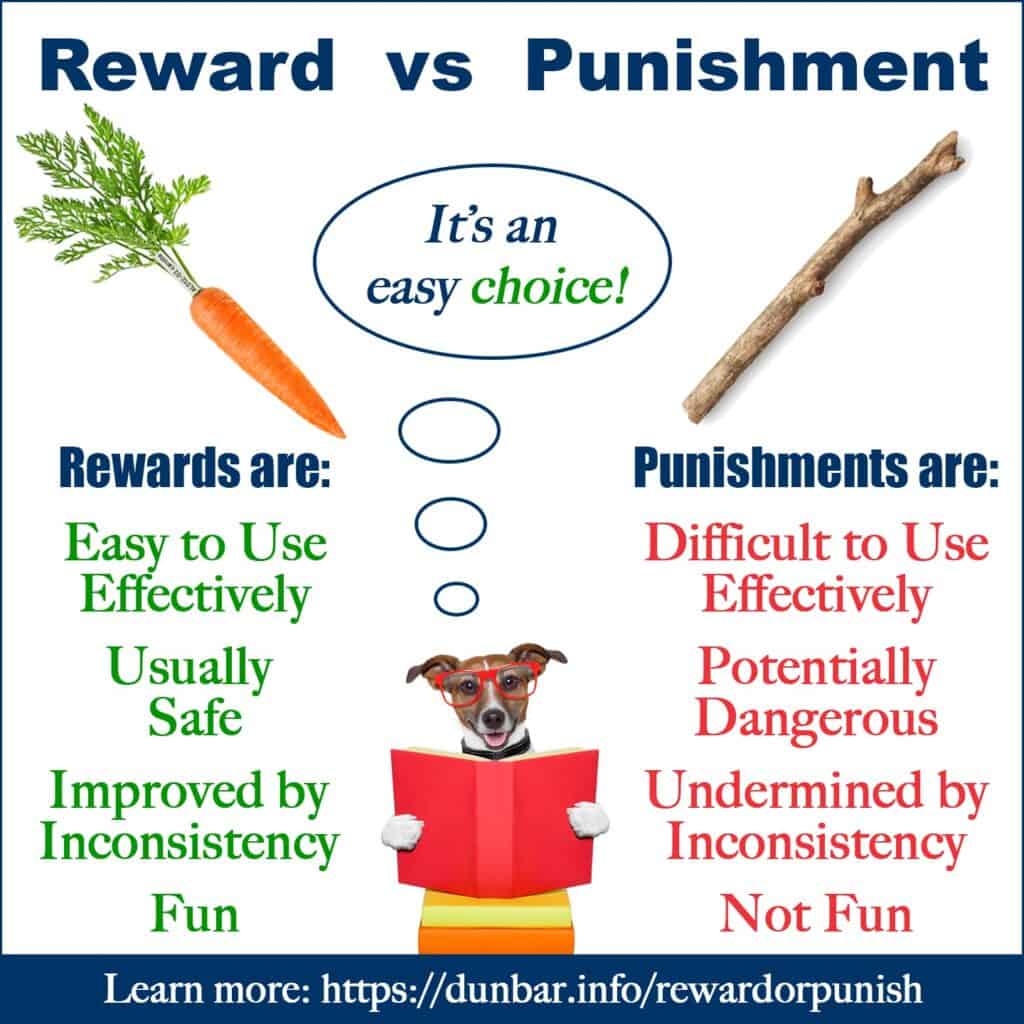
Reward vs. Punishment
This great little graphic from the Dunbar Academy, headed by legendary dog trainer and behavior expert, Ian Dunbar, explains why:
Bottom line to stop your dog from chewing his bed in his crate
The key to changing your dog’s chewing behavior is to work on helping him feel more relaxed, while at the same time teaching him a different behavior.
By doing this, you can be sure you’re meeting your dog’s needs and setting him up for success – without resorting to anything that’s unpleasant or scary.
It’s not always easy, so don’t hesitate to call on a certified positive reinforcement dog trainer if you need more help.
But why does my dog chew his bed?
It’s important to remember that chewing is a natural behavior for dogs.
There are also different reasons that dogs chew, many of which are related to emotional states like boredom or anxiety.
In this article, I’ve discussed actionable steps to help address your dog’s bed chewing habits, but understanding the root cause is crucial.
But you also need to get to the bottom of the possible reasons why he is doing it.
That’s exactly why I wrote this article: 8 Reasons Why Your Dog Is Chewing His Bed.
It’s full of practical insights and actionable steps to address inappropriate chewing behaviors.
Read it now to gain more valuable insights and ensure a contented canine companion!
MORE TO EXPLORE
- 10 Expert Tips To Keep Your Anxious Rescue Dog Calm At Night
- 8 Reasons Why Your Dog Is Chewing His Bed
Separation Anxiety Specialists
*These are my personal recommendations for specialized separation anxiety trainers. Even better, they all do online consults so geography doesn’t matter!
Recommended Products
- Adaptil Calming Pheromone Collar
- Adaptil Diffuser
- Six Panel Dog Play Pen
- LickiMat
- KONG
- Relax My Dog Music
- Through A Dog’s Ear (iCalmPet)
Resources
- Chewing behaviour in dogs – A survey-based exploratory study – Christine Arhant, Rebecca Winkelmann, & Josef Troxler
- Crate Training Basics – Kelly Fahey / Kong Classroom
- Destructive Chewing – ASPCA
- Separation Anxiety in Dogs & Dog Owners in 2021 – CertaPet
- Teach Drop [Video] – Dog Training by KikoPup
- The truth about chewing – Sarah Whitehead
- Tips for crating dogs with separation anxiety – Annie Moore
- Your Puppy Blueprint – Kelly Fahey
NEED A DOG TRAINER OR BEHAVIOR EXPERT?

If you need more help dealing with a training or behavior issue, please find professional help from a force-free dog trainer who can consult with you either in person or remotely.

GOOD PLACES TO START ARE:
- COAPE Association of Pet Behaviourists and Trainers
- Pet Dog Trainers of Europe
- International Companion Animal Network
- Institute of Modern Dog Trainers
- Pet Professional Guild

All dog owners deserve to have successful relationships with their canine companions!
