
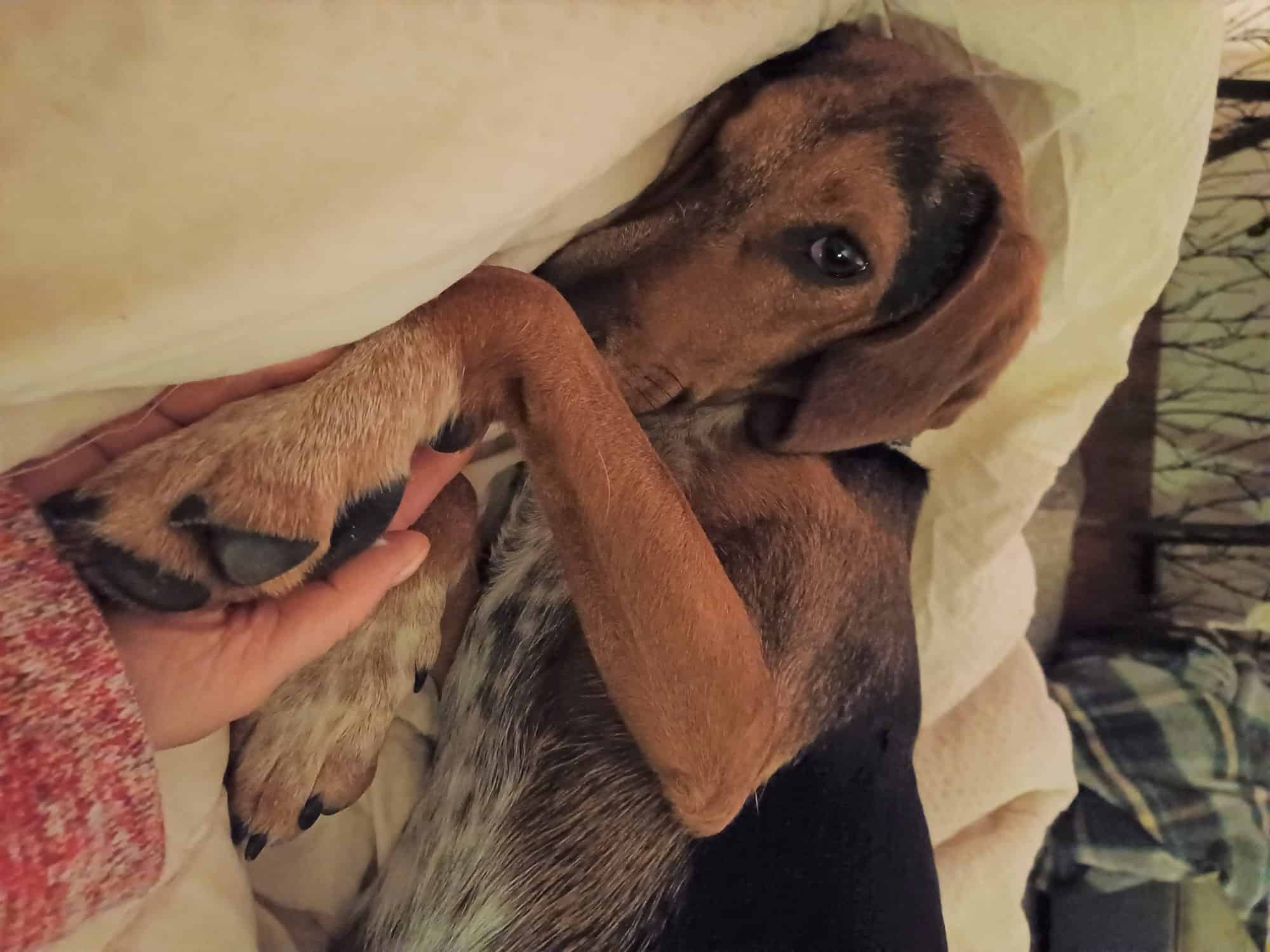
Why Does My Dog Put His Paw On Me? (10 Compelling Reasons)

Quick Answer
When your dog puts his paw on you, he’s trying to tell you something.
But what is he trying to say?
Let’s look at 10 of the most common reasons.
#1. Affection
Dogs use physical contact as a way to show love and affection, just like humans do with hugs and handshakes (note: lots of dogs don’t like hugs!). By placing their paw on you, your pup may simply be asking for some love and attention.
Not all dogs do this though.
Some dogs like to lean against you or rest their head on your legs when you’re sitting down.
Others show their love just by wanting to be close to you or in the same room, even if not touching.
Dog paws contain scent glands so the pawing behavior could also be your dog’s way of rubbing his scent on you.
Our rescued street dog Daisy liked to show her love by licking your face, ears and hair!
And our Romanian rescue dog Roman likes to stick his nose in your, well, crotch and just leave it there while you stroke his head.
So there you go!
#2. Just being friendly
This is similar to affection but is more a sign of friendliness than a declaration of undying love.
If a dog “wants to get close to you or another animal, look for pro-social (aka “friendly”) behavior,” says iSpeakDog.
In these types of situations, in addition to the paw raise, you’ll see your canine companion approaching another dog or person using a range of other behaviors.
These can include loose, often wiggly, body movements, loose facial expressions with relaxed ears, a relaxed mouth, licking (including ears and lips), jumping up to lick the person’s face, “happy” whining, nuzzling, “smiling,” teeth clacking, crouching, pretzeling, the play bow, and/or tail wagging in wide sweeping or circling movements (Miller, 2006; iSpeakDog, 2022).
“These behaviors can often be seen during greetings between dog and owner, or between friendly, compatible dogs,” says renowned dog trainer Pat Miller.

#3. Attention seeking
Another possible reason your dog puts his paw on you is that he’s simply seeking attention.
Of course, it’s also quite likely he’s learned that putting his paw on you will result in being petted or other attention from you. And rewarded behaviors get repeated, so why not do it again and again? It’s positive reinforcement at its finest and a win-win for him.
Our pitbull cross Maggie used to sit in the back seat of the car (with a proper car harness of course) because she loved it so much.
As you were driving along, she’d often reach forward and paw quite insistently at the arm of whoever was in the passenger seat to get a prolonged head scratch.
It worked every time because, really, who could resist?

#4. Appeasement gesture
Dogs use appeasement behaviors as a way of making friendly encounters with other dogs more predictable.
Appeasement gestures are also a dog’s way of trying to avoid conflict and can help them diffuse what might be a hostile encounter. So when dogs show appeasement behaviors, it’s often their way of saying they’re scared and unsure about what’s happening.
In the same way, dogs will often paw at their person or raise their paw as a way to calm a potentially tense or stressful situation, much like when they lick their lips or yawn in response to stress.
Say, for example, you’ve just arrived home and you immediately scold your pup for chewing the shoes that you forgot to put away (which, by the way, she correctly thought was fair game).
You may see your pup raise his paw as a sign of stress and because he doesn’t understand why you, his most trusted person in the world, are annoyed with him (and not because he feels guilty, as is commonly thought).
By raising his paw, he wants you to know he’s not a threat.
#5. Seeking reassurance
Sometimes your dog may put his paw on you to seek reassurance when he’s feeling anxious.
Dogs can get scared or stressed about all sorts of things (e.g. thunderstorms, fireworks, the doorbell ringing, a new pet in the home, being left alone, or a stranger coming to the house).
When we first adopted Maggie, she was still struggling with separation anxiety and would do anything she could think of to stop you from leaving the house.
Part of her strategy was to grab at your clothes or bag with her mouth or, you guessed it, paw at your leg as you were trying to put on your shoes or walk towards the front door.
In these types of contexts, you’ll usually see other signs that you’re dog is anxious, such as panting, low tail carriage, pulled back or flat ears, tight facial muscles, a tongue flick, looking away, yawning, or licking the lips.
If your dog is showing signs of anxiety, the best thing to do is provide reassurance by petting him, trying to engage him in a game, giving him a stuffed Kong or LickiMat to provide some mental stimulation (engaging in a brain game will inhibit emotional arousal and make him feel more calm and relaxed), or simply just keeping him company.
The power of touch should never be underestimated either. The so-called love hormone, oxytocin, is released in the brain in response to sensory stimulation, including during positive interactions between humans and animals, and “contributes to everyday well-being and ability to handle stress.” (Uvnäs-Moberg et al., 2015).
Plus, paired with some soft eye contact, the release of oxytocin helps cement that special bond between dogs and dog parents, just as it does with babies and their human parents.

#6. To provide comfort
Dogs are experts at reading human moods and emotions.
Sometimes, if you’re feeling sad or depressed, anxious or stressed, or you’re just not feeling well, you may have experienced your pup putting his paw on you as a way to provide comfort.
But how does he know? Apart from your more low-key body language, research has shown that dogs can smell “the volatile organic compounds emanating from breath and/or sweat” when their human is stressed (Wilson et al., 2022).
Maggie was a great one for this and would be right there to put her paw on me whenever something was wrong.
It was as if she was saying, “It’s okay, I’m here.” And after a few minutes of providing comfort, she’d be like, “Come on then, that’s enough of that. Let’s go for a walk!”
Which of course always made me feel better. Dogs are clever like that.
#7. To create distance
When your dog puts his paw on you it can sometimes be a pushing type of behavior. In other words, he may be attempting to push you away to create space for himself.
I’ve usually found this to happen when one of our dogs is trying to have a nap and wants to take over the entire sofa in their quest for a cozy sleeping position.
This isn’t a sign of dominance by the way – I’ll get to that later.
#8. He wants something
As we’ve already discussed, your dog has most likely learned that pawing at you is a surefire way of getting your attention.
So what better way to use the same behavior to engage with you in some capacity?
With a quick tap of the paw he can let you know he’s hungry, wants to play, wants to go outside for a bathroom break, or even to show you something.
All you have to do is figure out which one it is!
Sometimes you may just have something your dog wants, like a treat in your hand and he’ll paw at it to try to get it.
And we’ve all heard the stories about dogs who wouldn’t leave their owners alone and kept pawing at them, barking, or running off then quickly coming back again.
Why? Often because the house is on fire, or someone’s lying in a nearby ditch and needs urgent help.
We should always pay attention to what our dogs are trying to tell us.
So next time your pup puts his paw on you, try and observe the context and look out for any other accompanying dog body language or behavior to determine what he may be trying to communicate.

#9. Learned behavior
A paw lift or “handshake” can be “a lovely behavior to put on cue and turn into a series of fun and useful behaviors,” says Pat Miller, adding that a “paw lift on cue can become ‘shake,’ ‘wave,’ ‘high five,’ and ‘salute,’ and pawing motions can be useful for turning appliances on and off, indicating found objects for dogs doing scent and search work, pushing a ball (canine soccer!), and playing an electronic keyboard.”
I don’t know about playing the piano but our rescued Dubai street dog Daisy absolutely loved giving me a high five, one with each paw. She’d happily do that for several minutes at a time.

#10. Pointing
It’s worth noting that certain dog breeds, notably the pointing breeds, such as English setters, German short-haired pointers, Vizslas, and Weimaraners (and plenty of mixed breeds too) will often raise a paw to indicate they’ve picked up a scent and to “point” in the direction they smell prey (Gewirtz, 2019).
Dog communication signals
Looking at the rest of your dog to gauge his overall body language is important for understanding his behavior in any context or situation.
For example, if your pup is relaxed and wiggly, putting his paw on you could be a playful solicitation. However, if your dog’s body language is stiff or tense, it might be a sign of discomfort or anxiety.
“There are many reasons a dog may put his paw on you,” explains Angelica Steinker, accredited dog trainer and behavior consultant and founder/owner of the Courteous Canine Inc., in Lutz, Florida.
“It could be a trained behavior or could be that your dog is attempting to comfort you. It is also possible your dog is attempting to solicit play.”
That’s a pretty wide range, so let’s break it down and look more closely at nine possible reasons for this common dog behavior.
Why does my dog paw me when I stop petting him?
Dogs use pawing as a way to get attention or to elicit a response from their owner, so what better way to get you to keep petting him?
When your dog does this it means he’s not done yet and still wants your attention and affection.
We often talk about consent tests in our interactions with dogs. Essentially this means learning how to understand your dog’s body language and signals so you know when he’s saying “yes” or “no” in any given situation.
If your dog’s leaning into you, pawing at you, and trying to solicit your immediate attention, you can be sure in this context he’s giving you a very definite “affirmative.”
So go right ahead! He might change his mind though, so it’s always good to be aware of when it’s time to stop.
Going back to our car rides, the lovely Maggie would often paw at the unsuspecting person in the passenger seat (to be fair, this was usually me) if they dared to stop scratching her head.
I always went right along with it – because it was just too adorable not to.
I’d do anything to have Maggie back and be able to scratch her head one more time, but if your dog’s continual pawing gets to be too much and he just won’t stop, then you can just train him to do something else instead.
This could be to sit or lie down for a treat. Or just give him a chew toy to distract him.
Do dogs pick a favorite person?
There’s currently no scientific consensus on whether dogs have a “favorite person,” but many experts believe that dogs develop strong attachments to certain humans and may even prefer some people over others.
In my experience, some of our dogs have preferred me, some of them my other half, and some of them have been quite egalitarian in their devotion.
Why does my dog put his paw on me when he sleeps?
Dogs often put their paws on their owners when they’re sleeping as a way to feel secure and comfortable. It’s a show of trust and affection.
It also means they know if you move away. Sometimes they don’t want to be left alone, or just want to know where you are.
Is it a sign of dominance when my dog puts his paw on me?
Sometimes pet parents think their dogs use this pawing behavior as a way to “assert their dominance” in some sort of inappropriate pack hierarchy.
However, this is outdated thinking and modern canine behavior experts have completely rejected it.
“When people misunderstand what ‘dominance’ means, they will attribute certain behaviors to the dog ‘wanting to be dominant’ rather than the dog just being a dog,” explain Ha and Campion.
In reality, your dog’s pawing behavior is just a way for him to communicate with you. It’s not about power or control.
Dogs are dogs and they do dog things. That’s pretty mich all theres is to it.
READ NEXT
Resources
- Dog Behavior: Modern Science and Our Canine Companions – James C. Ha and Tracy L. Campion
- Dogs can discriminate between human baseline and psychological stress condition odours – Clara Wilson, Kerry Campbell, Zachary Petzel, and Catherine Reeve
- Pro-Social Behavior – iSpeakDog
- Self-soothing behaviors with particular reference to oxytocin release induced by non-noxious sensory stimulation – Kerstin Uvnäs-Moberg, Linda Handlin, and Maria Petersson
- Understanding Dog Appeasement Signals – Pat Miller
- Why Does My Dog Put His Paw On Me? – Elaine Waldorf Gewirtz
- Why Does My Dog Raise a Paw and Point? – Elaine Waldorf Gewirtz
