
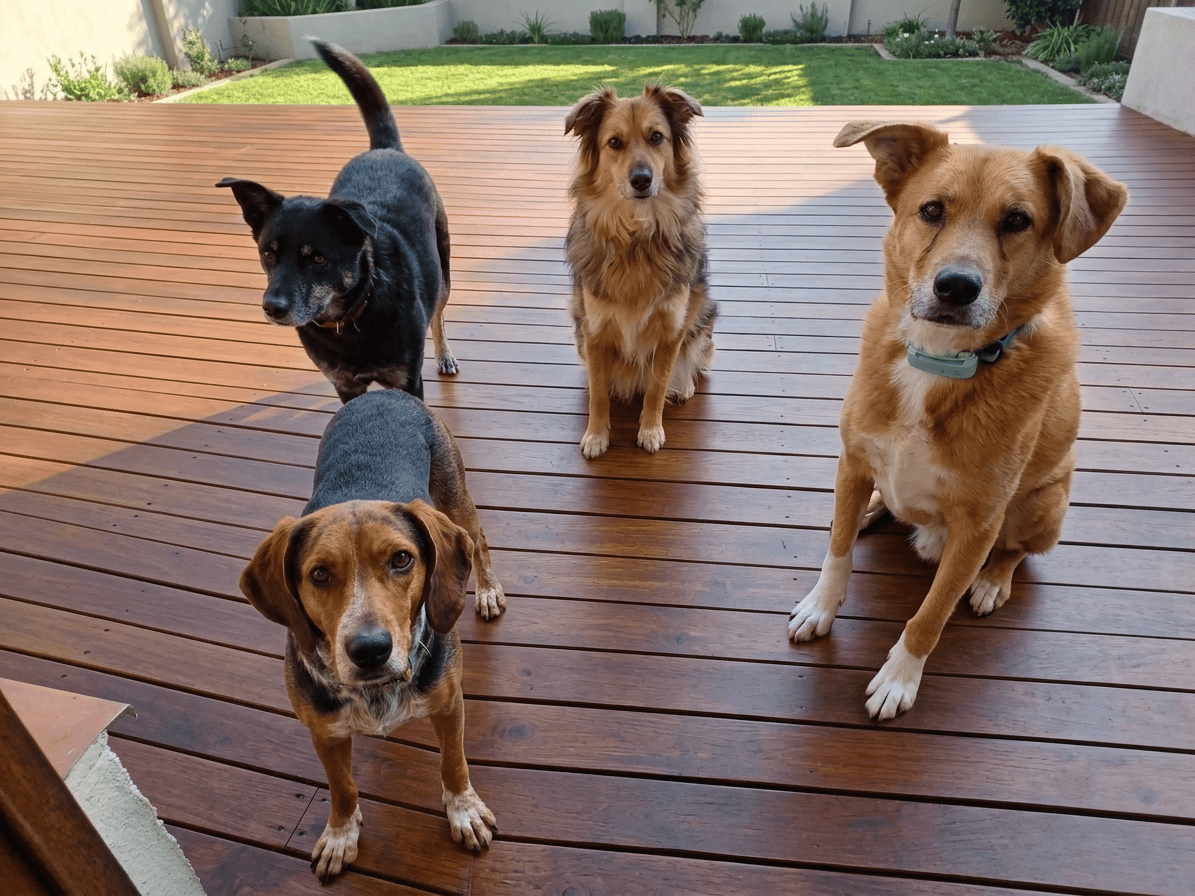
Four Dogs, One House, No Drama: Here’s What Makes It Work

I’m the first to admit, four dogs is a lot. And none of them arrived with simple backstories.
Roman, our big tan-colored boy, spent his first years being starved and mistreated in his original home before landing in a foster home and eventually finding his way to us. He’s one of the most sensitive dogs I’ve ever known but he still watches his food bowl carefully if another dog wanders too close, and probably always will.
Esme, our small but mighty Greek rescue, arrived as a whirlwind of energy and has fully embraced her role as the household’s most enthusiastic eater. Given the chance, she can inhale her food in seconds.
Woolly boy Lennox is our gentle soul, the one who likes to take his time over everything and gets extremely anxious when it rains or thunders.
And Kaia, the newcomer, who slotted in with the others far better than we dared hope. Except when she hears another dog in the neighborhood, at which point she can get a bit barky until the threat has passed.
Four dogs. Four completely different histories, quirks, and needs. One house that somehow has to work for all of them simultaneously.
The Two Things That Actually Keep the Peace
People often assume a household like ours runs on luck, or that it helps to have dogs who just happen to get along. But that’s only part of the story. The dogs who live together without drama usually do so because someone has made sure the right conditions are in place.
Here’s what that looks like in practice:
- Resources: The physical foundation, including enough feeding stations, sleeping spots, toys, water bowls, and separate spaces that no dog ever has to compete or feel crowded
- Routine: The daily framework that maintains that foundation, keeps everyone’s needs met, and catches the earliest signs of tension or stress before they become bigger problems
Before the routine: getting the resources right
In a multi-dog household, the physical setup of the home matters a lot. Dogs don’t need to be fighting over something for competition to create tension. Sometimes, the anticipation of competition is enough. A dog who has learned that their resources might run out, or might be taken away, is a dog operating with a low-level background stress that affects everything else.
The resource setup we use is straightforward but important.
Feeding stations
One per dog, well-spaced, in clearly separate areas. Roman eats on the deck. Everyone else has their own defined spot inside. No dog should be able to monitor another dog’s bowl while eating from their own.
Water
Multiple bowls in different locations around the house and yard, refreshed daily. Not one communal bowl that everyone crowds around.
Sleeping spots
More options than dogs. Each dog has at least one spot they consider primarily theirs, and there are enough alternatives that nobody ever has to displace anyone else to find somewhere to rest.
Separate spaces
This is especially important in a multi-dog household. Dogs need the option of solitude, and without it the social pressure of constant proximity builds up in ways that are easy to miss until something tips over.
Chews and food puzzle toys
We give these separately, always. A chew or puzzle toy is a high-value resource, and a high-value resource in a group setting is a flashpoint waiting to happen. Each dog gets theirs in their own space, where no one can bother anyone else.

The daily routine
The routine itself fairly straightforward.
Morning: Let them out for their morning bathroom break and a sniff around the yard. Then it’s time for breakfast with each dog at their own station. They all eat out of slow feeder bowls to give them a little mental challenge and to slow them down. We pick up the bowls come the moment everyone has finished.
Mid-morning: Chew toy treat and a sniffing game in the yard.
Afternoon: Quiet time. The calmer middle part of the day.
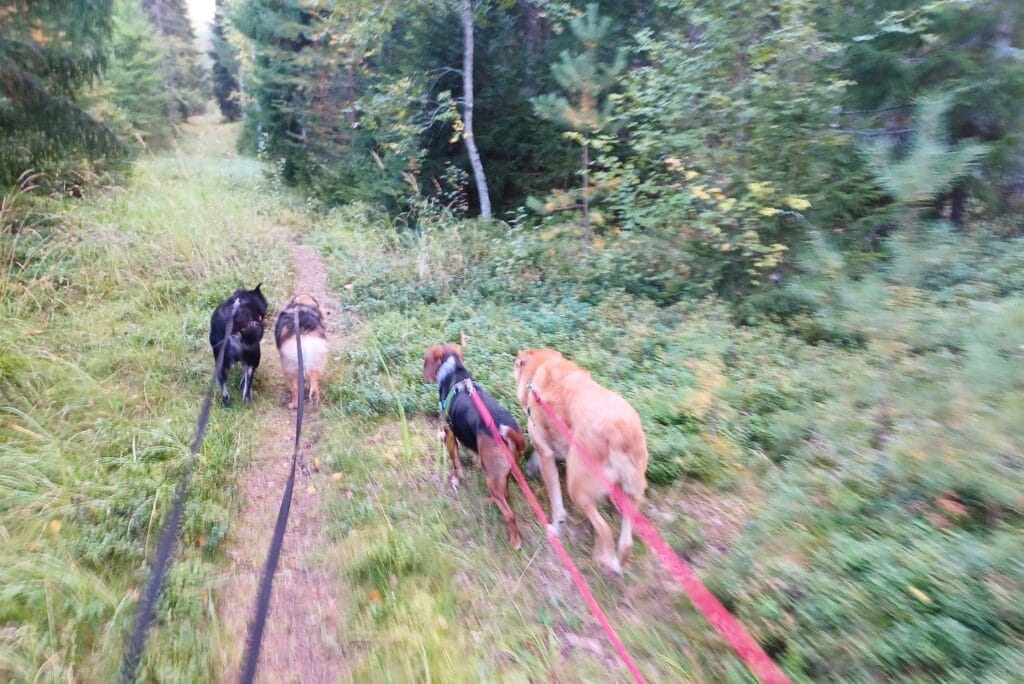
Evening: A long walk in the forest on long lines, followed by dinner when we get back home. More pottering around in the yard until each dog decides for themselves they’re ready to settle for the night, and where.
For us, a routine that’s too complicated to maintain consistently can quickly become stressful. What matters is that the same things happen every day, in roughly the same order, so the dogs always know what’s coming next. This is a powerful stress buster and helps them stay more relaxed overall.
Walks: making them count
With four dogs, it’s just not practical for us to take them on solo walks, so in winter, we walk them in pairs and switch them around for variety. The only pair I won’t walk together are Esme and Lennox as they tend to wind each other up if they see another dog.
In the spring, summer and fall, we drive them up to our local forest and walk them all together. As already mentioned, we walk the dogs on long lines to give each of them the freedom to range, sniff, and follow their nose without the risk of anyone disappearing into the trees chasing after a deer. A dog who gets to make their own choices on a walk, like which direction, what to investigate, and how long to spend on something interesting, is going to be a noticeably calmer, more confident dog at home.
On our winter street walks, we don’t rush them. If Lennox wants to spend four minutes sniffing a lamppost, we spend four minutes sniffing a lamppost. If Roman wants to go left and not right, then we go left. The walk doesn’t need to cover ground. It needs to be useful to the dog.
Play: what works for our four
Our dogs are not particularly toy-motivated, which is fine. Play looks different for every dog, and the goal is finding what genuinely engages each one rather than trying to impose a format that doesn’t fit.
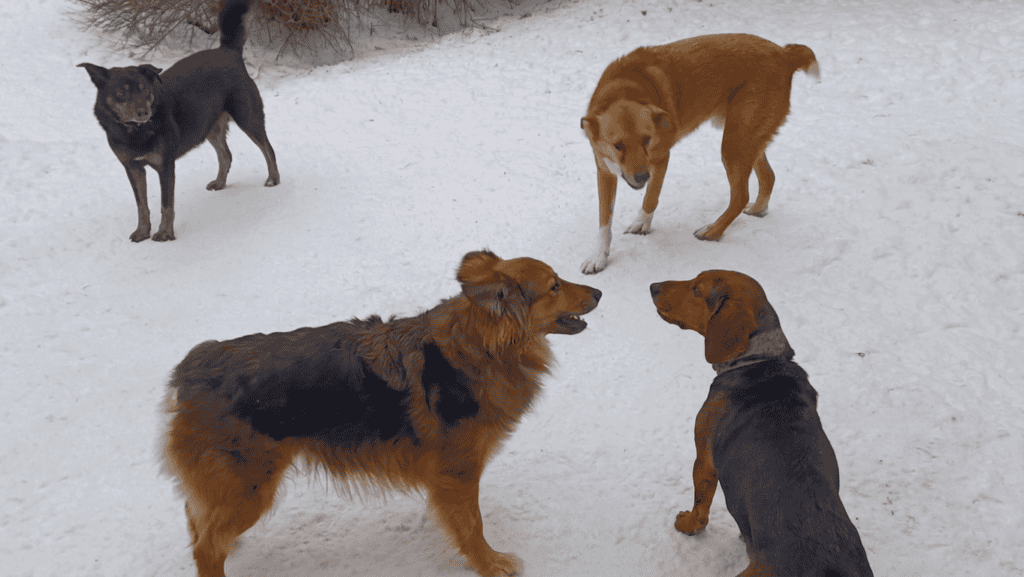
What our four dogs love most is running and chasing each other in the yard. We let them dictate the pace and duration, although if things look like they might get a little heated I’ll step in so they have a quick break to reset. They’ll also chase a ball occasionally, but chasing each other and wrestling is their go-to.
Play does something beyond the physical too. It actively shifts a dog’s emotional state from negative to positive. A dog who has just played is a dog whose stress hormones have dropped and whose brain has had a workout. Play is a great counter against negative emotions like fear and anxiety, and can work as a powerful mood booster too. In a multi-dog household, that post-play calm has a ripple effect on the whole group dynamic.
Mental enrichment: a key part of the puzzle
Physical exercise matters, but a dog whose brain hasn’t been engaged is not a tired dog; they’re a frustrated one. Mental enrichment is what closes that gap.
When dogs are given opportunities to problem-solve, sniff, search, and make their own choices, they use their thinking brain rather than their emotional one. And a dog operating from their thinking brain is calmer, less reactive, and significantly easier to live with than one running on frustration or pent-up energy.
We use four things consistently:
Frozen KONGs: Stuffed with food and frozen the night before, a KONG provides extended engagement that’s especially useful before we leave the house. The dogs are so focused on working out the contents that our departure barely registers.
Lick mats: Licking is a naturally calming behavior for dogs. It releases endorphins and has a direct soothing effect on the nervous system. Spreading wet food, yoghurt, cream cheese, or dog-safe peanut butter* on a lick mat gives dogs a quiet, focused activity that brings their arousal level down.
*Always make sure your peanut butter is xylitol-free; xylitol is highly toxic for dogs
Snuffle mats and slow feeders: Both tap into a dog’s most powerful sense, smell, and make mealtimes or treat times an active, engaging experience rather than a passive one.
Scatter feeding and find-it games: Scattering food in the yard and asking the dogs to “find it” is one of the simplest and most effective enrichment activities there is. Sniffing has a direct calming effect on the nervous system because it lowers pulse rate and brings dogs back to baseline in a way that physical exercise alone doesn’t always achieve.

What the routine is really for
A daily routine like this one isn’t about control. It’s about knowing your dogs well enough to notice when something is off, and having a framework consistent enough that any deviation from normal is visible.
The routine is how I read them and how I stay ahead of problems rather than responding to them after they’ve developed into something harder to address.
This article draws on the experiences documented in other articles on my site, including:
- Managing Dog Energy in a Multi-Dog Home: 10 Tips That Really Work
- Feeding Time Hacks Every Multi-Dog Parent Needs to Know
- Why Individual Attention Matters in Multi-Dog Homes
For the cat version of this daily routine, see I Live With Five Cats. Here’s How I Keep the Peace
