

Your Cat Doesn’t Care That Your New Dog Is “Good With Cats”

Introducing a new dog to your resident cats? There’s a moment that happens in a lot of multi-pet households, usually sometime in the first week after a new dog arrives, where the resident cats have collectively retreated to the highest point in the house and are staring down at the newcomer with an expression that says, quite clearly, that nobody asked them about any of this.
They’re right, of course. Nobody did.
Your cats were there first. They know every inch of that territory. They have their routines, their preferred spots, and their established sense of how the household works. And now there is a dog in it.
How you handle the next few days (and weeks) will determine whether your cats eventually accept the new arrival, tolerate them under duress, or spend the next several years conducting a cold war from the top of the wardrobe.
I’ve introduced newly adopted rescue dogs to multiple resident cats more times than I can count. Here’s how I do it.
Before the dog arrives: set your cats up to win
The single most useful thing you can do for your cats is prepare the environment before your new dog comes home. What this means in practice is making sure your cats have access to spaces the dog cannot reach, and that those spaces have everything they need. Food, water, a litter box, sleeping spots, scratch posts, and toys. If your cats need to pass through dog territory to get to any of these things, there may be a problem before the dog has even walked through the door.
When I’m introducing a new dog, I start by using dog gates that have a small cat door at the bottom. This means the cats can move freely but the dogs cannot follow. It sounds simple, but it makes an enormous difference to how confident and relaxed the cats remain during the adjustment period. They never feel trapped because they always have an exit.
Vertical space matters too. Cat trees, high shelves, elevated perches — anywhere your cats can observe the new dog from a safe height. A cat who can watch from above is a cat who feels in control of their environment and therefore, less stressed. A cat who is cornered at floor level, however, is a cat who may well become aggressive out of self-defense.
Check all of this before the dog arrives. Once your new dog is home, you’ll likely have your hands full.
The first day: keep everyone separated
When your new dog comes home, your cats should not be in the same space.
This may feel counterintuitive. You want everyone to meet. You want to see how they get along. But on day one, your new dog is overwhelmed by all the new scents, new sounds, new people, and the new environment. They don’t yet know if they are safe. And your cats are suddenly aware that something large and unfamiliar has entered their territory, because they can smell it, even through a closed door.
Let both sides decompress separately. Your new dog needs time to settle into their safe space. Your cats need time to register the new smell without a face-to-face encounter that neither party is ready for.
Keep your own energy calm and matter-of-fact. Cats read our emotional state with remarkable accuracy, and anxious behavior communicates that there is, in fact, something to be worried about.
Scent before sight
Once your new dog has had a day or two to start settling in, you can begin scent swapping. This is where the real introduction work starts.
Take a blanket or soft toy your dog has been sleeping on and place it in the cats’ space. Let them investigate it in their own time, with no pressure and no audience. You’re looking for a calm, curious response, like a sniff, maybe some chin rubbing or cheek marking if they’re feeling bold. What you don’t want to see is sustained hissing, fluffed-up tail, or a cat who refuses to go near the item at all.
Do the same in the other direction. Place something that smells of the cats in the dog’s space and watch their response. A dog who fixates obsessively on the scent item, won’t leave it alone, or becomes highly aroused by it is telling you something important about how they’re likely to respond to the actual cat. A dog who sniffs with mild interest and then moves on is giving you a much more promising signal.
Pair these scent exposures with high-value food on both sides. Every time your cat investigates the dog’s scent item calmly, something delicious happens. Every time your dog sniffs the cat’s item calmly, something delicious happens. You are starting to build an association: the smell of that animal predicts good things.
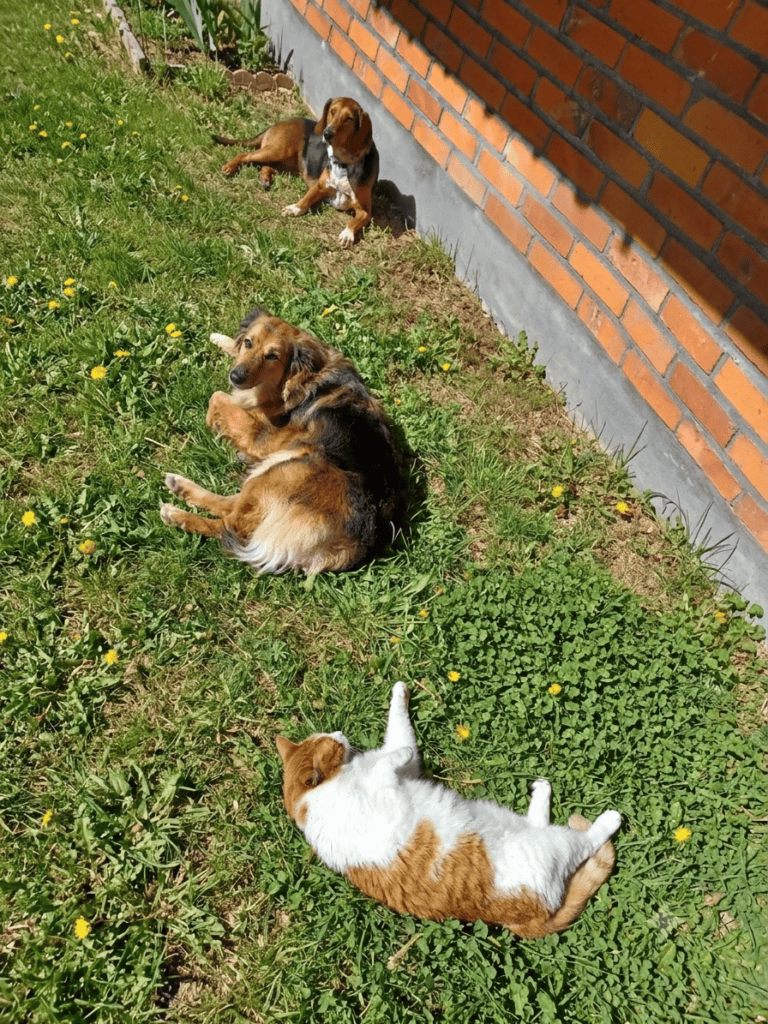
Kasper is one of our five current rescue cats. When we adopted him, he was extremely wary of our big dog Roman. Our other three dogs ignored him so were not an issue. But Roman’s coloring is similar to that of a fox, and tiny orphan kitten Kasper had survived a nasty fox attack on a golf course before he was rescued. That, paired with Roman’s large size, was intimidating for him and it took more time than the others for them to become friends.
Sight before contact
When both animals are showing calm responses to each other’s scent, you can move to visual introductions through a barrier.
A dog gate works well for this, or even a door opened just a crack. The point is that both animals can see each other without any possibility of physical contact. Best to have your dog on a harness and leash for safety. Keep the sessions brief, even just a few seconds to start with, gradually extending as both animals remain relaxed.
Watch the body language on both sides.
On the cat side: ears forward or in a natural position, body relaxed, tail in a neutral or upright position, and slow blinking are all positive signs. Flattened ears, puffed tail, crouching, hissing, or sustained staring at the dog are all signs of stress and you’ve moved too fast.
On the dog side: loose body, mild curiosity, able to look away from the cat and redirect their attention are all good. Intense staring, whining, lunging toward the barrier, or an inability to settle are not so good, and again, things have progressed too soon, before your dog is ready.
Watch your dog closely during these early gate sessions. A dog who can glance at the cat, take a treat, and look back at you is a dog who is coping well. A dog who locks onto the cat and stays locked on, and who can’t be tempted away by food or called back to you, is telling you they need more time at this stage before you move forward.
When we adopted Esme, our Greek rescue dog, she had lived with cats in her foster home and had been described as “cat-friendly.” What that actually meant, we discovered, was that she didn’t actively harm cats, but she did want to “play” with them. This meant chasing them, especially if they ran away from her. The gate period with Esme was longer than with some of our other dogs. We spent weeks doing short, calm, food-rewarded sessions at the gate before we were confident she could be in the same space as the cats without trying to chase them.
The first shared space
When both animals are consistently relaxed during visual introductions, in other words, when your cat is willing to come close to the gate voluntarily and your dog can be present without fixating, you can begin supervised shared time.
Again, keep your dog on a leash for the first few shared sessions. Not because you expect anything to go wrong, but because a leash allows you to manage your dog’s movements calmly and quietly without any sudden intervention that might startle either animal. It also prevents your dog from following your cat if the cat chooses to leave.
And the cat must always be able to leave. This is non-negotiable. If your cat wants to exit the room, they exit the room. No blocking, no herding them back, no encouraging them to “stay and get used to it.” Every time a cat is able to retreat when they choose to, you are reinforcing that they have control over their environment and what happens to them, and a cat who feels in control is a cat who is less likely to feel the need to be defensive.
Again, keep sessions short. A few good seconds are far better than a few minutes where everyone is starting to get stressed. Always end your sessions while both animals are still calm. The goal of these first sessions is not for them to interact; it’s simply for them to be in the same space without incident.

What the cats are watching for
This is something worth mentioning, because it can change how you interpret the early interactions.
Your cats are not only reacting to what the dog does. They are also reacting to what the dog might do. The anticipation of threat is, in many ways, more stressful than the threat itself, which is why a dog who simply stares at a cat, without moving, can cause as much anxiety as one who chases.
What cats need to learn, through repeated exposure, is that this particular dog is predictable, that they behave in consistent, readable ways, and that nothing bad follows from their presence. This can take time and may involve many calm, unremarkable encounters. It cannot be rushed by engineering a single positive interaction and hoping it sticks.
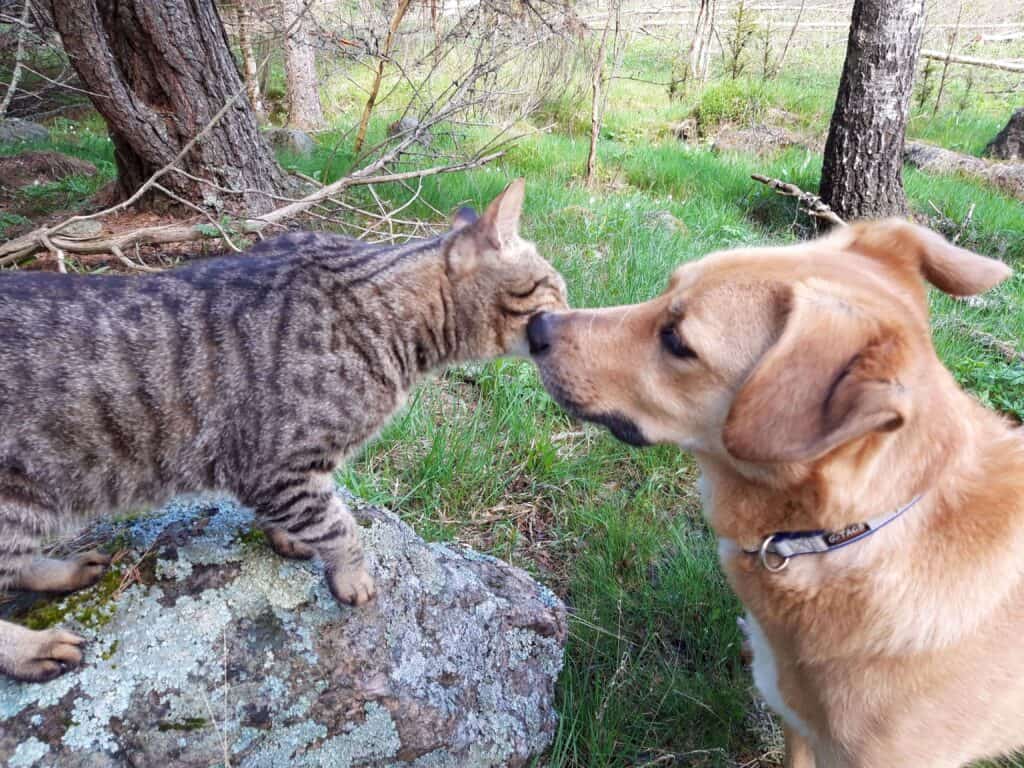
Roman and another of our cats, Oakley, eventually developed one of those wonderful cross-species friendships. They play chase games in the yard and walk around together. But that relationship took months to build, and it was built on a foundation of multiple encounters where nothing happened at all.
When it’s not going well
If your cat is consistently showing high levels of stress, like hiding more than usual, not eating, not using the litter box, sustained aggression toward the dog, or decreased activity levels, take it as a signal to go back a step (or more). That means more separation, more scent work, and slower visual introductions.
If your dog is showing predatory behavior toward the cats – not just excitement or curiosity, but a fixed stare, a low body posture, and intense tracking of the cat’s movements, that is a different situation that may warrant professional input. Not all dogs can live safely with cats, and recognizing that early is kinder to everyone than persisting with introductions that are causing sustained distress.
But in many cases, with time and a structured approach, cats and dogs can find a way to share a household. Some will become friends. Most will reach a comfortable tolerance. A few will maintain a polite distance for the rest of their lives.
All of those outcomes are fine. The goal is not a Hollywood friendship. It is two animals who can live in the same space without either of them being stressed about it. It’s a completely achievable goal. It just takes longer than people often expect.
Quick reference: Introducing a new dog to resident cats
Before the dog arrives: Dog-free zones established. Vertical space available. Cat resources accessible without crossing dog territory.
Day 1: Full separation. Both animals decompress separately. No introductions.
Days 2-7: Scent swapping. Calm responses rewarded with high-value food on both sides.
When scent responses are calm: Visual introductions through a barrier. Brief, positive, food-rewarded. Watch body language closely.
When visual introductions are calm: Supervised shared time. Dog on leash. Cat always able to exit. Short sessions, always ending while calm.
Throughout: Go at the slowest animal’s pace. Any sign of sustained stress means going back a step.
This article draws on the experiences documented in the following articles on my site:
- Are Rescue Dogs Good With Cats? Introducing Your New Dog
- Cat Aggression Towards Dog? 8 Proven Steps to Stop It
- How Well Can Cats and Dogs Really Communicate?
- Cat Meets Dog: 5 Truths Behind That Adorable Rubbing Behavior
For the dog owner’s perspective on this introduction, see How I Introduced a Rescue Cat to Four Dogs (Without Anyone Getting Hurt)
