

Cat Meets Dog: 5 Truths Behind That Adorable Rubbing Behavior

The first time our sweet cat Finlay rubbed around our amenable dog Bertie’s legs, the look on Bertie’s face was priceless.
He stood there like a statue, wondering what on earth this strange behavior was.
So what exactly was happening?
5 Reasons Cats Rub Against Dogs
#1. Marking Territory
Cats have scent glands on various parts of their body, including their cheeks, chin, forehead, tail base, and paws.
These glands are most concentrated in areas where cats tend to rub, each producing a slightly different scent to create complex olfactory messages.
When your cat rubs against your dog, she’s marking him as part of her territory by depositing her scent via chemical signals known as pheromones.
Pheromones work to help cats establish territorial boundaries, create security, and identify family members.
By rubbing against your dog, your cat is essentially saying, “You belong here with me,” treating him as part of her family group.
Cats don’t limit this to dogs either.
They often mark their human family members in the same way, especially when you return home (or it’s feeding time!).

#2. Social Bonding
When cats rub against other cats, it’s known as “bunting” or “allorubbing” and it’s a key part of feline social interaction.
It’s often reserved for those a cat considers part of her inner circle, so when your cat rubs against your dog, it’s a sign of friendliness and social acceptance.
Over time, the exchange of scents makes the dog smell more familiar to the cat, leading to even more relaxed interactions.
And because your cat starts to see your dog as part of her family or territory, it can create a more harmonious environment – especially in multi-pet households where it can help reduce tension.
#3. Affection Through Physical Contact
As well as a bonding behavior, rubbing can be a sign of affection.
Signs of cat-to-dog affection include head butting, rubbing along the dog’s side, and curling up next to the dog.
These actions not only help build trust but also contribute to that shared “family scent.”
#4. Seeking Attention
Sometimes, cats use allorubbing to get a dog’s attention, possibly to initiate play or simply interact with their canine companion.
This can be especially true if the two have developed a close bond over time, with your cat seeing your dog as a potential playmate or source of entertainment.
#5. Gathering Information
With about 200 million odor-sensitive cells in their noses (compared to a human’s 5 million), cats rely heavily on their keen olfactory ability to perceive and interact with their world.
For this reason, when your cat rubs against your dog, it’s a good way to collect information about where he’s been, as well as detect any new scents and learn about his current status (in terms of mood, health, etc.).
This scent exchange helps your cat stay “up-to-date” about her surroundings and the other animals in the household.

Do Dogs Understand Why Cats Rub Against Them?
Because dogs and cats communicate differently, your dog may not fully grasp your cat’s rubbing behaviors.
At least, at first.
Hence the aforementioned Bertie’s bewilderment at Finlay’s friendly gesture!
Scent Communication
Dogs, like cats, have a highly developed sense of smell that they use to gather information about their environment.
When your cat rubs against your dog, he can detect the scent left behind – even if he might not fully comprehend its intended message.
But he can still discern several key pieces of information about the cat, including:
- If the cat is male or female
- The cat’s general health status
- Whether the cat is familiar or a stranger
This all helps your dog build a more complete picture of his feline housemate(s).
Social Bonding in Dogs
Dogs, as social animals, have their own intricate communication system that relies heavily on body language, vocalizations, and facial expressions.
It’s a robust system that allows them to convey a wide range of emotions and intentions to other dogs.
Plus, it helps defuse tension in situations of potential conflict.
Mixed Signals and Misinterpretation
While it’s common for cats to use rubbing as a greeting and bonding gesture, dogs may not always recognize it as such and their reaction may vary:
- Curiosity: The dog may sniff the cat to gather more information.
- Indifference: Some dogs might ignore the behavior entirely.
- Confusion: The dog may have no idea what’s happening.
- Discomfort: If not accustomed to cats, the dog might feel uneasy with the close contact.
However, with time and repeated exposure, many dogs learn to accept and even enjoy this behavior from their feline housemates.

Can Cats and Dogs Form Bonds Through Allorubbing?
Physical touch between humans and animals triggers the release of oxytocin, the “love hormone” that plays a key role in social bonding—including between species.
When cats and dogs engage in friendly rubbing, both experience an oxytocin boost, which helps increase trust and strengthen their bond.
It may also explain why some dogs tolerate or even enjoy a cat’s affection.
However, not all cats and dogs will form close bonds.
Every animal has their own personality and comfort level with other species.
Factors like early socialization, temperament, and past experiences also shape how they respond to interactions with different species.
Stress Reduction Through Oxytocin
Another advantage of the oxytocin release experienced during cat-dog rubbing is that it can help reduce stress on both sides.
That’s because oxytocin has a calming effect, lowering heart rate and blood pressure.
When your cat rubs against your dog, she may be seeking comfort and trying to lower her own stress levels.
For dogs, the gentle touch of a cat rubbing against them can be soothing.
This physical contact, combined with the release of oxytocin, helps create a more relaxed environment for both pets.
Positive Behavioral Reinforcement
This surge of oxytocin encourages both animals to repeat the rubbing interaction, gradually reinforcing their bond.
It creates a positive cycle that strengthens their relationship, and you may even notice your cat and dog seeking each other out for companionship and comfort.
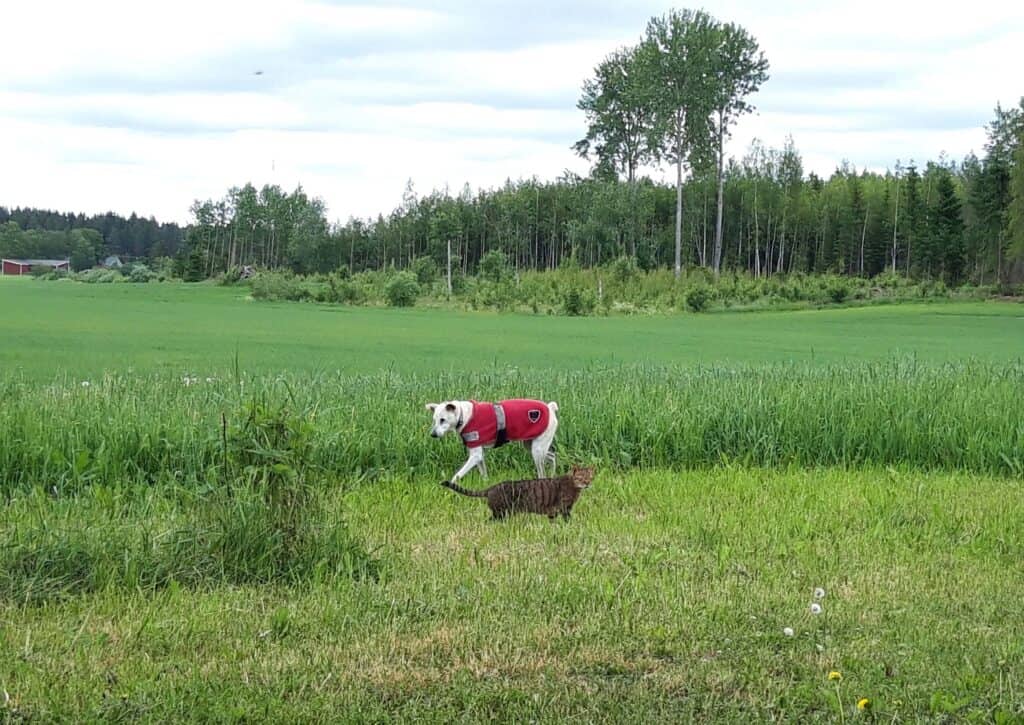
5 Signs That Cats And Dogs Are Forming A Bond
#1. Mutual Grooming
If your cat and dog start to groom each other, it’s a big step in their friendship.
You might see your cat licking your dog’s fur, or your dog may gently nibble at your cat’s ears.
This shows trust and acceptance between them.
Mutual grooming also helps spread scents between pets, and is a good sign your cat and dog are bonding.
#2. Resting Together
If your cat and dog rest close to each other, it’s a clear sign of their bond.
Even if they’re not touching, being near shows they feel safe with each other.
You may find them napping on the same bed or couch.
As they grow closer, they might even snuggle together.
This type of closeness while resting means they trust each other a lot.
#3. Playful Interactions
When cats and dogs play together, it’s another great sign.
You might see them chasing each other around the house., or they may play with toys together.
Look for:
- Gentle paw swats
- Play bows (when a dog lowers her front end)
- Taking turns chasing each other
- Sharing toys
Make sure the play stays fun for both pets.
If one seems scared or stressed, step in to calm things down.
#4. Relaxed Body Language
As I’ve mentioned, body language tells you a lot about how animals feel.
When cats and dogs are interacting and bonding, they will look relaxed around each other.
Signs of relaxed pets include:
- Soft eyes (with constricted pupils)
- Ears in a neutral position
- Tail held loosely
- No tense muscles
- No vocalizations (other than purring!)
#5. Following Each Other
When your cat and dog start to follow each other around, it’s also a good sign.
A cat might trail around with a dog in the yard, or a dog may follow their cat friend to her favorite nap spot.
They might even wait for each other by doors or windows.
Keep an eye out for these signs.
They show your cat and dog enjoy each other’s company and are on their way to being great friends.
READ NEXT
Resources
- Oxytocin-gaze positive loop and the coevolution of human-dog bonds – Miho Nagasawa, Shouhei Mitsui, Shiori En, Nobuyo Ohtani, Mitsuaki Ohta, Yasuo Sakuma, Tatatsushi Onaka, Kazutaka Mogi, & Takefumi Kikusui
