

Hurry Up And Wait: How To Lure Your Cat Out Of Hiding

This post may contain affiliate links, which means we may receive a commission, at zero cost to you, if you make a purchase through a link. Please see our full disclosure for further information.
Cats love to hide.
Whether it is under the bed, in a closet, or behind furniture, our feline friends love to seek out small, enclosed spaces.
While research shows that hiding can actually reduce cats’ stress levels, it can be concerning if your cat hides away for an extended period of time.
But before attempting to lure her out, it is important to assess the situation and consider whether it is really necessary to move her.
If it is not, it is usually best to wait it out. With the right approach, you can most likely encourage her to come out of hiding on her own.
If she doesn’t though, then there are ways to make her “retrieval” as stress-free as possible – for both of you!
Read on to learn about the most effective ways to coax your cat out of hiding, ranging from gentle approaches to more intensive – but humane – measures, if all else fails.
Preparing to Lure Your Cat Out of Hiding
The first step is to make sure that wherever your cat is hiding is safe, comfortable, and secure.
Provide her with a litter box nearby, and ensure there are no hazards such as exposed wires or sharp objects.
The next step is to create an inviting space just outside the hiding spot by providing food and water close by.
The idea is to make it as easy as possible for your cat to move from her hidey-hole to her food, water, and litter box without feeling threatened.
You can also place some soft bedding near the opening of the hiding space. Try sprinkling catnip or silver vine on it to make it extra appealing.
Another trick is to scatter some of kitty’s favorite treats nearby.
You can also try talking to her softly in a reassuring tone – but don’t overwhelm her if she’s feeling scared.

Create A Safe And Calm Environment
Creating a safe and calm environment is crucial when luring your cat out of hiding.
So try to avoid sudden movements or loud noises that could startle her and cause her to retreat further into her hiding place.
If you have other pets, make sure they are not around when you’re trying to lure your kitty out.
If she is hiding in a closet or under a bed, make sure to adjust the lighting so it’s not too bright and intimidating.
Check For Signs Of Fear Or Pain
First of all, if your cat is hiding, it is essential to check for signs of fear or pain.
If kitty is fearful or stressed, it will most likely take longer to lure her out of hiding.
Same with a sick cat.
When cats are injured or in pain, it’s very common for them to hide away so they don’t reveal their vulnerability to potential predators.
Not sure how to tell if your cat is scared? This handy video from Fear Free Happy Homes provides a crash course in feline body language:
How To Lure Your Cat Out Of Hiding
Now that you’ve set up the environment to give yourself the best chance of success, it’s time to try to lure your cat out of her hiding spot.
Using Food And Treats
One of the easiest ways to lure a cat out of hiding is to use a can of tuna, baby food, or some of her favorite tasty treats as bait.
Try holding the dish of food near the entrance to your cat’s hiding place and lightly tapping on it.
If you have a bag of treats, shake it lightly to try to entice her into moving. My cats find tuna flavor Temptations irresistible!
You can also try tossing some treats close to the opening of the hiding spot, encouraging her to come forward for them.
Then, sit back and be patient.
Let your cat take the lead – it may take some time before she feels safe enough to come out.
You can even leave the room or area completely if kitty is looking reluctant.
Once your cat starts to emerge from her hiding spot, make sure you reward her with lots of verbal praise and treats.
It’s best not to make a grab for her as this might scare her and send her right back to her hiding spot.
And it’ll be harder to get her out the next time!

Using Toys and Play
Playing with your cat can be a great way to encourage her to come out of hiding.
You can see if she responds to any of her favorite toys.
Interactive toys such as wand toys or a laser pointer can be good options.
Simply pulling a piece of string along the ground for her to stalk and pounce on can work too.
These types of toys will stimulate your cat’s natural predatory behavior and encourage her to play.
Using play can be a good strategy if your cat is fearful, as transitioning to a playful state can override those feelings of fear.
Having said that, if your cat is really scared for some reason, then she is unlikely to respond to your efforts.
Note if she tracks the movement of the toy with her eyes or not, as this will give you an indication of how fearful she really is.
Using Catnip Or Silver Vine
Cats have a powerful sense of smell and scent is extremely important in the world of feline communication.
Putting some catnip or silver vine near your cat’s food or on her toys may just be enough to encourage her to venture out from her hiding place.
Get Creative
If your cat is particularly skittish or frightened, you may need to get creative.
One option is to set a strategic trail of treats leading out from her hiding place, then sit back and let her come out to explore at her own pace.
Wait It Out
This is my personal favorite and the one that has worked best for me over the years.
If you have the luxury of being able to wait for your cat to come out on her own, it’s really the best option as it means she comes out only when she’s ready and feels safe.
By allowing the cat to control the situation, you can keep her stress levels at a minimum.
Whatever you do, try to avoid pulling kitty out of her hiding place or chasing her as this will only make her feel more scared and stressed.
Case Study: Jasmine – Hiding In The Forest
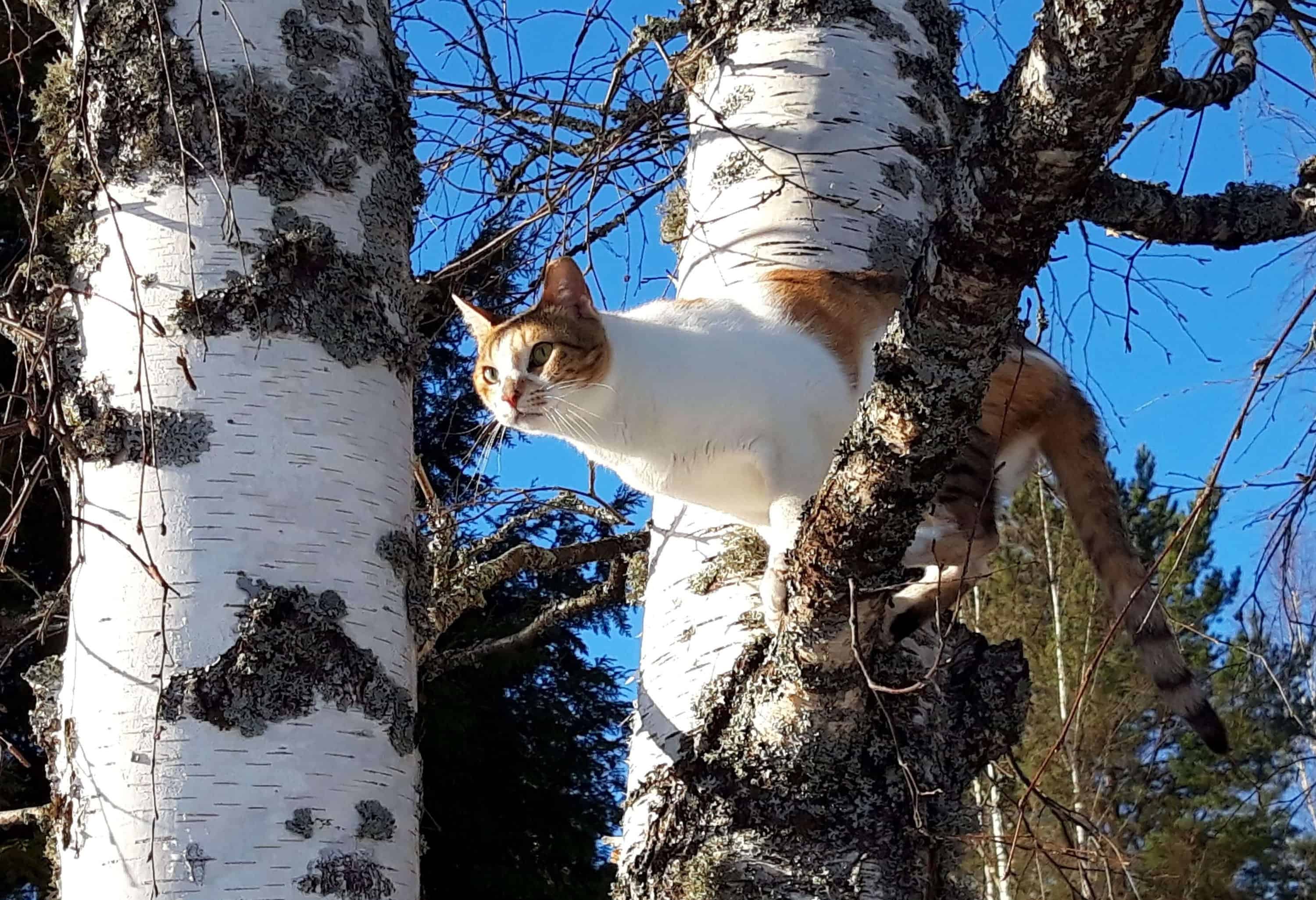
One of our rescued street cats from Dubai, Jasmine, went through a phase of hiding in the forest for days at a time.
Whenever I would go out looking for her I would shake my bag of Temptations the entire time, because she finds them irresistible.
It worked so many times. I would suddenly hear this little meow and Jasmine would appear from wherever she’d been hiding in the depths of the forest.
She would be happy to see me and let me pet her – but she wouldn’t allow me to pick her up and carry her home.
I used to call it her “wild mode” (aka survival mode) and it would take her a while to calm down and relax again.
Instead, I would shake the bag of treats and walk slowly home, with her following happily along behind.
What If I Can’t Lure My Cat Out of Hiding?
If you’ve tried all the tricks in the book to lure your cat out of hiding but to no avail, don’t worry, there are still some things you can try.
Coaxing Your Cat Out of Hiding: Tips and Tricks
One way to coax your cat out of hiding is to try placing a cardboard box or a cat carrier near her hiding spot.
Cats love to explore new spaces and she may be tempted to come out and investigate – especially if you lace it with catnip.
Next – and I don’t particularly recommend this but if you have no other choice and absolutely have to get your cat out of hiding – you can use something like a broom to gently coax her to move toward the box or carrier.
That doesn’t mean pushing her though.
The idea is merely to slide the broom slowly along the ground behind her so she actively moves to try to avoid it.
You can then coax her in the direction you want her to go – in other words, toward the cat carrier.
Block as best you can any other escape routes.
You can also use items of furniture, large pieces of plywood, anything really, to reduce the cat’s space, without touching her, to encourage her to seek safety in the cat carrier.
Be ready to close the door as soon as she goes in before she has the chance to back out again.
Cats can move lightning fast and you don’t want to lose this opportunity!
As I said, I don’t recommend this but it can be a handy trick if you can’t get close to your cat because of where she is hiding, or she’s so scared she starts getting aggressive.

Using A Cat Trap
Another option is to use a humane cat trap.
A cat trap usually consists of a cage with a door that closes when the cat enters to eat the bait.
I would recommend using tuna fish, sardines, or your cat’s favorite wet food as bait to lure your kitty into the trap.
Case Study: Jethro – Hid Under The Shed For 10 Days
During a house move a few years back, our fearful rescue cat Jethro became extremely anxious with all the activity and fled to hide under the shed at the back of the garden.
Despite leaving food out for him, he refused to come out from under the shed and would run back underneath if I approached.
As our move date came and went, I stayed behind in an empty for 10 days to try to coax him out.
I tried various tactics, such as leaving the window open and waiting for him to come back into the house, but to no avail.
Eventually, I borrowed a drop trap from a cat rescue.
I left tuna first in front of, and then inside, the trap without setting it.
I did this over a period of a day or so.
My goal was for Jethro to first get used to going near the trap and then venturing inside with nothing scary happening.
After 24 hours, I was confident that this had been achieved, so I set the trap with a small trail of tuna leading to a big dish of tuna and Temptations right at the back of the trap.
Jethro finally took the bait at 1.30 a.m. on a very cold night.
I heard the trap door slam shut and went racing outside in the frigid night air, so I could get him back inside the house before anything else went wrong.

How To Use A Cat Trap
- If you use a cat trap, first get your cat used to the trap by leaving the bait by the entrance without setting the trap. This way you won’t scare her by trap snapping shut the first time she ventures anywhere near.
- After she’s eaten food a few times from the trap entrance, move the food dish about halfway inside.
- After one or two times of that, move the food to the back of the trap. A couple of times of that, then you are ready to set the trap.
- By this time your cat will “trust” the trap and associate it with good things happening (e.g. yummy tuna).
- Be very careful when setting the trap and make sure you test it before leaving the area. You may only get one chance at this!
- Keep your distance at all times so as not to scare your cat. Be very quiet and hide behind a tree or the house or whatever else is nearby.
- Alternatively, set up a trail camera so you can keep track of how often your cat is visiting the trap and also make sure she is eating the food herself (as opposed to some other wild animal).
Should I Lure My Cat Out Of Hiding?
Whether you should lure your cat out of hiding or not depends very much on the situation.
If your cat is missing or lost, or if she’s sick or injured and in need of immediate medical attention, then you should definitely try to coax her out.
In these cases, time is of the essence, and you need to act quickly to get your cat the help she needs.
However, in most cases, it’s best not to force a scared cat out of hiding as this risks making her even more scared and can lead to aggression or injury.
So it’s important to be patient, set up the environment so the cat knows she’s safe, and give her time to trust you.
How to Prevent Future Hiding
In addition to possible physical or medical issues, hiding behavior can be an indication of stress, fear, or anxiety.
Because of this, it is important to ensure that your feline friend feels safe and comfortable in her environment so she is less likely to feel the need to hide away.
Set Up The Environment
Providing a safe space for your cat to retreat to when she feels stressed or frightened can help her feel more secure.
This could be a quiet room with comfortable bedding, food and water bowls, a litter box, a scratching post, a cardboard box for hiding, or even a tall cat tree where kitty can hide away on a high shelf to feel safe.
Throughout the home, make sure there are multiple resources for your cat to choose from (feeding stations, water dishes, hiding places, scratch posts, toys, litter boxes, etc.) – especially if you have a multi-cat household.
Provide Mental Stimulation
Providing toys, interactive playtime, and hiding treats around the house can help keep your cat entertained and engaged, reducing stress levels.
Interactive puzzle toys with hidden compartments for treats are great for engaging cats both mentally and physically.
They also give cats an outlet for their predatory instincts, which is essential for their mental well-being.
You can also encourage your cat to explore her environment by providing perches or shelves at different heights and secure outdoor enclosures.
Once again, you can use scent marking techniques with familiar scents such as catnip, silver vine, or lavender to help make the space feel more secure to your kitty.
Cat pheromones such as Feliway (spray or diffuser) are another option, as they can help cats feel more relaxed and secure in their environment.
Why Do Cats Hide?
Hiding is a completely natural behavior for cats.
They use it both as a survival strategy and a way to cope with stressful situations.
Most cats like routine and generally don’t do so well with sudden change.
Look at how poor Jethro coped with our house move!
So if something unexpected or scary happens, your cat may get scared and hide away till she feels safe again.
Common Reasons Why Cats Hide
- Keeping safe from predators
- Stalking prey
- Pain, illness, or injury
- Giving birth
- Lost/displaced from their home environment
- Loud noises (e.g. vacuum cleaner, home renovations)
- Visitors to the home
- New pets in the home
- Being bullied by another cat in the home
- New baby in the home
- Noisy young children
- Tradespersons in the home
- Moving furniture
- Moving to a new house
- Coming home from the vet
- Newly adopted cat in a new home
- New situations in general
Hiding Boxes Reduce Stress
A study of 43 shelter cats found that cats who were provided with a box to hide in showed a “significant reduction in stress” compared to cats who were provided with a regular, open-type cat bed.
The cats with the hiding boxes were also “more likely to approach and displayed relaxed behaviors much more frequently,” said researchers Kry and Casey (2007).
This gives us an idea of just how important hiding behavior is for cats.

Why Is My New Cat Hiding?
When you adopt a new kitten or adult cat, she may hide until she feels safe in her new surroundings.
This is completely normal, and it’s best to just provide a safe place for your new pet to nest and leave her to regroup.
This may be a cozy spot in your laundry room or bathroom with food, water, a litter box, toys, hiding places (e.g. cardboard boxes), vertical space (i.e. somewhere high up she can retreat to if he wants to), and a soft bed.
You can always check in periodically to see how she’s doing and let her approach you if she wants to.
If not, just wait and let her come out in her own time and decide when and how much she wants to interact with you.
Allowing her to be in control of her new environment like this will help build her confidence and learn that she can trust you.
Once your new cat feels safe in her new home, gets to know her new family, and gets used to the sounds and scents of the home, she’ll most likely feel less inclined to hide away.
How Long Will My Cat Hide?
If you have just adopted your cat it may take her a while to feel safe and confident enough to start exploring her new place.
It could just be a matter of hours or it could take days.
A shy cat or outdoor cat (as well as feral cats who have had little human interaction) will most likely take longer to come out of hiding than more confident and curious cats.
Our forest roamer Jasmine hid away in a tiny compartment on a cat tree for two weeks when we first adopted her.
She only came out to eat, drink and use the litter box when no one was around.
A scared, lost, or missing cat could hide for days, weeks, or even months if she is hiding outdoors.
Recommended Products
READ NEXT
Resources
- Cat Body Language 101 [Video] – Fear Free Happy Homes
- Lost Cat Behavior – Missing Animal Response Network
- PLAY – Animal Emotions/Module 4 [Educational Course] – Dr. Karolina Westlund/Illis Animal Behaviour Courses
- The effect of hiding enrichment on stress levels and behaviour of domestic cats (Felis sylvestris catus) in a shelter setting and the implications for adoption potential – K. Kry and R. Casey
NEED HELP FROM A CAT BEHAVIOR SPECIALIST?

If you need more help dealing with a training or behavior issue, please find professional help from a certified feline behavior consultant. They will be able to offer you tailored advice for your cat(s) and situation.

Good places to start are:
- International Association of Animal Behavior Consultants
- COAPE Association of Pet Behaviourists and Trainers
- American Veterinary Society of Animal Behavior
