

How to Turn a Spare Room Into the Ultimate Cat Paradise

You have a spare room. You have a cat (or if you’re like me, multiple cats). And you’ve arrived at the very reasonable conclusion that the cat should have it — not as a storage space with a cat bed shoved in the corner, but as an actual room, designed for them, with thought and care and possibly a ceiling-mounted walkway that makes visitors stop in the doorway and stare.
A dedicated cat room can help solve the problems that every multi-cat household knows intimately (think territory disputes, competition for the best perch, the litter situation), and it does so by simply giving cats enough room to coexist on their own terms. For devoted single-cat households, it is an act of love so wholehearted that your cat will probably still choose to sleep on your pillow anyway. But the room will be there, and it will be magnificent.
This guide is for anyone who has looked at their spare room, currently home to a treadmill being used as a clothes horse, a box of things that should have gone to the charity shop two years ago, and no particular potential, and thought: I could do something better with this. You absolutely could. Here’s how.
Section 1: Plan the Layout First
The temptation when designing a cat room is to start buying things immediately and fit them in later. Resist this. A well-planned cat room with considered zones works dramatically better than a room full of individually good pieces that haven’t been thought about together. Spend time on the layout before you spend money on anything else, and the whole project will be more coherent and more satisfying.
Every complete cat room needs five zones: sleeping, scratching and climbing, play and enrichment, eating and drinking, and litter. Sketch a rough floor plan and mark where each zone will go. As a general principle, litter goes furthest from food and water, sleeping areas benefit from being elevated or semi-enclosed, and the climbing zone should flow into (or connect with) the sleeping zone so cats can move between them naturally. The play zone should have enough floor and wall space to feel genuinely active; this is not the place to crowd in extra furniture.
For multi-cat households, the layout planning stage is where you earn your investment. Cats are territorial even with companions they like, and a well-designed room provides multiple feeding stations (always separate — eating is a private activity for most cats), more sleeping spots than there are cats (so no one ever has to negotiate for a bed), and climbing routes with multiple entry and exit points so no individual cat can block another’s path. The goal is a room where every cat can simultaneously feel like they have the best spot.
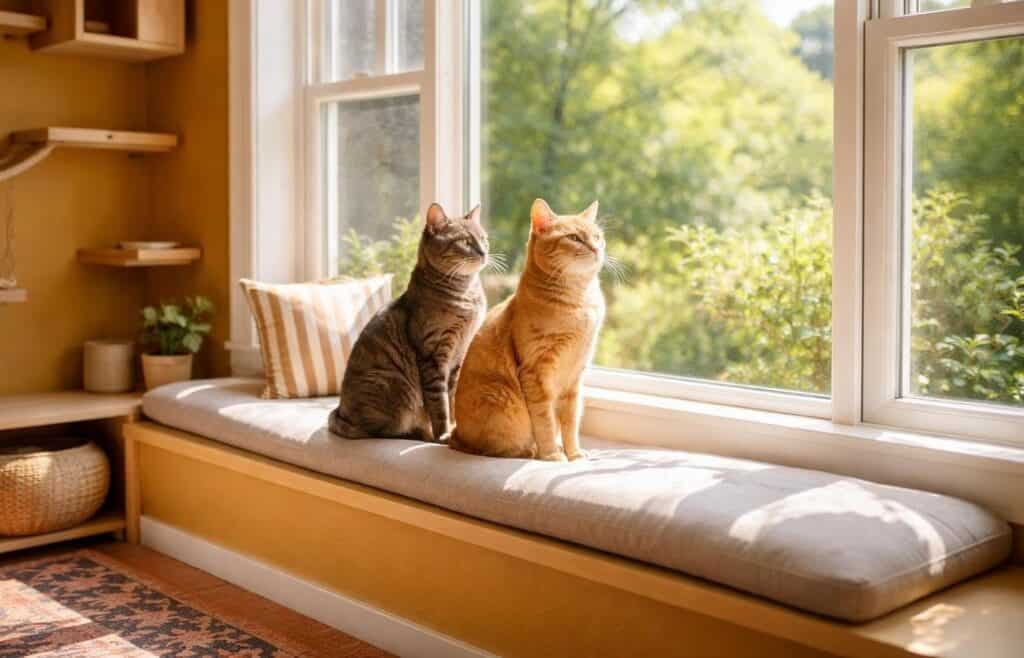
Think about the window early. Natural light and the view outside are among the greatest sources of entertainment and well-being for indoor cats, and the position of the window should influence where the main perching and climbing structures go, not the other way round.
Section 2: The Climbing and Exploration Zone
Cats love to scratch, climb, and perch up high. Scratching isn’t just a preference; it’s a full-body behavior that stretches muscles and tendons from the paws all the way through the back, maintains claw health by removing old outer sheaths, and allows cats to deposit scent from the glands in their paws so they can mark their territory.
Research suggests most cats prefer a scratching post of at least three feet tall (tall enough for a full vertical stretch) with a sisal substrate that gives satisfying resistance under the claws. In a dedicated cat room, you can meet every one of those needs properly, and then some.
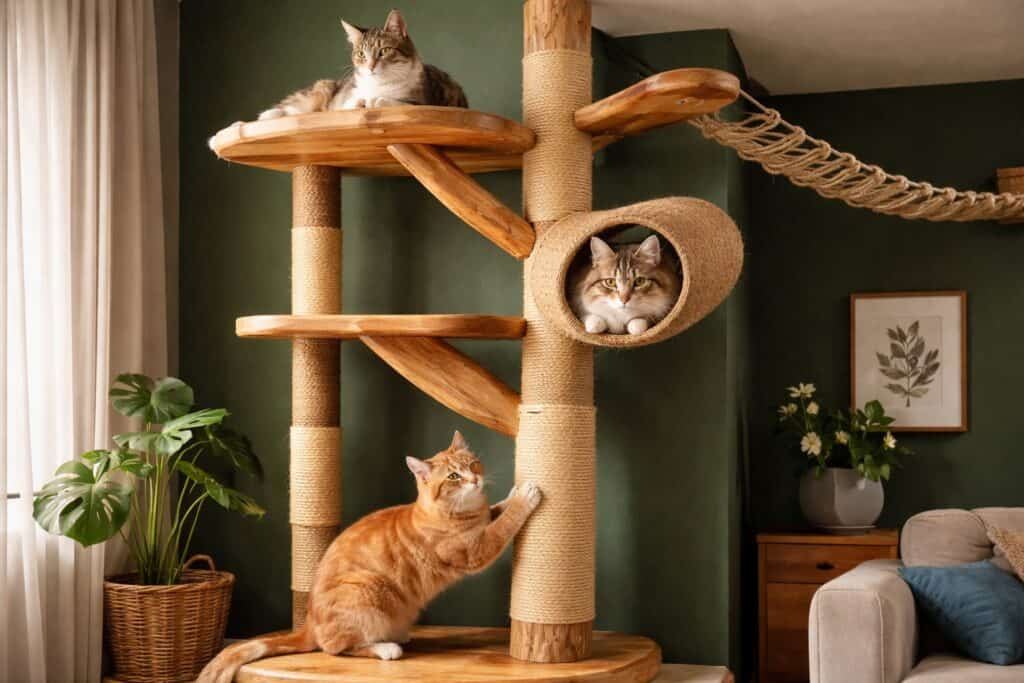
A floor-to-ceiling cat tree in a dedicated room can be as ambitious as you like. Unlike the living room version that’s constrained by visual weight and square footage, the cat room version can be tall, wide, multi-branched, and genuinely imposing. Natural wood constructions with sisal or carpet wrapping satisfy your cat’s scratching instinct at every level.
Providing platform perches at varying heights and integrated hammocks, hiding spots, or tunnels give multiple cats plenty of options, empowering them to make their own choices (good for confidence) and reducing competition-based stress.
Dedicated scratch posts positioned around the room complement the tree and ensure every corner of the room has a scratching option within easy reach. A post beside the door, one near the window perch, and one at the base of the main climbing structure covers the spots cats naturally gravitate toward when the scratching urge strikes.
Note: As per the research, some cats (especially older cats who may have stiff joints, or cats with injuries) prefer to scratch horizontally on a softer substrate like cardboard, so make sure you provide for them too, as needed.
Wall-mounted shelving systems transform the entire perimeter of the room into a climbing route. IKEA Lack shelves are a beloved DIY starting point. They’re inexpensive, sturdy, and available in sizes that suit most cats, and with carpet tape or sisal mat offcuts for grip, they become a perfectly functional cat walkway at a fraction of the cost of purpose-built systems. For a more polished result, dedicated cat shelf brands like Catastrophic Creations, The Refined Feline, and Cozy Cat Furniture produce modular systems in thoughtful finishes that install cleanly and look amazing.
Cat tunnels, rope bridges, and fabric hammocks woven between structures at height add variety and encourage exploration. A tunnel that connects two shelf runs at mid-height, a rope bridge between a tree platform and a wall shelf, or a hanging hammock tucked into a corner at ceiling level all help make the room feel like an adventure course rather than a collection of furniture, which is exactly what it should be.
A window perch is always a popular addition. A wide, padded shelf mounted at window height, or a built-in window seat if the budget extends to it, is where your cat will spend many of their waking hours, watching the world, warming themselves in the sun, and looking generally content with life.
Section 3: The Cozy Sleep Zone
Cats sleep between twelve and sixteen hours a day, which means the sleep zone isn’t a minor detail. Rather, it’s a significant proportion of everything they do. In a dedicated cat room, the sleep zone can be genuinely luxurious: multiple options at different heights and levels of enclosure, each one considered and comfortable.
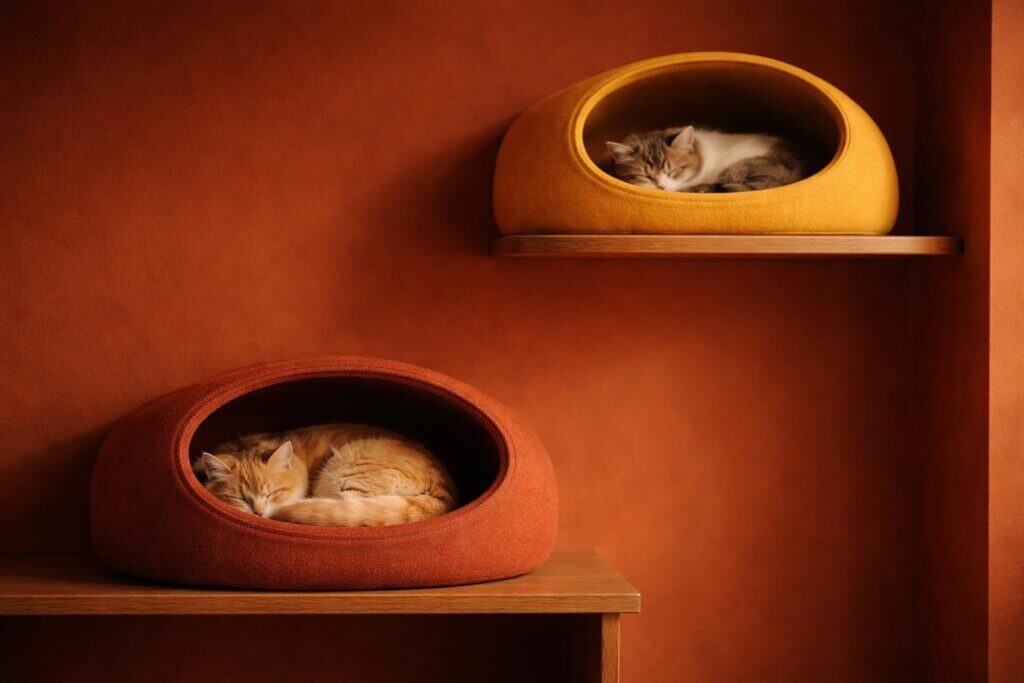
Variety is the guiding principle for sleep spaces. Different cats prefer different things. Some want a fully enclosed cave bed they can disappear into; others want an open, elevated platform where they can see the room. Some curl tight; some sprawl. Providing several different bed styles means each cat gravitates toward what suits them at the time.
Cave beds and enclosed pods are perennially popular and belong in any multi-bed setup. Position them at different heights — some at floor level, some elevated on shelves — so your cat can choose not just the style of enclosure but the altitude. Heated pads inside cave beds are a particularly valued addition in cooler months: self-warming versions that reflect body heat require no power and no safety concern, while low-wattage electric options provide a reliable warmth that older or less mobile cats find especially appealing.
In a multi-cat room, the aspiration is a dedicated sleeping spot for every cat plus one or two extras. This isn’t excessive, but a territorial buffer. A cat who knows that their specific shelf cubby or their specific cave is reliably theirs (well, usually anyway) is a calmer, more settled cat than one who has to compete for resting space.
Section 4: The Play Zone
The play zone is where your cat room earns its ‘paradise’ billing. This is the space dedicated to mental enrichment, hunting, and the kind of energetic, engaged activity that keeps cats mentally and physically healthy, especially indoor cats who have no other option. Done well, it’s also genuinely fun to watch.
A large floor-based ball track — the kind with multiple intersecting circuits — keeps cats occupied in a way that combines physical movement with problem-solving. Puzzle feeders, scattered through the play zone rather than concentrated in one spot, tap into natural foraging behavior and slow down eating in a way that benefits digestion and extends engagement time.
This last bit is important because it makes your cat feel happier for longer, which translates into a calmer, more positive overall mood state. While great for all cats, it’s especially helpful for anxious, stressed, or fearful cats. Not to mention cats who are frustrated from not having an outlet for those all-important predatory instincts.
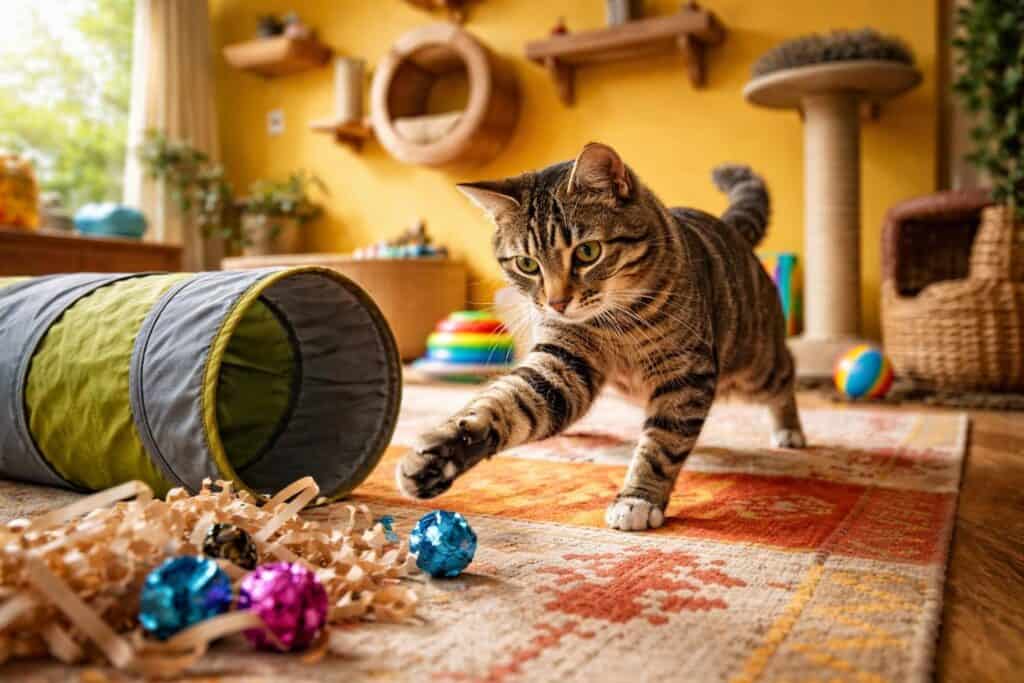
Speaking of which, a designated hunting area (consider a low tunnel or two, some crinkle balls concealed in a pile of paper strips or a ball pit, and some hidden treats in a scatter area) gives your cat the full hunting sequence: locate, stalk, chase, pounce, catch. This is one of the most enriching things you can offer an indoor cat, and it requires very little space or budget to create. Rotate the toys and change the hiding spots regularly to maintain the sense that the environment is genuinely unpredictable and worth investigating.
Lastly, a wand toy station is a simple addition with a disproportionate impact. A hook or a small rack on the wall, positioned near the play zone, can hold an assortment of wand toys (think feathers, ribbons, and crinkle attachments) in an organized and accessible way. It also serves as a visual prompt: when you come into the room to spend time with your cats, the toys are right there, requiring no searching and no delay between intention and play.
Section 5: Practical But Pretty
Practical decisions, such as flooring, wall finish, litter setup, feeding station, are worth getting right from the start, because they determine how much effort the room takes to keep looking good day to day.
Litter Boxes
The litter setup in a dedicated cat room can be more generous than anywhere else in the house. The rule of thumb is one litter box per cat plus one extra. Enclosed litter cabinets keep the visual impact minimal and the odor contained. Positioning them in a corner with good airflow (near a window that can be safely cracked open without risk of jumping out) handles the olfactory side of things without resorting to a battery of air fresheners. Scoop daily, of course.
Food and Water
Your cat’s feeding station benefits from being slightly separated from both the litter area and the main traffic flow. A low console or a shelf unit with the food bowls, a mat underneath for spillage, and nearby storage for food and scoops makes feeding time calm and organized.
In a multi-cat household, separate feeding stations prevent the anxiety that communal eating produces in some cats. Even two bowls on opposite sides of the same shelf is an improvement over a single shared area.
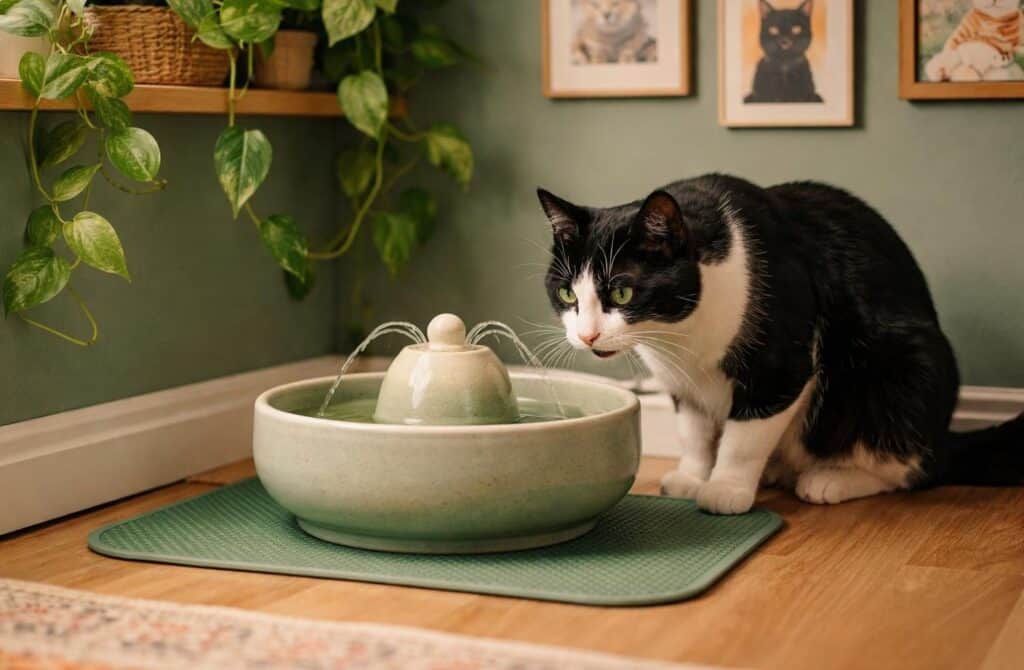
For water, a cat water fountain is worth prioritizing over a standard bowl. Cats are instinctively drawn to moving water. In the wild, still water is more likely to be contaminated, and that wariness is hardwired. A fountain’s continuous circulation keeps water fresher, better oxygenated, and more appealing, which encourages cats to drink more consistently. Better hydration supports kidney health, which is particularly important in cats, who can be prone to renal issues as they age.
In a dedicated cat room, the fountain is best positioned away from the food bowls and away from the litter area. A spot near the window or along a quieter wall, somewhere the sound of the water is audible but not intrusive, is ideal.
Floors and Walls
For flooring, easy-clean is the non-negotiable requirement. Smooth vinyl, sealed wood, or large-format tile all clean quickly and don’t trap hair, litter, or muddy pawprints the way carpet does. A washable flat-weave rug in the sleeping zone adds warmth and comfort underfoot without the cleaning challenge of a pile carpet. And walls painted in a washable matt emulsion can be wiped down without losing their finish.
Note: Painting your cat’s room in blues or purples creates a space they can actually perceive clearly, rather than one that fades into dull, indistinct tones. Because cats see the blue-violet end of the spectrum more vividly than reds and oranges, these cooler hues make their environment feel more defined, engaging, and visually comfortable.
Lighting
Natural light deserves particular attention. Position the main perching structures to catch the sunlight at the times of day when your cat most likes to nap.
The Aesthetic Finishing Touches
Wall art and murals give your cat room a character and identity that furniture alone can’t provide. A large-format cat mural on a feature wall immediately establishes the room as a complete, considered space. For example, a jungle scene, a botanical illustration populated with cats, or an abstract piece in the room’s color palette.
For those who prefer something more restrained, a gallery wall of framed cat art, botanical prints, and photography in matching frames achieves a similar effect with more flexibility and no permanent paint commitment.
A neon sign is a fun finishing touch. ‘Cat Paradise,’ ‘Paws Only,’ or simply a neon cat silhouette provides warm ambient light, a visual focal point, and the kind of personality that makes a room feel genuinely loved rather than merely furnished. LED neon options run cool and consume minimal power. Wall-mounted on a dimmer switch, the brightness can be dialed down during rest times to keep the room calm and unstimulating when your cat needs to wind down.
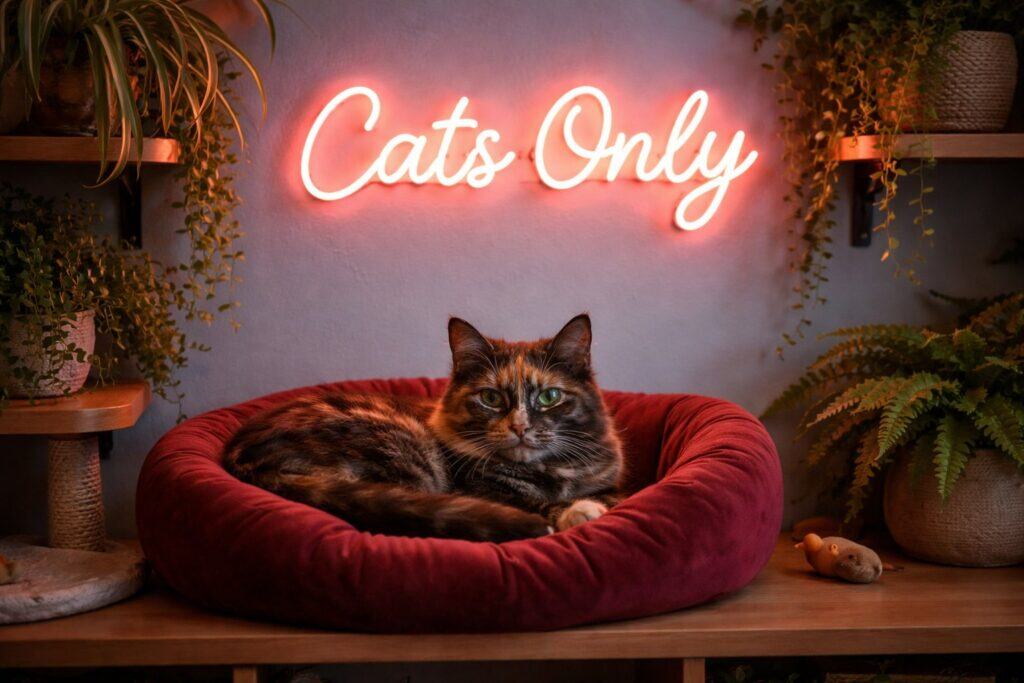
Cat-safe plants bring life, oxygen, and the kind of lush, layered quality that makes a room feel genuinely alive. Spider plants, Boston ferns, calathea, parlor palms, and catnip (naturally) are all non-toxic for cats and thrive indoors. Arrange them at different heights so you have trailing plants on high shelves, statement plants in floor pots, and small succulents tucked into shelf corners. The room will start to feel like a greenhouse that your cat just happens to live in.
Note: Check every plant against the ASPCA’s comprehensive non-toxic list before introducing it, as some common houseplants that look perfectly innocent are harmful to cats.
Finally — and this matters more than it might seem — include somewhere comfortable for you to sit. A chair, a floor cushion, or a small sofa if the room is large enough. A cat room that you can only stand in is a room you’ll visit briefly and leave. A cat room with a good chair is a room where you’ll spend an entire Saturday afternoon without noticing, and your cat will appreciate the company. Well, sometimes at least.
Images in this article are AI-generated for illustrative purposes and inspiration
