

How to Carve Out a Dedicated Dog Space in Every Room of Your Home

If you live with a dog, you already know: some dogs follow you everywhere. From the kitchen to the home office to the bathroom (yes, even the bathroom) your dog is there, usually within tripping distance, watching your every move with unwavering devotion. It’s one of the best things about them.
But here’s an idea that will change how your home feels for both of you: rather than your dog just trailing after you and collapsing wherever there’s floor space, what if every room had a spot that was genuinely theirs? A place that says, clearly and comfortably, ‘this is where you belong in here.’
A dedicated dog space in each room isn’t just a nicety. It gives your dog a sense of structure and security that reduces anxious behavior, encourages them to settle instead of restlessly pacing, and means you’re not constantly moving their bed from room to room like a piece of nomadic furniture. It also means you can design those spaces intentionally, so they look good and work well for everyone.
Here’s how to do it, room by room.
The Living Room
The living room is where many of us spend a fair bit of our time, which means it’s almost certainly where your dog wants to be too. The challenge is making their presence feel designed rather than dumped — like the dog bed really belongs in the room.
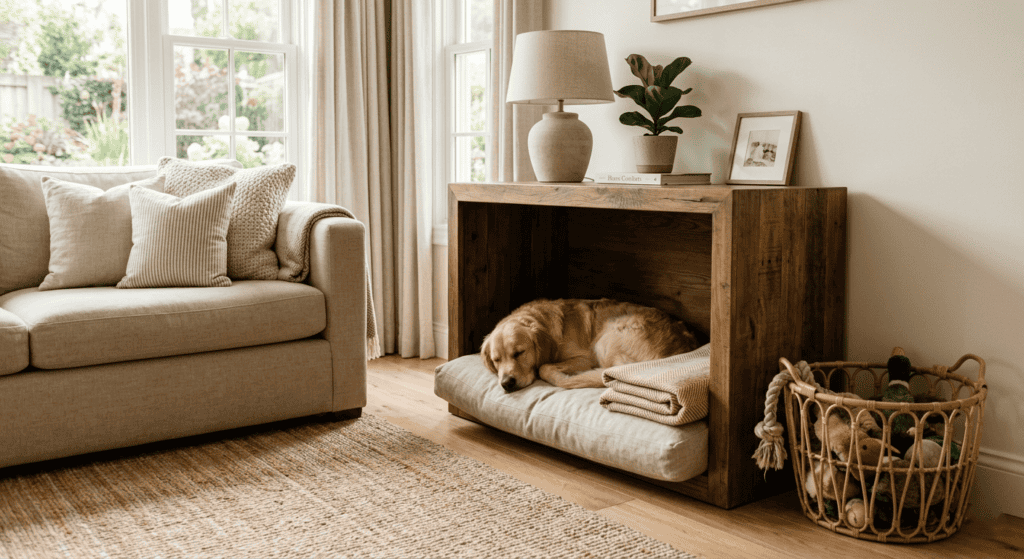
The key is treating your dog’s bed as a piece of furniture. Choose something with clean lines and colors that complement your sofa and rug. Oval bouclé beds, linen bolster cushions, and woven basket-style beds all look intentional in a way that the default rectangular fleece option may not. Position it somewhere considered, like beside the sofa, near the fireplace, or in a natural alcove, rather than just wherever it fits.
A toy basket that doubles as decor is one of the easiest wins in dog-friendly home design. A rattan basket or a fabric storage cube keeps toys contained and tidy, and when it’s styled well, it looks like a deliberate design choice rather than evidence that a Golden Retriever lives here. Your dog gets easy access to their things; you get a living room that still looks like a living room.
If your layout allows it, consider creating a small dog nook in the space under a side table, a built-in alcove, or the gap beside a bookcase. Add a cushion or a small mat, a blanket, and maybe a low wall hook for their leash, and you’ve created a genuine little haven within the room. Many dogs love a slightly enclosed spot to retreat to, and this kind of setup gives them that without taking up a single extra square foot.
The Kitchen
The kitchen is a high-traffic, high-interest zone for dogs, mostly because it smells incredible and food appears there on a reliable schedule. It’s also usually where their bowls end up, possibly in a slightly awkward spot that gets in everyone’s way. A dedicated feeding station solves this immediately.
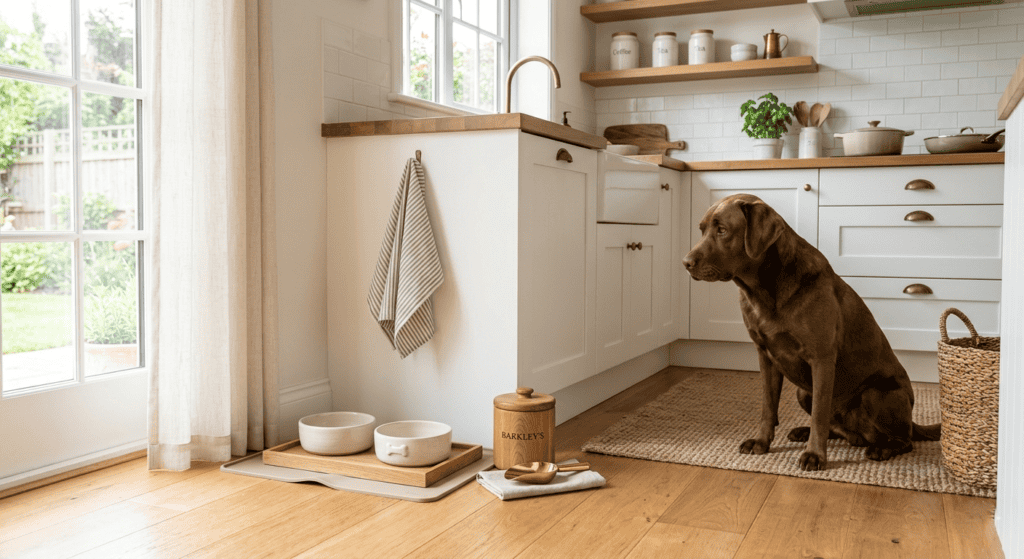
A feeding station doesn’t need to be anything elaborate. It can be as simple as a wooden tray with two matching bowls and a folded mat underneath to catch splashes, but the effect is transformative. Everything has a place, cleaning up is easier, and it looks like something you chose rather than something that evolved over time. Pair it with a nearby storage canister for their food and a small scoop, and the whole area becomes a genuinely functional little corner.
A spill-proof silicone mat under the water bowl is one of those practical additions that sounds unglamorous but makes a real difference to daily life. Dogs can be messy drinkers. A good mat means the water stays contained and the floor stays dry, which is especially welcome in kitchens with wood or laminate flooring.
Don’t overlook the treat jar. A nice ceramic or glass container on the counter for dog treats is a small thing that works on multiple levels: it keeps treats fresh and accessible, it’s genuinely useful during training, and when chosen thoughtfully, it looks like just another piece of kitchen decor. It’s the kind of detail that makes a dog-friendly kitchen feel considered rather than chaotic.
The Bedroom
Whether your dog sleeps on the bed, beside it, or in their own bed across the room, the bedroom is one of the most important spaces to get right. This is where nighttime routines are established and where your dog’s sense of security gets set for the hours ahead. A well-thought-out bedroom setup makes bedtime calmer for everyone.
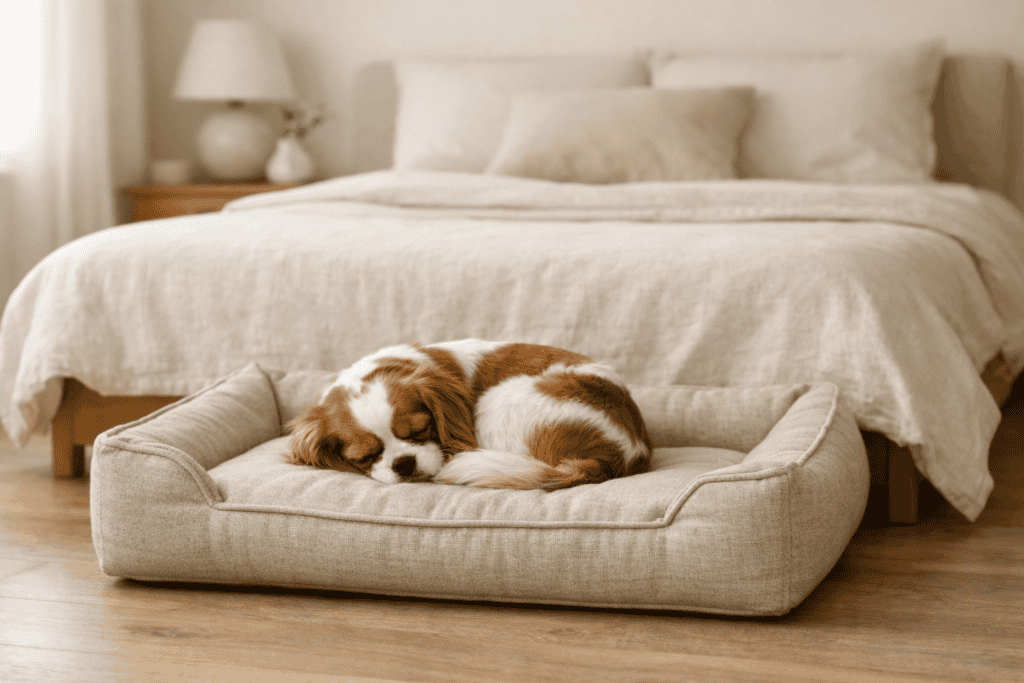
A stylish dog bed positioned at the foot of the bed is the classic solution, and it works so well because it keeps your dog close without them sprawling across your legs at 3am. Look for low-profile beds in neutral tones that echo your bedroom palette. A bed that looks like it was chosen to go there, rather than tolerated, makes the whole room feel more cohesive.
If your dog uses a crate, there’s no reason it has to look clinical. Modern crates with wooden surrounds or powder-coated frames can be styled as a bedside table or a bench at the end of the bed, complete with a lamp or a book on top. Your dog gets their den; your bedroom keeps its aesthetic. It’s one of those genuinely clever double-function solutions that interior designers talk about.
For dogs who do share the bed, a small set of pet steps or a low ramp are worth their weight in gold, especially for smaller breeds or older dogs whose joints don’t love the leap. Wooden steps that match your bed frame are widely available now and look far more intentional than a plastic pet staircase.
The Home Office
If you work from home, you already know that your dog has strong opinions about this arrangement. Mostly, those opinions boil down to: ‘I should be near you at all times, including during your 10am call.’ Rather than fighting it, design for it.
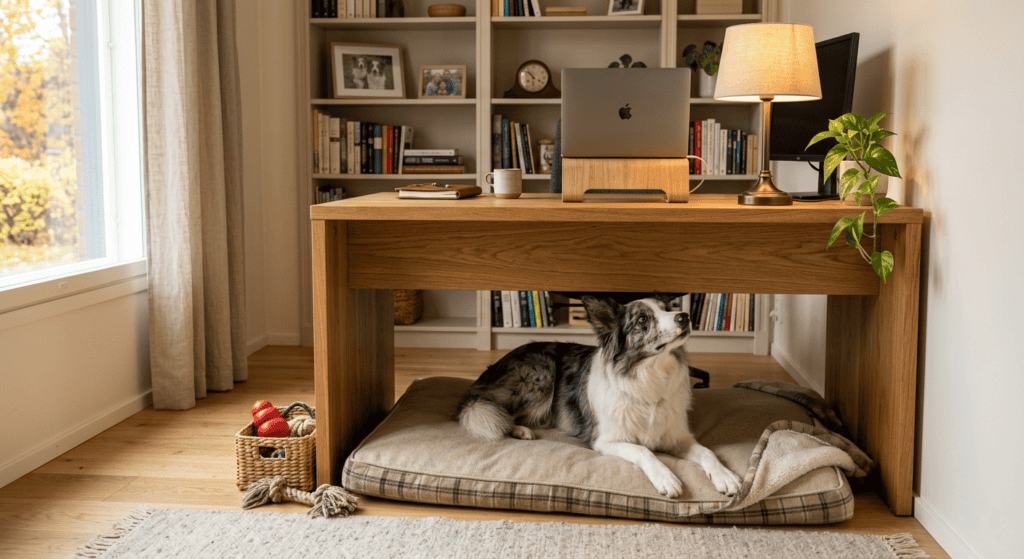
A dog bed tucked under your desk is one of the most effective setups for keeping a working-from-home dog happy and settled. They get to be close, they can see you, and they have somewhere comfortable to lie down that isn’t your feet. Flat, low-profile beds or oversized cushions work best for under-desk setups — something they can stretch out on without it becoming a trip hazard.
And if your dog does use a crate, an office is actually a great place for it. A crate styled as a piece of furniture (think a wooden-framed crate that doubles as a printer stand or side table) keeps the room looking professional while giving your dog a calm, enclosed space during video calls or focused work sessions.
Toy rotation is the unsung hero of the home office dog space. Keep a small selection of toys and chews in the office, ideally a mix of things that keep them quietly occupied, like a stuffed KONG or a chew toy, and swap them out regularly. A dog who has something engaging to do is a dog who isn’t pawing at your keyboard. A small basket beside the desk keeps things contained and within easy reach for those moments when you need to buy yourself thirty minutes of uninterrupted concentration.
The Entryway and Mudroom
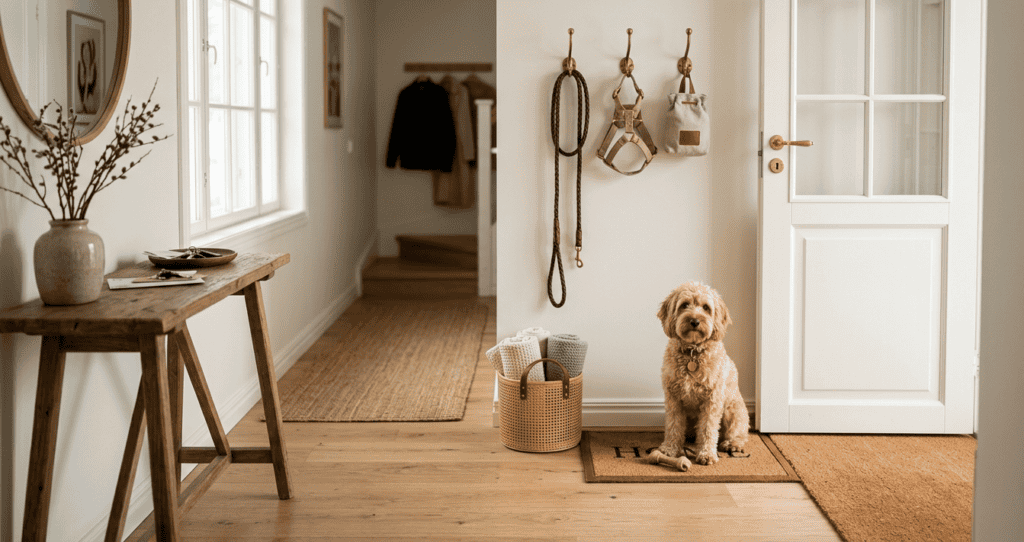
The entryway is often the hardest-working space in any dog owner’s home. It’s where walks begin and end, where muddy paws meet clean floors, and where all the leashes, harnesses, and bags tend to pile up into a chaotic heap. Getting this space organized isn’t just about aesthetics; it can genuinely make daily life with a dog so much smoother.
A paw-rinse station is one of those investments that transforms the post-walk routine. It can be as simple as a bucket of water and a dedicated towel, or as considered as a built-in outdoor tap at the right height. Either way, having a designated spot for cleaning up before anyone comes inside saves a surprising amount of mess and stress. particularly in autumn and winter.
A set of hooks at dog-gear height is another small addition that makes a big difference. One for the leash, one for the harness, one for the treat bag, and so on. When everything has a home, you stop hunting for the leash every single time you want to go out. A small shelf or basket below the hooks can hold poop bags, a spare collar, and anything else that needs to live near the door.
A dog towel basket by the door is non-negotiable if you live somewhere with four distinct seasons. Keep a stack of dedicated dog towels (microfiber dries fastest) within arm’s reach so the wipe-down happens before anyone steps further into the house.
And for the dog who positions themselves by the front door the moment they sense a walk is coming (which is somehow always twenty minutes before you’re ready), a small bed or mat in the entryway with a chew toy gives them somewhere to direct that anticipatory energy. It also helps establish a calm waiting behavior rather than frantic circling, a small training win built right into the design of the space.
Outdoor Spaces
If you have outdoor space like a garden, a patio, or a balcony, your dog almost certainly has opinions about it. Channeling those opinions into a dedicated outdoor zone makes the space work better for everyone and gives your dog somewhere to genuinely decompress in the fresh air.
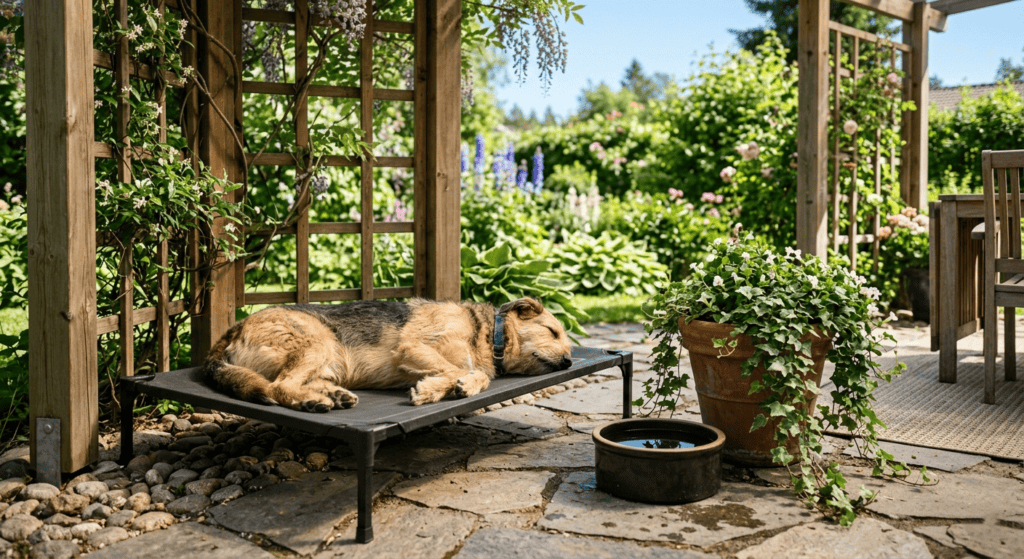
A shaded dog corner on the patio or balcony is the outdoor equivalent of the cozy indoor nook. Position a weatherproof dog bed or a raised cot-style lounger in a spot that gets morning sun but afternoon shade, and you’ve created somewhere your dog will choose to be on warm days. A simple parasol, a pergola, or even the natural shade of a large potted plant can provide enough cover to make the spot genuinely comfortable in summer heat.
In the garden, it’s worth designating a dog-friendly zone, like a patch of lawn or ground-cover where digging is allowed, where toys can be left out, and where your dog can be a dog without you worrying about the flower beds. A low border of raised planters or edging can define the zone visually without fencing it off completely. Your garden gets to stay beautiful and your dog gets a sanctioned space to do their dog things.
An outdoor water station is a great addition too. A sturdy, tip-resistant bowl — ideally one that can be refilled easily from a nearby tap or hose — positioned in a shaded spot near where your dog spends time outside means they stay hydrated without you having to think about it. Some dog owners install a simple self-filling water bowl that connects to an outdoor tap, which is as low-maintenance as it gets.
A Home That Works for Everyone
The through-line in all of this is intentionality. A dog-friendly home isn’t one that has been surrendered to dog stuff. It’s one where dog stuff has been designed into the space thoughtfully, so it serves your dog’s needs without overwhelming your own.
You don’t need to overhaul every room at once. Start with the space where your dog spends most of their time, or the space that causes the most daily friction. Get one feeding station right. Create one proper nook. Add one good hook. And build from there.
A dog who has a place in every room of the house isn’t just a happier dog. Most likely they’re a calmer one too. And a calmer dog makes for a calmer home all round. That’s a result worth designing for.
Images in this article are AI-generated for illustrative purposes and inspiration
