

What Happens When You Let Your Dog Say “No”

Not every pet owner may have heard of a consent test, yet it’s probably one of the single most useful tools in my daily life with four “challenging “ rescue dogs.
It sounds formal but it isn’t. A consent test is simply the practice of asking your dog whether they’re okay with something before you do it, and then actually listening to the answer.
I use it every single day with all my dogs. It takes seconds. It has prevented countless uncomfortable situations, even potential bites. And once you start doing it, you’ll wonder how you ever managed without it.
What a consent test actually is
At its core, a consent test is a way of giving your dog a genuine choice between saying yes, no, or maybe, and respecting whatever they tell you.
That might sound simple, and in principle it is. The complexity comes from the fact that dogs don’t communicate in words. Their “yes,” “no,” and “maybe” are expressed entirely through body language: the set of their ears, the tension in their muscles, the position of their tail, the speed of their breathing, their posture, where they’re looking, the tiniest shift in their facial expression…
Learning to read those signals accurately is what makes consent testing work. And the good news is that once you know what to look for, you start seeing it everywhere — in every interaction, every greeting, every grooming session, and every moment your dog decides they’ve had enough.
Why it matters more than you might think
Dogs are extraordinarily tolerant animals. They put up with an enormous amount, like being hugged by strangers, dressed in Halloween costumes, climbed on by small children, and held still for nail trims they hate, without retaliating. The internet is full of photos of dogs doing exactly this, tolerating, while their signals scream discomfort and the humans around them remain completely oblivious.
The problem is that tolerance has limits. Dogs rarely bite without warning. What looks like a bite “out of nowhere” is almost always the end point of a long sequence of signals that were missed, ignored, or misread. A dog who has learned that their signals don’t work — that saying “no” changes nothing — eventually stops bothering to say it first.
Consent testing breaks that cycle. When your dog learns that their “no” is always respected, they never need to escalate to a growl, a snap, or a bite to make themselves understood. And when they learn that their “yes” is acknowledged and understood, they become more willing to engage, to participate, and the big one: to trust.
What “yes,” “no,” and “maybe” look like in dogs
Yes
Your dog approaches you, leans into you, makes soft eye contact, or paws at you for attention. Their body is loose and relaxed, with soft muscles, easy tail movement, and an open facial expression. We rescued one of our dogs, Daisy, from the streets. Initially extremely wary, once she got to know me and learned that she could trust me, would lean into me with her whole body and enthusiastically lick my face, and if I stopped petting her before she was ready, would nudge my hand pointedly to continue. There’s no ambiguity. A dog who is saying yes makes it very clear.
At the same time, just like people, dogs can quickly change their minds. Always watch for signs that they’ve had enough and give them space.

Maybe
A “maybe” often looks like conflict. Your dog may want to engage (e.g., they want the treat or attention), but something is making them hesitant. Maybe it’s a new dog who doesn’t fully trust you yet or feel completely safe. Maybe there’s something in the environment making them nervous. This dog might approach and then pause, or take a half-step forward and then freeze. They might look toward you and then look away, scratch an imaginary itch or yawn (a stress signal).
A maybe should always be treated as a no. The conflict itself is the signal. A dog who is saying “maybe” is already experiencing some level of stress, and pushing forward only increases it. Remove the conflict by gently tossing the treat toward them rather than asking them to come all the way to you, end the interaction and give them space, then try again later.
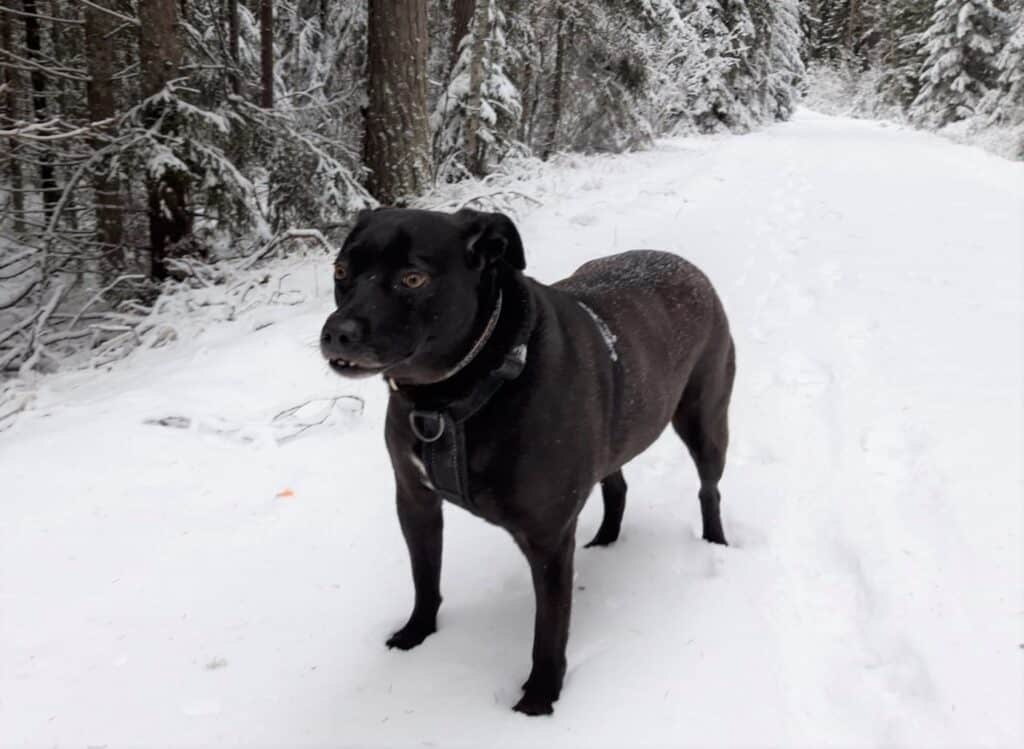
No
A “no” can be loud or barely visible, and the barely visible ones are the ones that matter most to learn.
Obvious signals include turning the head or body away, moving away from you, freezing, growling, or showing teeth.
Subtle signals include a tongue flick, a lip lick, a yawn when the dog isn’t tired, ears pinning back, whale eye (the whites of the eyes becoming visible), a furrowed brow, stiff facial muscles, or a very slight curl of the top lip.
That last one was our fearful rescue dog Louis’s tell. Louis came to us after spending his first two years chained up a mistreated, and when we first adopted him he would solicit attention, enjoy it for a few seconds, and then suddenly snap with his teeth, sometimes hard enough to break the skin. It happened several times before I figured out what was really going on.
What I eventually noticed was a curl of his top lip so minimal it was barely there — a millimeter of movement, if that. But once I knew to look for it, I could see it every time, a second or two before the snap. From that point on, I made sure every interaction with Louis ended before we ever got to that curl. Short sessions. Watching constantly. Stopping while things were still good.
He never snapped at me again. Not because he changed, but because I started listening to what he was already telling me. And he learned that he could trust me.

How I use consent testing in practice
Harness and leash time
Another of our rescue dogs, Roman, is wary of having his harness slipped over his head. Despite years of patient, positive work, it’s simply something he finds uncomfortable. So I never chase him around to put it on.
Instead, I wait by the door. I hold the harness, let him see it, and give him time to come to me when he’s ready. When he chooses to come over and stands “on his place,” that’s where we start. Then I ask him if he’s ready. If he turns to look at me, that’s his yes. That’s when I proceed. If he doesn’t look at me, we wait until he’s ready. The whole thing takes maybe an extra two minutes, and in exchange for those two minutes, Roman trusts me to make sure that nothing scary will happen to him. That trust is worth far more than the time spent.
On walks
Wherever possible, and if it’s safe and practical to do so, I allow my dogs to choose which direction we go in on our walks. Why? Because it empowers them to make their own decisions, which is a major confidence booster. It also gives them a sense of control over their environment and agency over what happens to them, both major stress reducers. And again, it shows them that they can trust me not to force them into doing something they don’t feel comfortable with.
Here’s Roman in action on one of our walks, choosing which way we go:
Nail trims
Most dogs find nail trims at least mildly unpleasant, and many find them genuinely distressing. Forcing the issue — holding a dog still, pushing through their protests — builds a negative association that gets worse every time.
Back to Daisy, whose nail trim history before she came to us was at best uncertain, I spent weeks doing nothing more than touching her paws and rewarding calm behavior. Then the clippers came out just to be sniffed. Then one nail. Then two. Always stopping the moment her body language shifted. Always ending on a good note.
This approach takes longer upfront. But it takes infinitely less time than dealing with a dog who is terrified of nail trims for the rest of their life.
Grooming sessions
I do the same with brushing. I show my dogs the brush and watch their response. If they stay where they are — or better, lean toward it — that’s a yes and we begin. If they walk away, I don’t follow them. I put the brush down and try again later.
During the session itself, I watch continuously for the moment a yes becomes a maybe or a no. A tongue flick. A slight stiffening. A head turned away. Any of these and I stop, give them a moment, and check in again before continuing. The grooming session ends when the dog says it ends, not when I’ve decided I’ve done enough.
Meeting new people
When someone meets one of my dogs for the first time, I ask them to do one thing: sit quietly and wait. Don’t reach forward, don’t make eye contact, don’t call the dog over. Just be still and let them come to you if and when they choose.
If they approach, sniff, and then move away, that’s fine. Let them go. If they come back, they can decide what happens next. If they don’t approach at all, that’s also fine and completely valid information about how that dog feels about that person on that day.
I say “on that day” deliberately, because consent isn’t static. A dog who said no to meeting a stranger last week might say yes this week. A dog who was happy to be groomed yesterday might have a sore spot today that means they’d rather not. Consent is always situational, always current, and always worth checking.
The moment that changed how I think about this
About six weeks after we adopted Florence, who was the most shutdown dog I’ve ever met, she came out of her safe room and curled up next to me on the sofa. She had spent four weeks barely moving from a bathroom, and several more weeks inching gradually closer to the rest of the household. I hadn’t invited her. I hadn’t called her. I’d simply been sitting quietly, and she’d made the decision herself.
I didn’t move. I barely dared to breathe in case I scared her. I didn’t try to touch her or talk to her. I just sat there with her for about an hour, and then she decided that was enough and took herself back to her room.
That moment happened because she chose it. And the only reason she felt safe enough to do so was because, for six weeks, every single “no” she’d communicated had been respected without question. The consent test, practiced consistently and without exception, had built enough trust that she could make that choice freely.
That’s what this is really about. Not the technique. The trust.
A note on children and dogs
Children and dogs are one of the most important contexts for consent testing, and one of the most commonly mishandled.
Children are naturally inclined to approach dogs enthusiastically, to hug them, to put their faces close, even to climb on them (eek — please don’t ever let your kids do this!). Dogs, as I’ve said, are remarkably tolerant. But tolerance in a dog being overwhelmed by a child is actually acute distress, and a child cannot read those signals.
Teaching children to do a simple consent test, like hold out your hand, wait to see if the dog comes to you and if they don’t, leave them alone, is one of the most effective bite prevention tools available. It gives the dog a way to say no that is actually heard, which means they never need to say it more forcefully.
Never leave children unsupervised with dogs, regardless of how well the dog is known, how gentle their temperament, or how confident you are in the child’s understanding. Consent testing supports safety but it doesn’t replace active supervision.
What consent testing does for your relationship
The cumulative effect of consistent consent testing is something that’s hard to describe but immediately recognizable when you see it.
Dogs who know their signals are listened to are generally calmer, and less stressed, anxious, or fearful, which translates to being more confident and willing to engage. They approach interactions with curiosity rather than anxiety. They recover more quickly when something surprises or worries them. They are, in every measurable sense, easier to live with.
And the relationship you build through that practice, through thousands of small moments of asking and listening and respecting, is qualitatively different from a relationship built on old-fashioned coercion and compliance. It’s a relationship built on genuine trust.
Quick reference: Consent testing with your dog at a glance
Yes: Loose body, soft eyes, approaches you, leans in, pawing for attention. Proceed, but keep watching.
Maybe: Conflicted, hesitant, half-approaches and pauses. Treat as a no. Remove the conflict, try again later.
No: Turns away, moves away, freezes, tongue flick, lip lick, ear pinning, whale eye, top lip curl, growl. Stop immediately. Give space.
Key moments to use it: Harness and leash fitting, grooming, nail trims, meeting new people, petting sessions, any new experience.
The rule that never changes: A maybe is always a no. A yes can always become a no. Keep watching, keep listening.
This article draws on the principles explored in my article Yes, No, or Maybe? Understanding the Consent Test in Dogs
For the cat version of this daily practice, see Your Cat May Be Telling You “No.” Are You Listening?
For more on building trust with a fearful dog, see Why Rescue Dog Timelines Can Set Owners (and Dogs) Up to Fail
