
Aesthetic Cat Corners That Actually Look Good in Your Living Room

This page may contain affiliate links, which means we may receive a commission, at zero cost to you, if you make a purchase through a link. Please see our full disclosure for further information.
Cat owners are a creative bunch. We rearrange our furniture around their preferred napping spots, we buy them three different beds before finding the one they’ll actually use, and we’ve all at some point found ourselves Googling ‘do cats like hammocks’ at 11pm. The dedication is real.
And yet, for a long time, the options for cat furniture that also looked good in a home were… limited. The classic cat tree served its purpose, but it wasn’t exactly something you’d style around. Most of us just found a corner for it, accepted the situation, and moved on.
The good news? Things have changed, and in the most satisfying way. There’s now a whole world of beautiful, design-forward cat furniture and accessories that work with your interior rather than despite it. The secret is the same as any good room design: intentionality. When you approach a cat corner the same way you’d approach any other corner — with your color palette, your aesthetic, and your sense of proportion in mind — the results can be genuinely stunning. Sometimes the cat corner ends up being the best-looking spot in the room. Stranger things have happened.
Here’s how to make it happen.
Find Your Style Profile
Before you buy anything, spend a few minutes identifying which aesthetic you’re actually working with. It sounds obvious, but a lot of mismatched cat corners happen because someone bought a piece they loved in isolation without asking whether it belonged in their specific living room. Different styles call for entirely different choices.
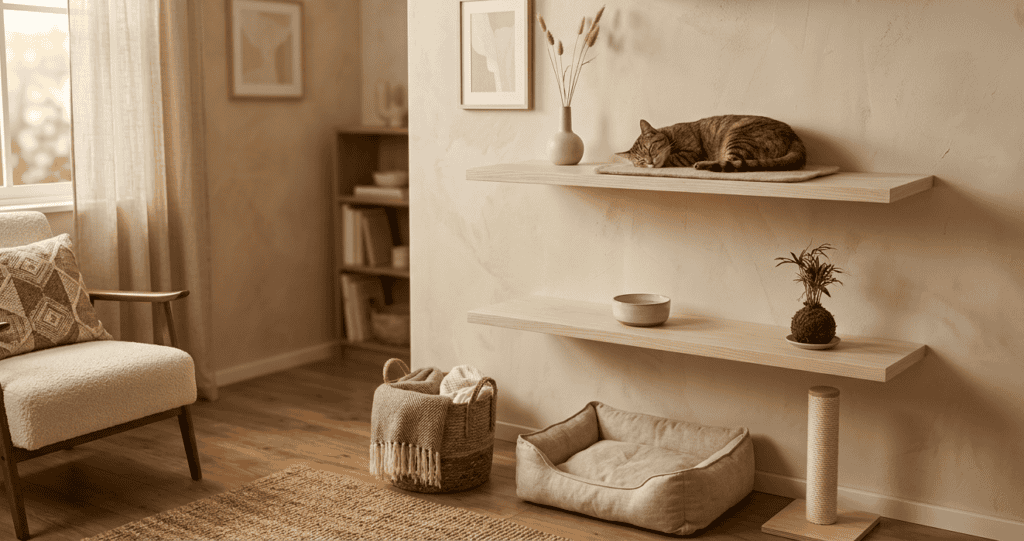
Minimalist / Japandi
If your living room leans calm, clean, and pared-back — think natural wood, muted linen, and not a single decorative item without a purpose — your cat corner should follow the same rules. Look for cat beds in undyed natural fibers, wall-mounted shelves in pale ash or oak, and scratching posts in seagrass or raw sisal. Restraint is the whole aesthetic here; one considered piece per zone, chosen with real care.
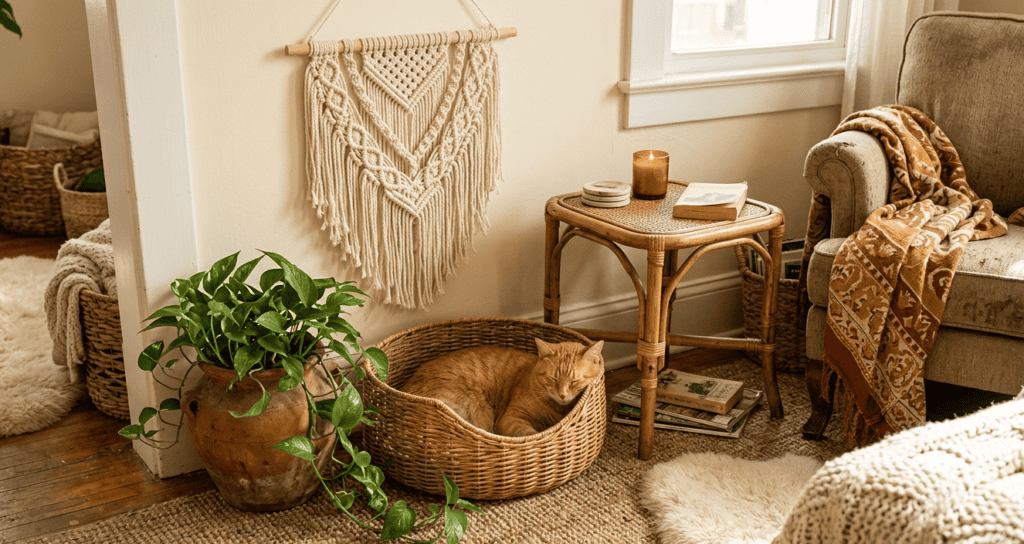
Boho / Natural
This is the style that probably photographs best with cats in it, because the warmth and texture of boho interiors — rattan, macramé, terracotta, trailing plants — is exactly the kind of environment that makes cats (and cat photos) look magical. Wicker cat baskets, woven wall-mounted perches, and beds in warm earthy tones all feel completely at home here. Layer textures freely; this aesthetic rewards it.
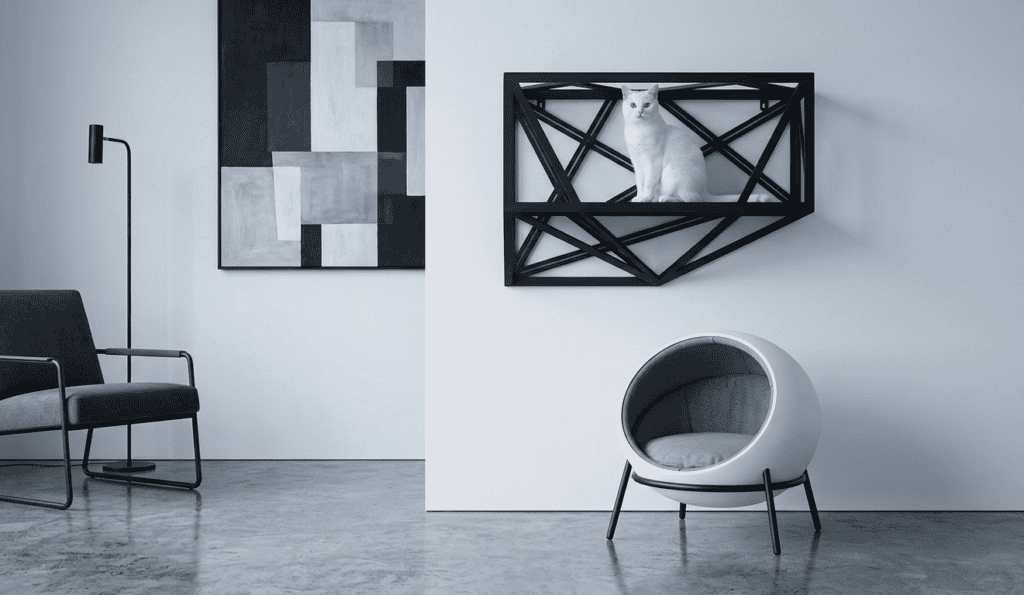
Modern / Sleek
Clean lines, monochrome or carefully limited color palettes, and materials like powder-coated steel, matte wood, and structured fabrics. For this aesthetic, the cat furniture needs to look almost architectural — think geometric cat shelves in black or white, structured pod beds with metal legs, and feeding stations that look more like product design than pet accessories. The goal is for a visitor to notice the design before they notice it’s for a cat.
Cottagecore / Cozy
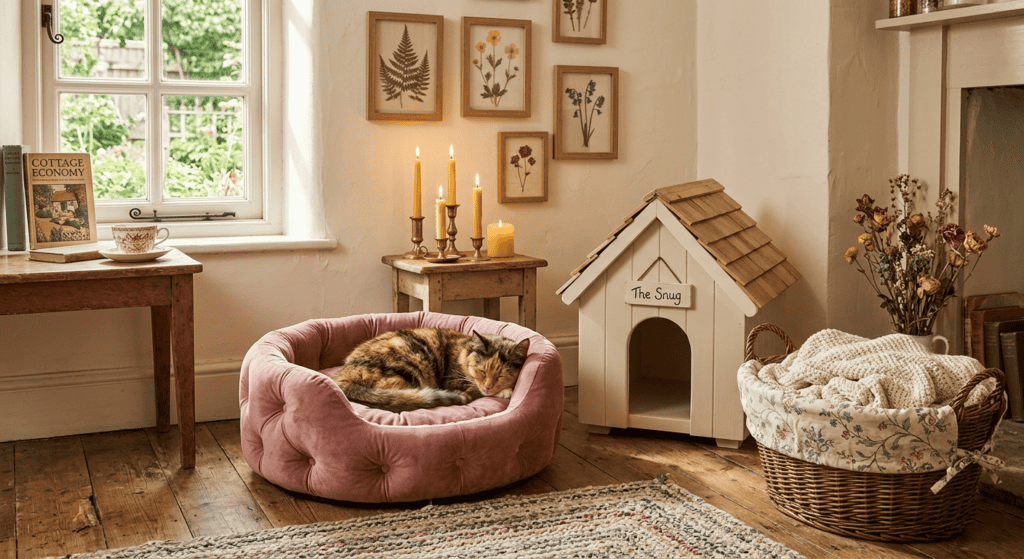
Warm woods, floral accents, vintage-feel textiles, and an overall sense that the room has been slowly and lovingly assembled rather than styled all at once. Cat corners in a cottagecore interior can be wonderfully indulgent — a tufted velvet bed in dusty rose, a wooden cat house with a pitched roof, a basket lined with a vintage-style print. Sentiment and softness are the guiding principles; the more it looks like a tiny, enchanting room within a room, the better.
Furniture That Doubles as Cat Space
The most elegant cat-friendly living rooms are the ones where the cat furniture doesn’t announce itself as cat furniture at all. It just looks like furniture. This is the double-function principle, and it’s the single biggest upgrade you can make to a cat corner.
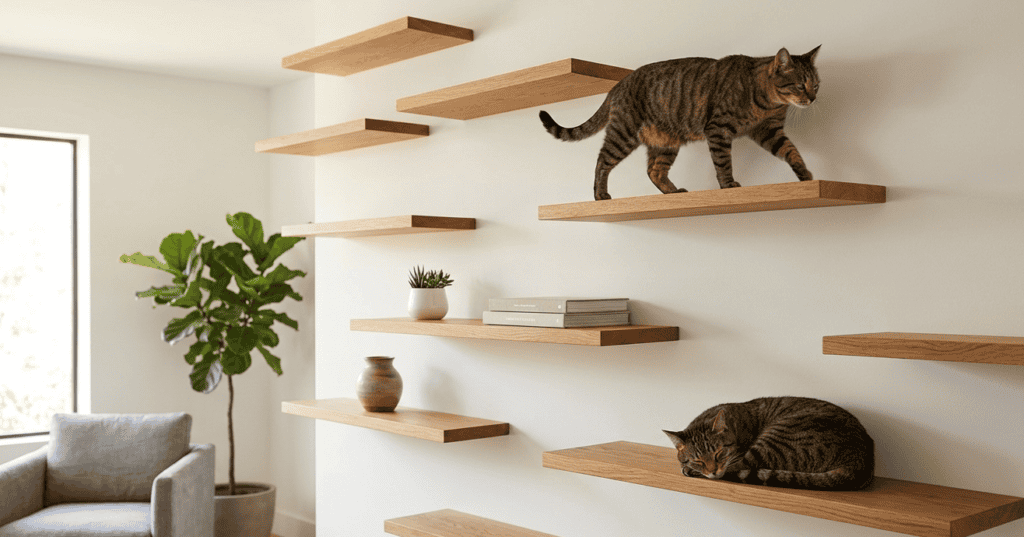
Floating shelves used as cat walkways are one of the most popular and satisfying approaches. A series of staggered wall-mounted shelves in matching wood tones creates a visual feature on the wall — an architectural detail — that also functions as a climbing and perching route for your cat. Done well, it looks like intentional wall art. The cat thinks it’s a luxury hotel. Everyone wins.
Ottomans with hidden interior space can moonlight as cat beds. A large, lidded storage ottoman with a cushioned interior and a small opening cut into the side becomes a stylish enclosed den that reads, from across the room, as simply a piece of living room furniture. This works particularly well in modern and minimalist spaces where concealment is part of the design language.
Bookcases with dedicated cat cubbies (either custom-built or cleverly adapted from existing shelving) are another brilliant option. Leave one or two shelves empty and pad them with a fitted cushion. Your cat gets a perch at a satisfying height; your bookcase gets a quirky, characterful detail that most visitors will find charming rather than odd.
And then there are the stylish cat trees that have emerged in recent years that genuinely look like real furniture — branching structures in solid wood, modular climbing units in neutral fabric, tiered platforms with upholstered surfaces. These are no longer the exception; they’re increasingly easy to find from pet furniture designers who clearly grew up caring about both cats and aesthetics.
Color Coordination
Color is probably the fastest way to make a cat corner look either pulled-together or chaotic. It’s also one of the easiest things to get right once you have a framework.
The simplest approach is to match your cat’s furniture and accessories to the dominant tones already present in the room. If your sofa is warm oatmeal, a cat bed in a similar shade disappears into the scene in the best possible way — present but not intrusive. If your room has a terracotta accent wall, a bed in rust or cognac leans into the palette rather than fighting it. The goal is for the eye to move through the room smoothly, landing on the cat corner as part of the whole rather than a jarring interruption.
Neutral tones, like cream, stone, warm grey, natural linen, are the safest choice for most interiors because they work with almost everything and photograph beautifully. But don’t dismiss the bold accent piece approach either. A cat bed in a deep forest green or a rich cobalt can function like a throw cushion — a deliberate pop of color that adds visual interest precisely because it’s different. The key is that it should match something else in the room: a cushion, a vase, a piece of art. Chosen with intention, a bold cat bed can look surprisingly chic.
There are now several brands that have built their entire offering around aesthetic cat furniture — companies like Inicio, Hepper, and Tuft + Paw produce beds, trees, and accessories in coordinated color palettes designed to work with real interiors. Browsing their ranges with your room’s color palette in mind is a genuinely useful starting point if you’re not sure where to begin.
The Cat Wall Trend
If you spend any time on Pinterest or Instagram looking at cat-friendly interiors, you’ll have encountered the cat wall and you’ll probably already know why it’s one of the most saved and shared ideas in pet home design.
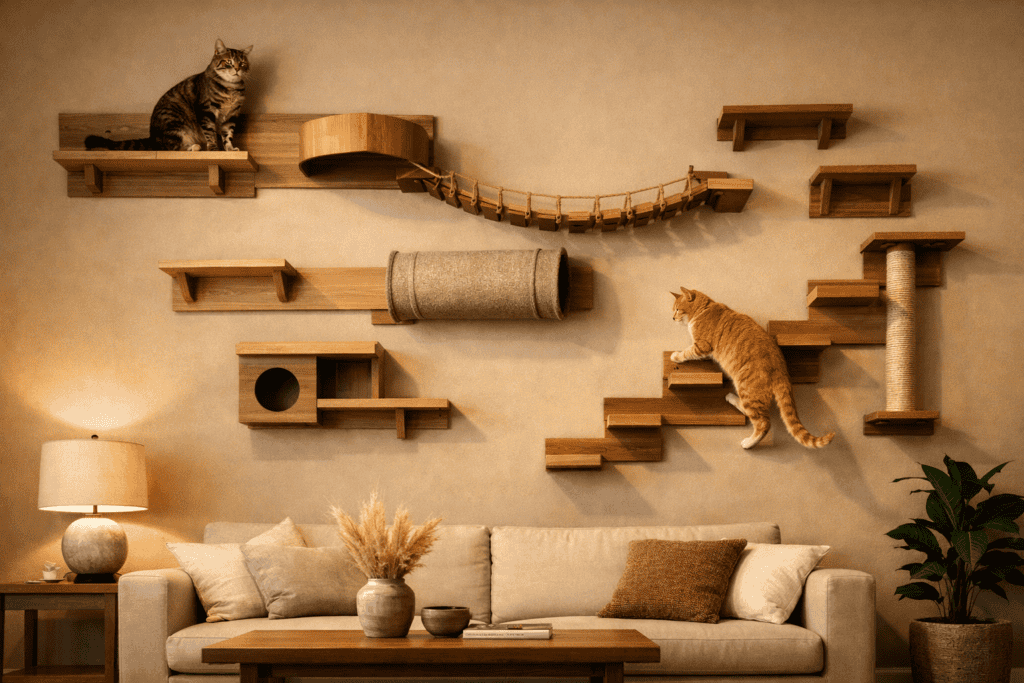
A cat wall is exactly what it sounds like: a wall fitted with an arrangement of shelves, walkways, bridges, steps, and perches that create a three-dimensional climbing environment for a cat. At its best, it looks like a piece of installation art. It makes use of vertical space that would otherwise go completely unused, gives a single or multiple cats an enriching environment, and adds visual texture and interest to a room that a picture rail simply cannot match.
Planning a cat wall well requires thinking about three things: flow, height variation, and visual balance. Flow means your cat can move continuously across the wall without having to jump down and come back up — the route should feel natural and rewarding. Height variation means mixing low perches, mid-level walkways, and a high lookout spot so there’s something interesting at every level. Visual balance means the shelves and platforms shouldn’t all cluster in one area; they should feel like they belong on the wall, not like they were added wherever there was a free stud.
For DIY enthusiasts, a cat wall can be built from standard floating shelves with added traction (carpet tape, sisal mat offcuts, or upholstered surfaces for grip) and wall anchors rated for the load. For those who prefer a ready-made solution, brands like Catastrophic Creations, Fukumaru, and The Refined Feline produce purpose-built modular cat wall systems in finishes that look genuinely considered.
Either way, the cat wall works best when it’s treated as a design project rather than a practical one — when the layout is sketched out first, the finishes are chosen to match the room, and the whole thing is installed with the same care you’d give to any permanent wall feature. The results, when it comes together, are extraordinary.
Small Details That Elevate the Look
The difference between a cat corner that looks nice and one that looks genuinely styled often comes down to the small things — the details that signal that someone thought carefully about this space rather than simply assembling functional objects within it.
Toy storage in a decorative basket pulls double duty in exactly the right way. A woven rattan basket, a canvas tote in a neutral linen, or a ceramic pot for smaller toys keeps the inevitable collection of feather wands and crinkle balls from becoming visual clutter. It also makes tidying up fast. Just scoop everything in and the corner goes from lived-in to styled in about four seconds.
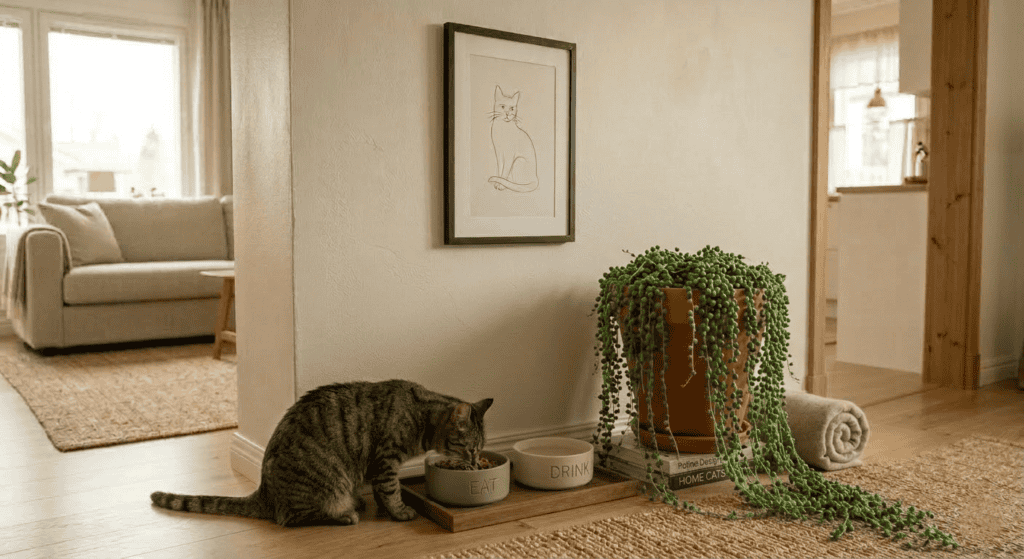
Food and water bowls presented on a tray or small platter are an easy upgrade that makes a disproportionate difference. Choose ceramic or stoneware bowls in colors that complement the room, arrange them on a small wooden or marble tray, and the feeding area becomes a design moment rather than a practical necessity. It also makes cleaning easier, which is a bonus that has nothing to do with aesthetics and everything to do with real life.
Cat-safe plants positioned near the corner add life, greenery, and that effortless organic quality that makes interiors feel genuinely inhabited rather than staged. Spider plants, Boston ferns, calathea, and parlor palms are all non-toxic to cats and look lush and layered in a living room context. A large statement plant beside a cat corner creates a natural frame that pulls the whole zone together visually.
Finally, a piece of framed cat art above the corner is the finishing touch that turns a nice setup into a genuine vignette. It doesn’t have to be a realistic portrait — an abstract print with a feline subject, a line drawing, or even a simple typographic print can work beautifully. The point is that it anchors the corner visually, gives the eye somewhere to land, and signals that this space was designed with intention. Which, by this point, it absolutely was.
Beautiful for You, Perfect for Them
The best cat corners do two things simultaneously: they give your cat everything they need — height, enclosure, warmth, stimulation — and they look like they were designed for the room rather than imposed on it. These two goals are not in conflict. They just require a bit more thought than grabbing whatever is on the shelf at the pet shop.
Start with your style profile. Choose furniture that earns its place in the room. Coordinate the colours. Add the details. Step back.
Your cat will immediately lie down somewhere completely different and refuse to move. But the corner will look incredible — and eventually, on their own terms and in their own time, they won’t be able to resist claiming it as theirs.
Images in this article are AI-generated for illustrative purposes and inspiration
