

Pawsitively Puzzling: Why Do Cats Lick And Groom Each Other?

Cats are renowned for their fastidious nature, dedicating countless hours to meticulous self-care.
But here’s the twist – their licking obsession extends far beyond themselves.
That’s right! They generously share their grooming habits with their fellow feline friends too.
But why?
In this article, we’ll dive deep into the most common reasons why cats lick and groom each other.
By the end, you’ll have a fresh perspective on this unique aspect of feline behavior and a newfound appreciation for the bonds cats form through grooming.
Why Do Cats Lick?
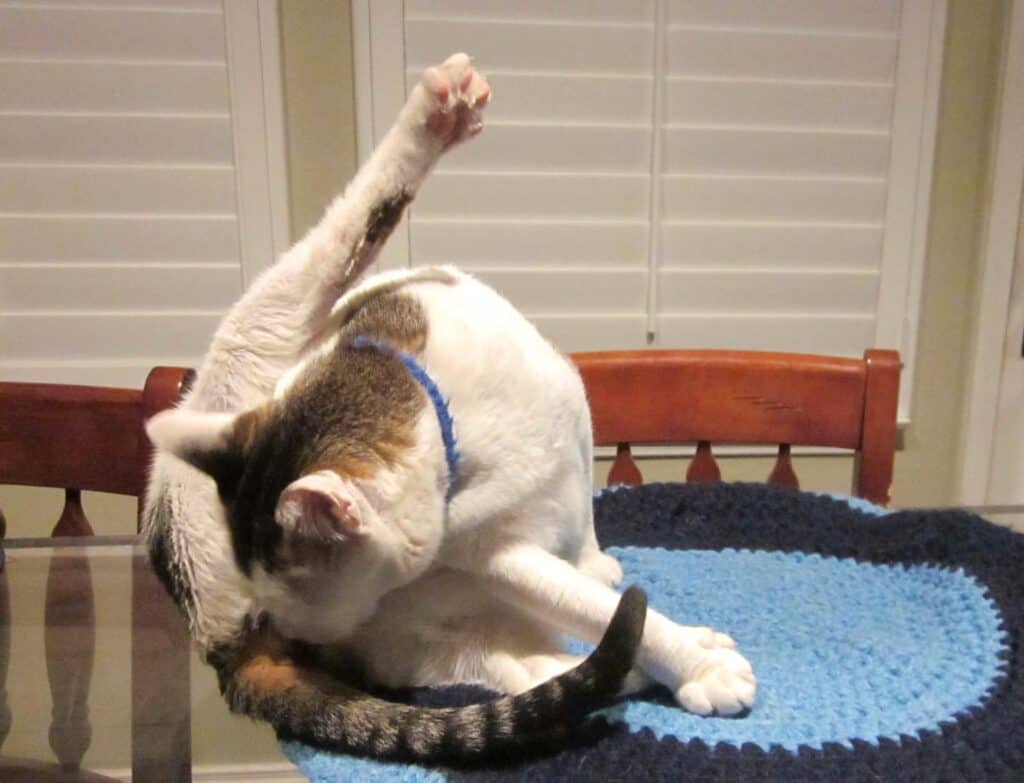
Domestic cats are often referred to as “nature’s most fastidious groomers” (Noel & Hu, 2018), and for good reason.
They typically spend a significant amount—up to 30 and 50 percent—of their waking hours grooming themselves and licking their fur clean (PetMD).
Allogrooming
Aside from licking themselves to maintain their sleek and pristine appearance, cats also frequently lick each other.
This not only helps the other kitty maintain a healthy and well-groomed coat but also strengthens the bond between the two feline friends.
This type of social grooming, when one individual helps “clean and maintain the appearance of an individual of the same species” is known as allogrooming (Merriam-Webster, 2023).
“Allogrooming occurs when a cat is relaxed and in the presence of a preferred social partner,” says animal health and behavior expert, Kristyn Vitale.
When cats engage in this behavior, it’s like a secret code they use to communicate and show affection.
It’s as if they are saying, “Hey, I care about you, and we’re part of the same group.”
And research confirms that allogrooming behavior in cats is not only about keeping themselves clean but also about building strong social bonds (Wilson, et al., 2020).

Grooming As A Social Behavior
Contrary to popular belief, cats are social animals, even if they don’t always act like it.
Admittedly, they tend to be sole operatives when it comes to hunting, but cats are entirely capable of building strong bonds with their fellow felines – especially if they have grown up together.
Sign Of Affection
As such, one of the most common reasons cats lick each other is to show affection and establish that familial bond with each other.
This is a social activity that starts at a young age and continues throughout adulthood.
Mutual grooming is most common among related or closely bonded cats, such as sibling pairs or mama cats and their kittens.
I have also seen it in unrelated kittens who spend their early months of life together, and in adult cats who were adopted into the same home and developed a close bond over time.
If you have multiple cats at home, you may notice them grooming each other during a play session or while lounging together.
This is a good sign that they are best friends and have established a strong social bond with each other.

Establishing Status
Allogrooming can also be a way for cats to establish their status within a group of cats.
In a multi-cat household or cat colony, a higher-ranking cat may groom a lower-ranking cat as a sign of their superior status.
However, this is not as cut and dry as it sounds (see Feline Social Structure).
In rare cases, excessive grooming by one cat may be a sign of hostility towards the other cat.
In our current group of six rescue cats, an older semi-bonded pair of males will groom each other, as will a younger unrelated male-female pair who were rescued together.
In the case of the latter, the male always defers to the female, and will often move away when her grooming spills over into hostility.
Feline Social Structure
When it comes to cats and their social behavior, things can get a bit complicated.
Cats don’t have a specific social hierarchy or pack mentality, but they can adapt to living in social groups under certain circumstances.
These groups work better when the cats already know each other and there’s no competition for things like food or other resources.
Within a group, cats tend to form relationships that are influenced by factors such as whether they are blood relatives, as well as age, temperament, gender, and general experience of living with other cats.
In my experience of adopting multiple unrelated rescue cats (six at present, 10 at one stage!) into the same home, I’ve found that some older cats are super cat-friendly, and some get along better with one or two of the other cats and pretty much ignore the rest.
Within those confines, some cats form close bonds, while others are more selective in who they spend their time with.
So while cats aren’t considered pack animals, they can absolutely form social groups and develop meaningful relationships with other cats (International Cat Care, 2018).
Grooming For Hygiene And Health
One of the primary reasons cats groom each other is to maintain their sleek and clean appearance.
Grooming helps remove dirt, loose fur, and parasites from a cat’s coat, and it also helps distribute natural oils throughout the fur, which keeps it healthy and shiny.
Grooming also has health benefits for cats, as it helps to prevent skin infections and flea infestations.
In a multi-cat household, cats may groom each other to help reach areas that are difficult to groom on their own, such as the head and the back of the neck.
Cats may also engage in grooming behaviors after bowel movements to maintain cleanliness.
This is particularly common when a mother cat uses her maternal instincts to care of her newborn kittens’ hygiene after they eliminate waste, ensuring that her babies and their living space stay clean and hygienic.
Can Cats Licking Each Other Spread Diseases?
While grooming can help keep cats clean, there is also a chance that it can lead to the spread of diseases.
For example, saliva from grooming can transmit diseases such as Feline Leukemia Virus (FeLV) and Feline Immunodeficiency Virus (FIV).
Grooming can also lead to the ingestion of fur, which can cause hairballs. This can potentially cause vomiting or even lead to other health complications.
Flea infestations can also be spread through grooming.
Having said that, our one-in-a-million FIV rescue cat Magnus had what we liked to call a bromance with our fearful adult cat Jethro, who was rescued from a hoarding situation in Los Angeles.
The two would take walks together, snuggle up together, and groom each other all the time, and the virus was never transmitted.

How Do Cats Groom Each Other?
I’m sure you have noticed that, unlike his doggy friends, your cat’s tongue is far from silky smooth.
Cats’ tongues are actually covered in hundreds of mini spikes that are straight-up scratchy like sandpaper when they give you a lick.
That’s because they are made from keratin, just like your fingernails and your kitty’s sharp claws.
When cats groom each other with their rough tongue, those tiny barbs help remove all that debris and any parasites they pick up when they are out and about exploring and rolling around in the dirt.
How Does Licking Help Cats Bond?
When cats groom each other, they exchange scents, which helps them recognize each other as family members or friends.
However, it’s important to note that not all cats enjoy being groomed by others.
Some cats may become aggressive or avoidant if forced to participate in a grooming session.
If you notice excessive licking or aggressive behavior during grooming, it is best to distract the cats with a game, or perhaps gently place a cushion between them to break the mood.
Providing each cat with their own resources, such as a water dish, food bowl, litter box (the rule of thumb is one box per cat, plus one extra), scratching post, high shelving/vertical space, toys, hiding places, and a cozy sleeping area, can significantly help reduce competition and conflict in multi-cat households.
If you take the time to set up your multiple cats’ home environment like this, it can go a long way toward decreasing the chances of bullying, intimidation, hostility, negative emotions, and aggressive behavior occurring.
What To Do If Your Cat Is Over-Grooming Another Cat?
Over-grooming can lead to health issues such as hair loss, skin irritation, and skin infection.
If you notice your cat is over-grooming another kitty in the home, it may be a sign of underlying stress or a medical condition in one of the cats.
Again, environmental enrichment in the form of multiple resources can help.
It is also important to monitor the cats’ behavior, temporarily separate them if necessary, and check with your veterinarian in case there are health issues that need to be addressed.
Frequently Asked Questions
How Do You Know If Cats Love Each Other?
Cats show their affection for each other in a number of ways, such as hanging out together, playing together, and allogrooming.
When cats lick and groom each other, it shows that they are comfortable and trust each other.
They may also rub against each other, snuggle, and play together.
If your cats are showing these signs, it’s a good indication that they have a strong bond.
Why Do Cats Lick Each Other Then Start Fighting?
Sometimes, cats may start fighting after grooming each other.
This can happen if one cat becomes overstimulated during grooming or if the grooming becomes too rough.
It’s important to supervise your cats during grooming and intervene if necessary.
If you notice that one cat is becoming agitated or aggressive, it’s best to separate them before a fight breaks out.
Is It Normal For Cats To Groom Each Other’s Heads?
Yes, it’s completely normal for cats to groom each other’s heads.
This is a common area for cats to groom as it’s a hard-to-reach spot for self-grooming.
Grooming each other’s heads is a sign of trust and affection between cats.
Before You Go
Now you know more than you ever thought possible about why cats lick each other.
But what does it mean when cats lick their humans?
Do they do it for the same reasons, or is it something else altogether?
Don’t miss my article, Why Does My Cat Lick My Nose? (10 Curious Reasons) to learn even more about your feline friend’s licking habits.
If it’s a spot of feline exfoliation you’re after, meow is the time!
READ NEXT
Resources
- Allogroom [Definition] – Merriam-Webster
- Cats that Lick Too Much – Cornell Feline Health Center
- Cats Use Hollow Papillae to Wick Saliva into Fur – Alexis C. Noel and David L. Hu
- How Emergent Social Patterns in Allogrooming Combat Parasitic Infections – Shelby N. Wilson, Suzanne S. Sindi, Heather Z. Brooks, Maryann E. Hohn, Candice R. Price, Ami E. Radunskaya, Nakeya D. Williams, & Nina H. Fefferman
- The Social Structure of Cat Life – International Cat Care
- Why Do Cats Lick? – Charles Q. Choi
- Why Does My Cat Lick Me? – PetMD
