
What Is Whisker Fatigue? Feeding Tips For A Happy Cat

This post may contain affiliate links, which means we may receive a commission, at zero cost to you, if you make a purchase through a link. Please see our full disclosure for further information.
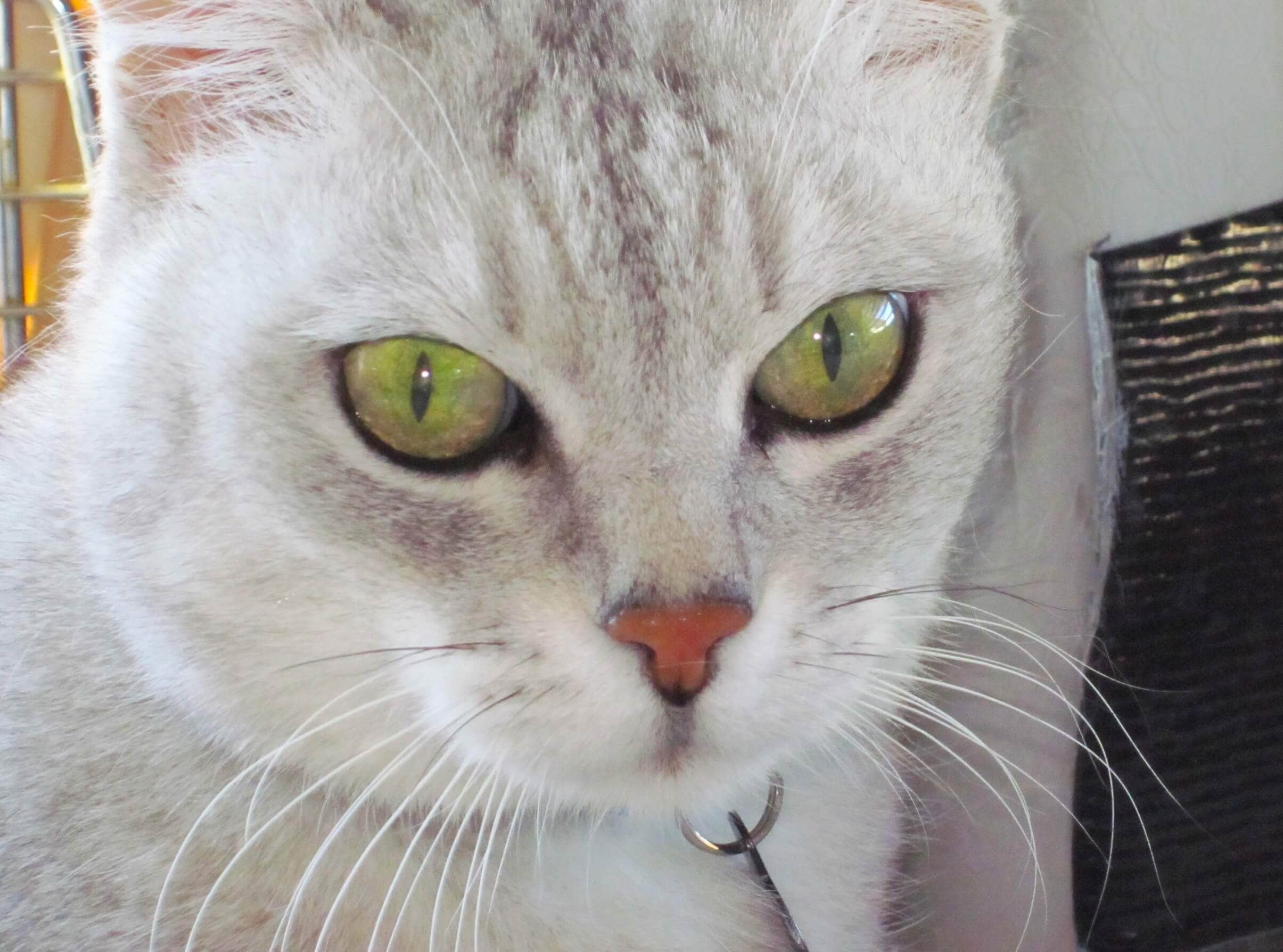
Whisker fatigue, also known as whisker stress, is the notion that a cat’s sensitive whiskers can become overstimulated in certain situations, causing them stress and discomfort.
The theory stems from observations of cats being reluctant to eat or drink, pawing at their food or water—even avoiding it altogether—due to discomfort from their whiskers repeatedly brushing against the sides of a deep or narrow container.
Whisker stress can even extend to litter boxes and cat flaps, as some cats may find it uncomfortable to enter a small space where their whiskers will be constantly touching the sides.
Does Whisker Fatigue Really Exist?
While not a medically diagnosed condition, some cat owners, veterinary professionals, and cat behavior experts believe that whisker fatigue is a real problem for some cats.
Others, however, consider it more of a marketing ploy to sell “whisker-friendly” cat bowls.
Whisker-friendly bowls are typically wider and shallower compared to traditional ones, allegedly providing a more comfortable eating experience for cats.
In a nutshell, we don’t know for sure whether whisker fatigue exists or not.
To date, there is no concrete scientific evidence either way.
I’ll talk about the research a bit later (skip directly to Scientific Insights Into Whisker Fatigue).
Personally, I have always used a mix of wide, shallow stainless steel and ceramic food dishes, pet water fountains, and wide ceramic water dishes, as well as food puzzles for mental stimulation and an all-important outlet for those predatory instincts.
We currently have six cats in the house, and they all have their preferred food and water containers.
The location of the container plays an important role too.
Some cats in particular seem to prefer to drink from deep bowls or a water fountain, while others will only eat or drink from very shallow bowls.
Others don’t care either way.
It’s essential to pay attention to your cat’s individual preferences and needs, rather than relying on generalizations about whisker stress.

Understanding Cat Whiskers: Their Structure And Functions
Regardless of the debate, it is undeniable that a cat’s whiskers are incredibly sensitive.
Also known as vibrissae, cats’ whiskers are thick, hollow structures that are deeply embedded into nerve-filled follicles beneath their skin.
This makes them highly specialized sensory organs that are extremely sensitive to touch and vibrations from air currents.
These high-powered antennae play a crucial role in helping cats navigate their environment, detect prey, and provide crucial sensory information.
Just like how our fingertips have highly sensitive nerve endings, feline whiskers are also connected to a network of nerves that send signals to the cat’s brain.
When these whiskers come into contact with objects or surfaces, they provide valuable information about the size, shape, and texture of their surroundings.

Causes Of Whisker Fatigue
One of the main causes of whisker fatigue is thought to be food and water bowls that are too deep or narrow for cats’ sensitive whiskers.
The repetitive contact of the cat’s whiskers against the sides of the bowl when eating or drinking can lead to information overload and become stressful, as well as being an unpleasant sensation.
Even a narrow cat flap or the entrance to a covered cat litter box can cause a similar sensation or experience.
Symptoms Of Whisker Fatigue
Cats experiencing possible whisker fatigue may display physical or behavioral changes, for example:
- Reluctance to eat, even when hungry
- Reluctance to drink, even when thirsty
- Pacing in front of food/water bowls
- Reluctance to approach food/water bowls
- Pawing at her food or water
- Avoidance of the covered litter box
- Reluctance to use the cat flap
- Avoidance of tight spaces in general
Note: If symptoms persist, it is important to consult your veterinarian to rule out any underlying health issues. It’s also worth considering the location of food/water bowls and litter box to see if changes can be made to suit your cat’s individual preferences.
How To Prevent Whisker Fatigue
Based on your cat’s behavior, if you suspect your cat may be experiencing whisker fatigue, there are a few simple adjustments you can make to help prevent it:
- Provide shallow food dishes and water bowls that are wide enough for your cat’s whiskers to avoid contact with the edges. Popular options include stainless steel or ceramic dishes with shallow sides. In a pinch, you can also use a paper plate or any other flat surface for feeding your feline friend.
- Provide food puzzle toys that require your cat to use her natural hunting instincts to “stalk” and obtain her food, while barely touching those sensitive whisker hairs.
- Consider a pet drinking fountain, as it will provide a constant supply of fresh water while being wide and open enough that your cat’s whiskers will not come into contact with the sides.
- Use a cat flap that is wide and tall enough to give your cat plenty of space to comfortably pass through without her whiskers brushing against the edges.
- Remove covers from litter boxes or purchase covers with larger entrance openings to allow your cat to enter and exit comfortably.

Scientific Insights Into Whisker Fatigue
Despite the skepticism within the cat care community, a recent study revealed that some cats do seem to prefer whisker-friendly bowls over traditional ones.
Specifically, some cats (63%) seemed to prefer the whisker-friendly dish over their usual food dish when given a choice between the two.
However, this particular study also found that cats fed from a whisker-friendly dish did not spend any more time eating than the cats presented with food in a regular dish.
Nor did they eat more food overall.
So there you go, the cats’ eating habits remained largely the same.
Although this study does not conclusively prove the existence of whisker fatigue, it does highlight potential preferences cats may have when it comes to their feeding dishes (Slovak & Foster, 2020).
A second study examined the best ways to feed cats to ensure their optimal mental and behavioral well-being.
The researchers proposed that:
- How cats are fed should reflect the way they naturally eat.
- Feeding should promote the physical and mental/behavioral health of the cat.
- Cats should be given choices to assess their preferences whenever possible.
The researchers emphasized that, while there is currently no empirical evidence that whisker stress occurs, it is still worthwhile for pet owners to try offering their cat’s food in a few different styles of dishes to see if she shows a preference (Delgado & Dantas, 2020).
Any time you can cater to your cat’s individual preferences at feeding time, you are helping to reduce environmental stress and provide an optimal environment where she can thrive.
While whisker fatigue may still be a controversial topic, a comfortable eating and drinking experience is easy to provide, and can be a game changer in its contribution to your cat’s overall physical and mental well-being.
READ NEXT
Resources
- Evaluation of whisker stress in cats – J.E. Slovak & T.E. Foster
- Feeding Cats for Optimal Mental and Behavioral Well-Being – Mikel Delgado & Leticia M. S. Dantas
